


It’s not often I experience the kind of anticipation I felt as I approached Beidou Township (北斗) in Changhua County. Quite literally, I knew nothing about the place. I wasn’t even sure where it was until I scanned my map, by which time I was already on my bicycle, about to set out from Yuanlin City.
I could see Beidou was fairly near Changhua High-Speed Railway Station, but I didn’t recognize the names of any of the “attractions” shown on the map. As it lay between my starting point and where I hoped to end up that day, I decided I’d take a look.
Containing my excitement wasn’t difficult. I’ve been in Taiwan for the better part of three decades, and writing about interesting places throughout the country for most of that time. It’s fair to say that, if I don’t know anything about a particular district or town, probably there’s nothing worth seeing there.
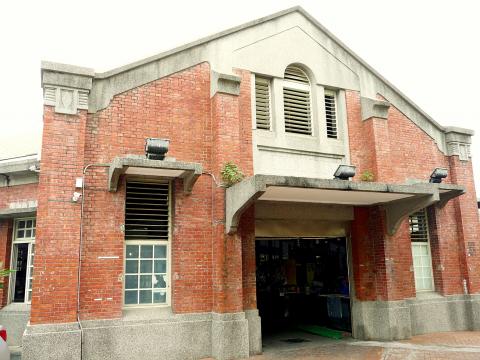
Photo: Steven Crook
Soon enough I was on the outskirts of Beidou. It’s not a large town (the population is just over 33,000) and I quickly found Dianan Temple (奠安宮), which seemed like a good place to lock up my bike.
The information panel outside the shrine told me it’s one of Changhua County’s “three great Matsu temples” (彰化三大媽祖廟), the others being Tianhou Temple (天后宮) in Lukang Township (鹿港) and Nanyao Temple (南瑤宮) in Changhua City. Matsu (媽祖), originally a sea goddess, has in recent centuries emerged as Taiwan’s most popular generalist deity.
According to the shrine’s Web site, the predecessor of Dianan Temple was located in Sijhou Township (溪州), a few kilometers to the southwest. After devastating floods in 1806, the community relocated to what’s now central Beidou. In the process, their hall of worship gained its current name.
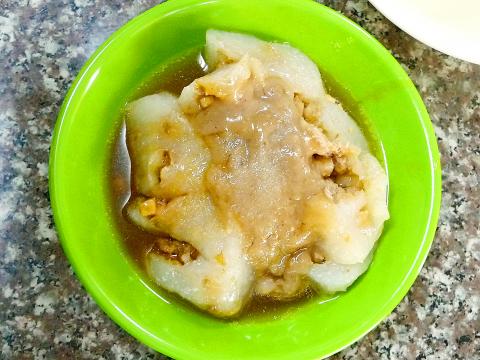
Photo: Steven Crook
FRAUGHT HISTORY
Since 1962, Dianan Temple has been a stop on the famous Matsu pilgrimage that connects Taichung’s Dajia (大甲) with Singang (新港) in Chiayi County. But relations with certain other Matsu shrines have been fraught. Because of a history of conflict between Taiwanese who trace their ancestry to different parts of China’s Fujian province, Dianan Temple did not communicate with or receive official visits from Nanyao Temple until 2014. The former place of worship has traditionally been aligned with Quanzhou (泉州) folk, while the latter was long dominated by descendants of settlers from Zhangzhou (漳州).
Despite its importance as a Matsu shrine, the two impressions I came away with had nothing to do with the sea goddess. The large statue of Guanyin (觀音), the Buddhist bodhisattva of compassion, was shockingly caked with soot. And at the cubby-hole dedicated to the Old Man Under the Moon (月下老人), a god to whom lonelyhearts often pray, I saw not one Polaroid of a happy couple. Typically, shrines to this Cupid-type figure are surrounded by photos of those who sought his help with the partners they subsequently found.
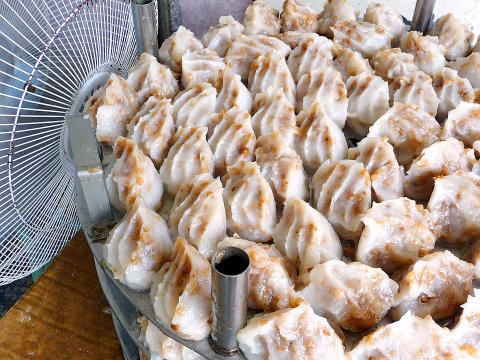
Photo: Steven Crook
The temple is located at 120 Douyuan Road Section 1 (斗苑路一段120號). From there, I walked south into the morning market. I didn’t expect anything out of the ordinary, but almost immediately I stumbled across the Red-Brick Market Building (紅磚市場) at 40 Sinshi Street (新市街, “New Market Street”).
Built in the 1930s and renovated after a fire in 2003, it’s a low-rise, less ornate version of Ximending Red House (西門紅樓). I thought it under-utilized — but compared to the next Japanese-era building I came across, it was positively abuzz.
Working my way north through back alleys, I emerged onto Dijheng Road (地政路) and turned to the 83-year-old Beidou Former Hoko Office (北斗保甲事務所) at number 421. Obviously, it had undergone a thorough and expensive renovation, but at the time of my visit it was locked up. Peering in through the windows, I could see that the interior was unfurnished, and there was no indication when it might next open to the public.
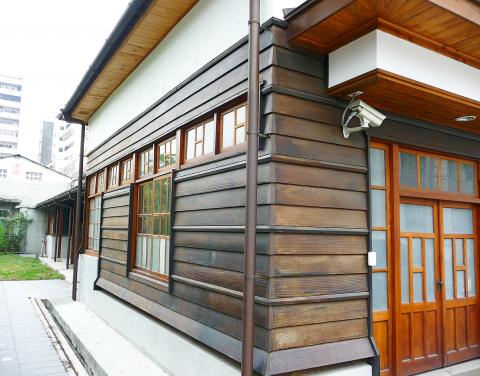
Photo: Steven Crook
On every corner in the downtown, eateries sell what’s usually translated as “meatballs” (肉圓). Having decided to try Chan Beidou Meatballs (詹北斗肉圓), I circled back to the south side of downtown — and by chance stumbled across the location where the Chan (詹) family and their helpers do most of the actual cooking.
At 111 Jhongjheng Road (中正路), scores of the Chans’ signature meatballs were being cooled by powerful fans after steaming. Unlike many of Taiwan “meatballs,” they weren’t thick gelatinous disks, but asymmetrical blobs of gray paste containing chunks of pork and diced turnip.
Eager to taste them, I walked down the road to the actual restaurant at number 75. After 20-plus minutes in the queue — and this was well after the lunch rush — it was my turn. The meatballs were quickly deep-fried, drained and drizzled with three types of brown gloop. A dash of garlic puree was thrown on top.
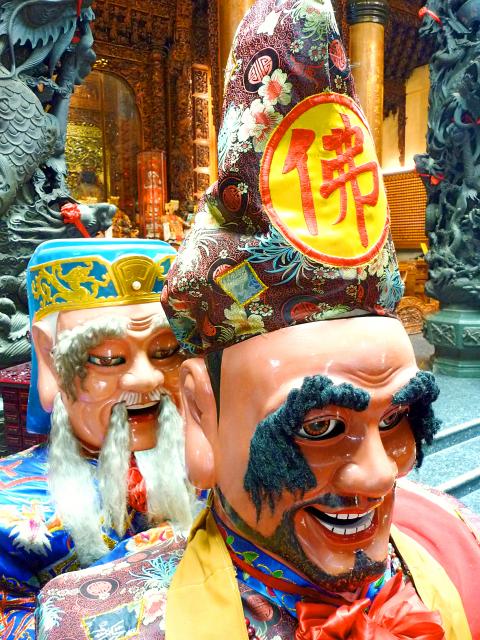
Photo: Steven Crook
The flavor was pleasantly umami, and the turnip component was surprisingly crunchy. As I strolled back to my bicycle, I found myself smacking my lips. Beidou meatballs are nice to eat, and even nicer once eaten. It’s a delicacy that gives pleasure for a good while after the bowl has been scraped clean. Two meatballs and a soup set me back NT$55, and the quantity was just about perfect. If I ever return to Beidou, it’ll be for the meatballs.
Steven Crook has been writing about travel, culture, and business in Taiwan since 1996. Having recently co-authored A Culinary History of Taipei: Beyond Pork and Ponlai, he is now updating Taiwan: The Bradt Travel Guide.
Photo: Steven Crook


Taiwan’s English education system is being pulled apart by three opposing forces. Bilingual Nation 2030 pulls students toward English and global communication. Artificial Intelligence (AI) readiness pulls them toward digital judgment, verification and AI-mediated work. But Taiwan’s old exam culture pulls them back toward memorization, grammar drills, timed reading and correct answers. If the education system keeps using old exams to define success, it risks producing graduates who are neither genuinely bilingual nor genuinely AI-ready, but trained for tasks machines can already perform. The first force is Bilingual Nation 2030. Launched in 2018, the policy aimed to “help Taiwan’s workforce connect

“Taiwan’s Opposition Leader Comes to US With a Message Straight Out of Beijing” read a May 31 headline in the Wall Street Journal. Top US administration officials and members of Congress almost certainly read the WSJ, and if there was a bullet point takeaway that people in Washington should absorb ahead of Chinese Nationalist Party (KMT) Chair Cheng Li-wun’s (鄭麗文) arrival in DC on June 9, that headline is it. The last few columns have discussed this very topic, and the timing is not coincidental. While those top officials likely do not read the Taipei Times, judging by the number
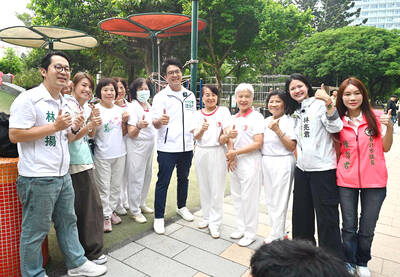
With weighty, anxiety-inducing geopolitical topics dominating the headlines, checking in on the wild and weird state of local politics can take some of the edge off. This November’s elections will determine who will be in charge of fixing potholes in your neighborhood, not the potholes in Taiwan’s complicated geopolitical space. Recently, after an online interview with a Taipei-based journalist, I commented that Taipei journalists never go further than the MRT can take them. He laughed and agreed. Naturally, the Taipei mayoral race is eating up much of the press attention. TAIPEI CITY Democratic Progressive Party (DPP) candidate Puma Shen (沈伯洋) has
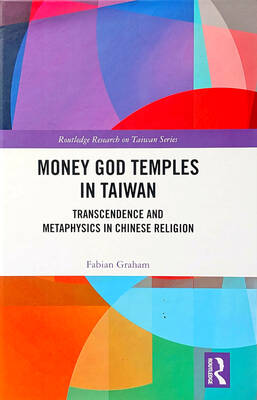
As someone who normally steers clear of books with “transcendence” or “metaphysics” in their subtitles, this reviewer — a casual observer of local belief systems since the 1990s — found Fabian Graham’s Money God Temples in Taiwan a challenging read. Those who’ve only dipped their toes into temple culture will likely need to parse several sections with special care if they’re to keep up with the author, a British ethnographic researcher whose previous books have investigated religious practices among ethnic Chinese in Southeast Asia. This scholarly volume examines a facet of Taiwan’s religious landscape that didn’t exist a century ago, and


 RSS
RSS