


April 23 to April 29
On the 20th anniversary of the Koo-Wang talks in 2013, then-president Ma Ying-jeou (馬英九) praised the meeting as a landmark in peaceful relations between Taiwan and China, opening up the era of “negotiation over antagonism” and “practical discussions while finding common ground and preserving our differences.”
From April 27 to April 29, 1993, then-Straits Exchange Foundation (SEF, 海峽交流基金會) chairman Koo Chen-fu (辜振甫) and his Chinese counterpart Wang Daohan (汪道涵) met in Singapore. It was the first public meeting since 1949 to occur between chairmen of Taiwanese and Chinese non-governmental organizations.
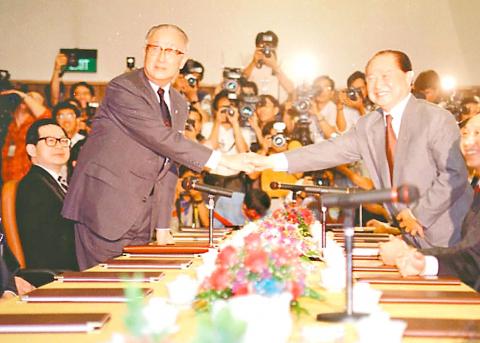
Photo courtesy of Wikimedia Commons
However, “peace” was not exactly what ensued as relations between both sides remained rocky, especially when China fired missiles into the waters surrounding Taiwan in 1995, igniting the Third Taiwan Strait Crisis in a bid to influence the results of Taiwan’s 1996 first ever direct presidential elections.
Even so, Koo and Wang were able to meet one more time in Shanghai in 1998, but after that there would be no more meetings between the two organizations until 2008 when Ma became president.
HISTORIC MEETING
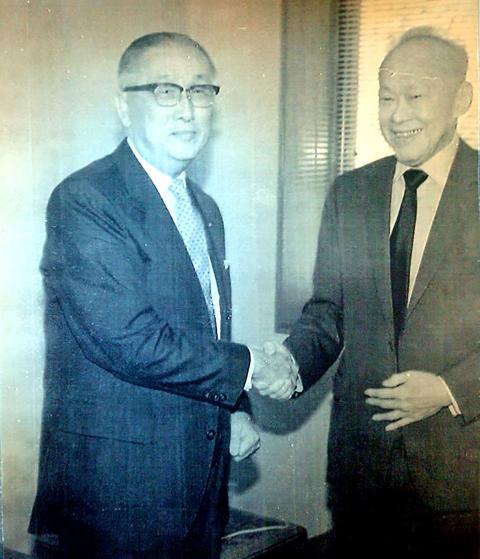
Photo: Chen Tse-ming, Taipei Times
The “no contact, no compromise, no negotiation” relations between Taiwan and China started thawing with the lifting of martial law in 1987, and in November of that year Taiwanese were allowed to enter China for the first time since 1949 to visit relatives.
The SEF was established in 1990 with government support as an intermediary body to handle cross-strait affairs since the two sides were still officially not talking to each other. In November 1991, China established its counterpart, Association for Relations Across the Taiwan Straits.
ARATS wasted no time. In January 1992, it sent a fax to the SEF office inviting its chairman to visit China to “strengthen the communication between both sides and exchange ideas for cooperation.”
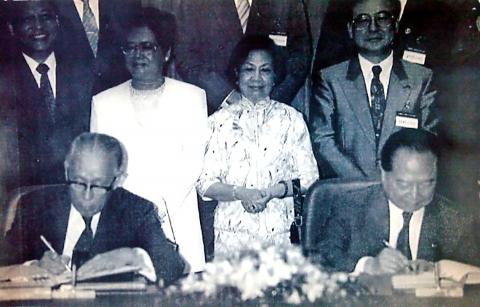
Photo: Chang Min-chung, Taipei Times
The talks were delayed due to debate over how they would handle the political situation: both sides claimed to be the legitimate ruler of both Taiwan and China.
In August, Wang sent a letter to Koo inviting him again: “In the past year, cross-Strait relations, especially in economic cooperation, has been increasingly vibrant. This is very moving and exciting … I hope we can meet soon just to talk about economic development, affairs between the two organizations as well as other issues. This is the optimal time, therefore I hereby extend another invitation.”
In Koo’s reply, he agreed that interorganizational affairs and economic development should be the main focus — such as safeguarding the rights of Taiwanese businessmen in China — and suggested Singapore as an alternate meeting location. Although the Chinese at first insisted on having at least a “pre-meeting meeting” in China, they later conceded to a single conference in Singapore.
In October of that year, the two offices met in British-ruled Hong Kong to prepare for the meeting, which resulted in the controversial so-called “1992 consensus” where both sides agreed on the “one-China” principle but with different interpretations on each side.
Whether the “consensus” was legitimate or not, it paved the way for the Koo-Wang talks by side-stepping contentious issues.
More than 200 reporters from 10 countries and territories, including 107 from Taiwan, arrived in Singapore for this historic event. The opposition Democratic Progressive Party (DPP) also sent a delegation led by then-legislator Shih Ming-teh (施明德) to Singapore to protest the meeting.
Politics were avoided in the talks as the two men signed four agreements promoting trade and civilian exchanges. The one issue the two couldn’t agree on was China’s request for direct trade, postal and transportation links and Taiwan’s desire for legal protection for Taiwanese investments and businesses in China.
“Because the antagonism between the two sides hadn’t really subsided, the Koo-Wang talks were more symbolic than practical, especially since it would be impossible to resolve all the issues during initial contact,” writes Chu Kuo-hua (初國華) in the study, Cross-Strait Negotiations Under an Asymmetrical Power Structure (不對稱權利結構下的兩岸對談). The goal was not to achieve concrete results, but to open the door to further negotiations.
ROCKY AFTERMATH
A year after the meeting, tensions between the two sides rose again with the Qiandao Lake Incident, where 24 Taiwanese tourists and eight Chinese were kidnapped and murdered by three men. The Chinese authorities’ insensitive attitudes and their attempts to cover up some of the details drew public ire in Taiwan, reportedly causing many Taiwanese to turn their support to independence.
In 1995, China broke off all negotiations when Lee Teng-hui (李登輝) accepted a visit to his alma mater, Cornell University. Although Lee claimed that it was a private visit, the symbolism was not lost as it was the first time a Taiwan leader had set foot on US soil since the two countries severed relations in 1979.
Finally, things came to a head with the 1996 missile crisis, which further fueled Taiwanese anger toward China. However, in 1998, new Chinese premier Zhu Rongji (朱鎔基) expressed that he would welcome Koo to China for a second meeting with Wang. They met for five days in Shanghai, with Wang promising to visit Taiwan for the third meeting. Politics were broached this time, with Koo reportedly stating, “Only when [China] has achieved democracy can the two sides of the Taiwan Strait talk about reunification.”
This plan was dashed when President Lee in July 1999 announced his “special state-to-state relations” (特殊國與國關係) stance, prompting China to cancel Wang’s visit and suspend talks again. With the DPP taking power in 2000, it was unlikely that there would be further meetings. Koo died in January 2005, and Wang followed in December, neither living long enough for the KMT to regain power and restart negotiations.
Taiwan in Time, a column about Taiwan’s history that is published every Sunday, spotlights important or interesting events around the nation that have anniversaries this week.

Taiwan’s English education system is being pulled apart by three opposing forces. Bilingual Nation 2030 pulls students toward English and global communication. Artificial Intelligence (AI) readiness pulls them toward digital judgment, verification and AI-mediated work. But Taiwan’s old exam culture pulls them back toward memorization, grammar drills, timed reading and correct answers. If the education system keeps using old exams to define success, it risks producing graduates who are neither genuinely bilingual nor genuinely AI-ready, but trained for tasks machines can already perform. The first force is Bilingual Nation 2030. Launched in 2018, the policy aimed to “help Taiwan’s workforce connect
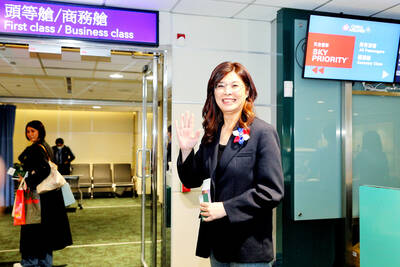
“Taiwan’s Opposition Leader Comes to US With a Message Straight Out of Beijing” read a May 31 headline in the Wall Street Journal. Top US administration officials and members of Congress almost certainly read the WSJ, and if there was a bullet point takeaway that people in Washington should absorb ahead of Chinese Nationalist Party (KMT) Chair Cheng Li-wun’s (鄭麗文) arrival in DC on June 9, that headline is it. The last few columns have discussed this very topic, and the timing is not coincidental. While those top officials likely do not read the Taipei Times, judging by the number
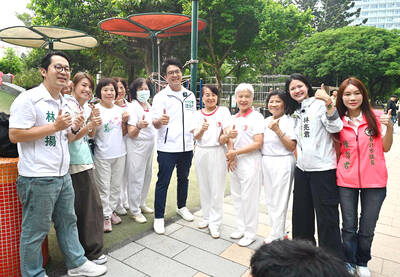
With weighty, anxiety-inducing geopolitical topics dominating the headlines, checking in on the wild and weird state of local politics can take some of the edge off. This November’s elections will determine who will be in charge of fixing potholes in your neighborhood, not the potholes in Taiwan’s complicated geopolitical space. Recently, after an online interview with a Taipei-based journalist, I commented that Taipei journalists never go further than the MRT can take them. He laughed and agreed. Naturally, the Taipei mayoral race is eating up much of the press attention. TAIPEI CITY Democratic Progressive Party (DPP) candidate Puma Shen (沈伯洋) has
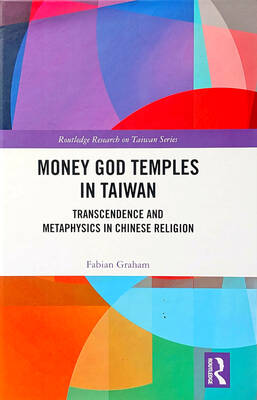
As someone who normally steers clear of books with “transcendence” or “metaphysics” in their subtitles, this reviewer — a casual observer of local belief systems since the 1990s — found Fabian Graham’s Money God Temples in Taiwan a challenging read. Those who’ve only dipped their toes into temple culture will likely need to parse several sections with special care if they’re to keep up with the author, a British ethnographic researcher whose previous books have investigated religious practices among ethnic Chinese in Southeast Asia. This scholarly volume examines a facet of Taiwan’s religious landscape that didn’t exist a century ago, and


 RSS
RSS