


Landlocked Nantou County lies at the heart of Taiwan in several senses. It’s the island’s geographical center, rich in Aboriginal heritage and a showcase of much other traditional culture too. For hikers, it has some of the nation’s most stunning scenery. Forget the over-rated charms of Sun Moon Lake (lovely, but too developed), and instead head for the county’s true scenic wonders, including Batongguan Ancient Trail (八通關古道) and Taiji Gorge (太極峽谷).
Up there among Nantou County’s greatest destinations, although a lot less well-known than most, Huisun hot spring (惠蓀溫泉) is possibly unique among Taiwan’s natural hot spring sources in that it lies in a small cave set into a sheer cliff face about eight meters above the surface of a fast-flowing river. The hot spring is fascinating, but the real highlight is the tough journey to it, which is a stunningly scenic adventure.
The hot spring is impossible to reach from the first plum rains (usually in May) until the beginning of the following year, and even during the dry season there is no guarantee of making it.
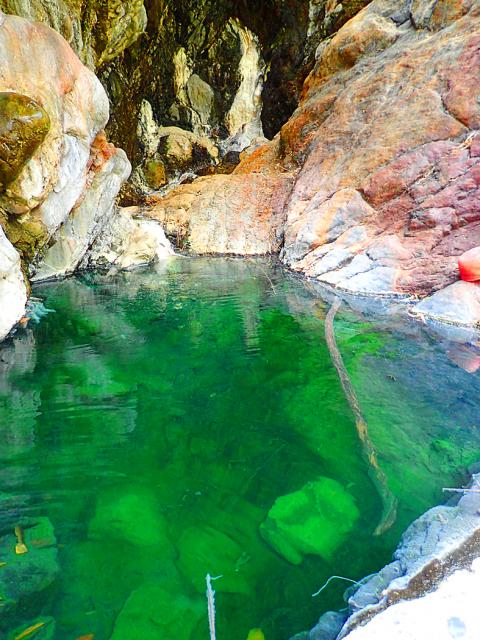
Photo: Richard Saunders
The jumping-off place for the hot spring is Huisun Forest Recreation Area (惠蓀林場), and a lane branching sharply off the main road through it, 600m after the service center. Walk up this road, pass around the gate at the top, and follow the wide track downhill into the deep river valley beyond.
BEWARE OF MONKEYS
The track is carved into sheer cliffs, so watch out for falling rocks. A group of local Atayal Aborigines we met here warned us of monkeys throwing rocks down on people as they walked along the road. It sounded like a joke, but we had exactly the same warning from Truku Aborigine guides when entering another of Taiwan’s great scenic wonders, the Golden Grotto (黃金峽谷) in Hualien County, so they might have been serious.
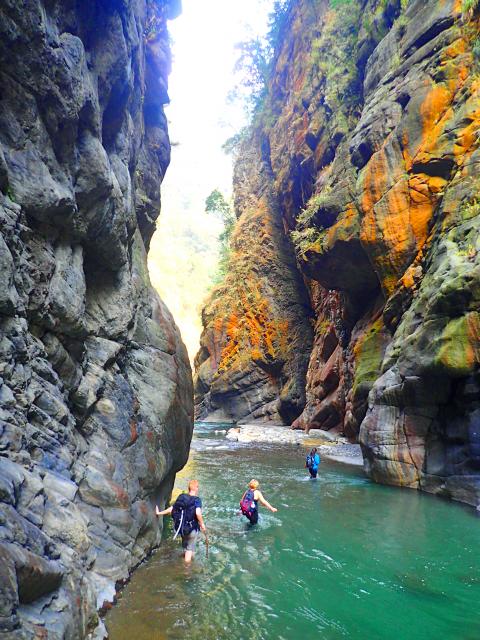
Photo: Richard Saunders
The road crosses the river by a very large bridge, narrows to a trail and descends to the river, which is the start of the exciting river trace up to the hot spring.
You will need to cross the river immediately, and if this first river crossing feels at all unsteady or risky, turn back immediately because the crossings get trickier further up.
The scenery here is stunning, with huge crumbling cliffs rising several hundred meters above the river. Look out for several small hot spring pools on the riverbank as you make your way upstream.
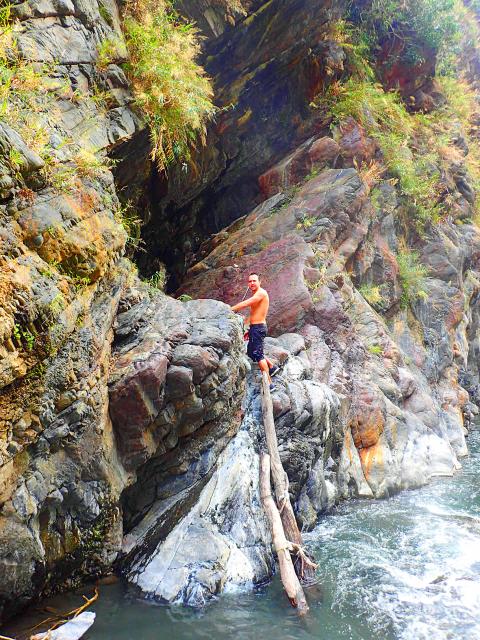
Photo: Richard Saunders
After about an hour, things start getting exciting, as the gorge narrows considerably, and the water is squeezed into the first of a series of awesome canyons, flowing deep and fast. Expect to wade waist deep.
Further upstream are rock faces stained by tiny trickles of seeping hot spring water, and, further along, narrow gorges funnel the gushing river through ever tighter spaces, making for a challenging route. A magnificent waterfall — a tall, narrow plume of water the better part of 100 meters high and plunging straight into the river — is a highlight.
FEEL THE BUZZ
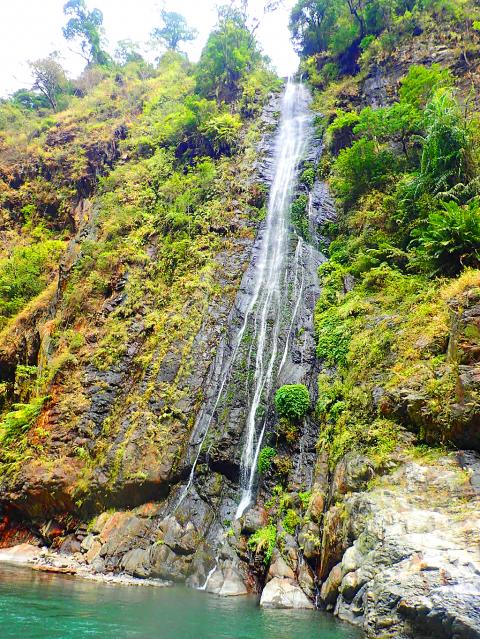
Photo: Richard Saunders
After the waterfall, the hardest part is over. Bright colors stain the rock faces of the gorge in several places as small hot spring sources seep out of the cliffs. The gorge widens, and becomes less strenuous. In another couple of hundred meters, however, the river narrows and becomes more rugged again, and on the right a small cave in the cliff conceals Huisun hot spring. Climb up the short rock face, and the cave holds a pool of bright green, bath-hot water, which trickles out of cracks in the back of the cavity. On our visit a colony of tiny bees had set up residence here, and buzzed harmlessly around our heads as we soaked.
IF YOU GO
>> There’s no public transport to Huisun Forest Recreation Area, so you’ll either need your own transport, or try hitching a lift (the recreation area is a popular destination on weekends).
>> Start early. It’s a long way out and back in one day, and camping or carrying heavy, bulky backpacks in the narrow canyon is a bad idea. A gravel track which once made the trip relatively easy (it was even used by mountain bikes) has long since been washed away by typhoon floods. A few short, overgrown stretches remain (look out for these — they’re all on the right as you work your way upstream), and you’ll need to use them all to reach the hot spring and get back in one day.
>> Get an early start by camping around Huisun Forest Recreation Area. Officially, camping isn’t allowed inside the Recreation Area, but in practice campers set up in car parks or quiet spots near the road after dark, and as long as they’re gone soon after dawn, there’s rarely a problem. It’s best to do this in fact, because the Recreation Area (which isn’t open 24 hours) opens at 8:30am for day-trippers, making it a rather late start for a long day.
Richard Saunders is a classical pianist and writer who has lived in Taiwan since 1993. He’s the founder of a local hiking group, Taipei Hikers, and is the author of six books about Taiwan, including Taiwan 101 and Taipei Escapes. Visit his Web site at www.taiwanoffthebeatentrack.com.


Taiwan’s English education system is being pulled apart by three opposing forces. Bilingual Nation 2030 pulls students toward English and global communication. Artificial Intelligence (AI) readiness pulls them toward digital judgment, verification and AI-mediated work. But Taiwan’s old exam culture pulls them back toward memorization, grammar drills, timed reading and correct answers. If the education system keeps using old exams to define success, it risks producing graduates who are neither genuinely bilingual nor genuinely AI-ready, but trained for tasks machines can already perform. The first force is Bilingual Nation 2030. Launched in 2018, the policy aimed to “help Taiwan’s workforce connect

“Taiwan’s Opposition Leader Comes to US With a Message Straight Out of Beijing” read a May 31 headline in the Wall Street Journal. Top US administration officials and members of Congress almost certainly read the WSJ, and if there was a bullet point takeaway that people in Washington should absorb ahead of Chinese Nationalist Party (KMT) Chair Cheng Li-wun’s (鄭麗文) arrival in DC on June 9, that headline is it. The last few columns have discussed this very topic, and the timing is not coincidental. While those top officials likely do not read the Taipei Times, judging by the number

With weighty, anxiety-inducing geopolitical topics dominating the headlines, checking in on the wild and weird state of local politics can take some of the edge off. This November’s elections will determine who will be in charge of fixing potholes in your neighborhood, not the potholes in Taiwan’s complicated geopolitical space. Recently, after an online interview with a Taipei-based journalist, I commented that Taipei journalists never go further than the MRT can take them. He laughed and agreed. Naturally, the Taipei mayoral race is eating up much of the press attention. TAIPEI CITY Democratic Progressive Party (DPP) candidate Puma Shen (沈伯洋) has

As someone who normally steers clear of books with “transcendence” or “metaphysics” in their subtitles, this reviewer — a casual observer of local belief systems since the 1990s — found Fabian Graham’s Money God Temples in Taiwan a challenging read. Those who’ve only dipped their toes into temple culture will likely need to parse several sections with special care if they’re to keep up with the author, a British ethnographic researcher whose previous books have investigated religious practices among ethnic Chinese in Southeast Asia. This scholarly volume examines a facet of Taiwan’s religious landscape that didn’t exist a century ago, and


 RSS
RSS