


The idea to visit all 193 UN-registered countries — as well as Taiwan — came to soul singer Joss Stone when she was in Japan, a country which fascinated her because the culture was “completely and utterly” different from that of the UK.
“I thought, ‘is there a reason why we can’t spread music freely to every country?’” Stone tells the Taipei Times in a phone interview from the UK. The only reason not to is purely financial. But tours don’t have to be profitable. It can just be a good thing to do with your time.”
So far, the 29-year-old Grammy award-winner from the UK has visited 96 countries, and when she completes her journey touring 193 countries, she will be the first singer in the world to achieve that feat. In addition to performing a gig in each country, Stone also gives back to a local charity and does a musical collaboration with a local artist which she posts on her Facebook page. Although the plans for the local charity and artist collaboration for the Taiwan segment have yet to be finalized, fans can check her Facebook page for updates.

Photo courtesy of Stone’d Records
Stone, who has been in the music industry since the age of 13 and whose music is a blend of soul, R&B and reggae, will perform songs from her seventh studio album, Water for Your Soul, in Taipei, at ATT Showbox, on March 16.
THE LANGUAGE OF MUSIC
“I feel a need to get out and explore — that is a part of my personality,” Stone says.

Photo courtesy of Stone’d Records
When she’s on vacation — which is rare — Stone prefers to hire a jeep and drive around without a plan, but being on tour has made her life far more structured.
“The tour is a very different type of exploration, because the idea behind it is that I don’t want to leave anyone out. It’s like righting a wrong,” she says.
While Stone sometimes introduces the meaning behind the song in the collaboration video as she did in Gabon and Macedonia, other times, she and the other artists simply launch into the melody. In Malawi, Stone belts happy and upbeat tunes outside of a straw hut with Gasper Nali, a local musician who plays a guitar that he made himself.
Stone sings in the native language of the country in each collaboration she does, sometimes with the help of her notebook where she writes notes on pronunciation.
“Pop radio believes that there is one thing that works, that there is one formula and you stick to it,” Stone says. “Real music is not simple and nobody can sing along but it still gives good feelings.”
While performing at a refugee camp in Djibouti, Stone met people from Somalia, Ethiopia and Yemen, all of whom spoke different languages and came from vastly different backgrounds but who she was still able to communicate with through music.
She jokes: “I’ve never landed in a country and had someone say to me, ‘I’m sorry madam, there’s no music here, people don’t make noises here.”
‘SPREADING GOODNESS’
Stone says a common misconception that people have of her tour is that she’s setting out to change the world or find herself.
The singer’s goals have been far less lofty: “I think we’re just having a lovely time. I feel like my opinion on the world and my attitude towards people has just been reinforced. People are good — that’s the attitude that I had when I began and that’s the attitude that I still have.”
In Panama, Stone worked with Hear the World Foundation, a non-profit that distributes free hearing aids to children with hearing loss and helps cover the cost of operations and hearing implants for those who need them.
Stone met a five-year-old girl who benefited from the foundation and heard music for the first time.
“She just freaked out, basically, which is kind of an amazing thing,” Stone says.
While in Peru, she met another young boy who couldn’t hear or see and is hoping to connect him with Hear the World Foundation so that he can receive a hearing aid, too.
Stone is realistic though: “Sometimes what we’re doing really helps and other times we just go and visit charities and not much comes of it.”
More important to her is the idea of “spreading goodness.” The fact that she’s met so many people who simply wanted to help others has also made her tour a gratifying experience.
Coming from a small village in the south of England, Stone is especially grateful for the opportunity to be exposed to so many different musical styles.
“If I were go to the pub near where I’m from in Ashill, and say, ‘I’m off to Taiwan,’ they’d be like, ‘What? Where the hell is Taiwan?’” Stone laughs. “It’s a whole other world. Basically, it’s a blank canvas.”
Stone admits it sounds self-evident to reiterate that travel makes you a less ignorant person. Rather, she prefers to tell people that her own musical style is “a bit of a mix.” No matter what you’re creating — whether it’s a novel or song or dance — if you’ve traveled, there will be traces of influences from cultures and peoples you encounter, she says.
“Or, you could just do the tango for the rest of your life and you’ll get really, really good at doing the tango, and there’s nothing wrong with that either.”


Taiwan’s English education system is being pulled apart by three opposing forces. Bilingual Nation 2030 pulls students toward English and global communication. Artificial Intelligence (AI) readiness pulls them toward digital judgment, verification and AI-mediated work. But Taiwan’s old exam culture pulls them back toward memorization, grammar drills, timed reading and correct answers. If the education system keeps using old exams to define success, it risks producing graduates who are neither genuinely bilingual nor genuinely AI-ready, but trained for tasks machines can already perform. The first force is Bilingual Nation 2030. Launched in 2018, the policy aimed to “help Taiwan’s workforce connect

“Taiwan’s Opposition Leader Comes to US With a Message Straight Out of Beijing” read a May 31 headline in the Wall Street Journal. Top US administration officials and members of Congress almost certainly read the WSJ, and if there was a bullet point takeaway that people in Washington should absorb ahead of Chinese Nationalist Party (KMT) Chair Cheng Li-wun’s (鄭麗文) arrival in DC on June 9, that headline is it. The last few columns have discussed this very topic, and the timing is not coincidental. While those top officials likely do not read the Taipei Times, judging by the number

With weighty, anxiety-inducing geopolitical topics dominating the headlines, checking in on the wild and weird state of local politics can take some of the edge off. This November’s elections will determine who will be in charge of fixing potholes in your neighborhood, not the potholes in Taiwan’s complicated geopolitical space. Recently, after an online interview with a Taipei-based journalist, I commented that Taipei journalists never go further than the MRT can take them. He laughed and agreed. Naturally, the Taipei mayoral race is eating up much of the press attention. TAIPEI CITY Democratic Progressive Party (DPP) candidate Puma Shen (沈伯洋) has
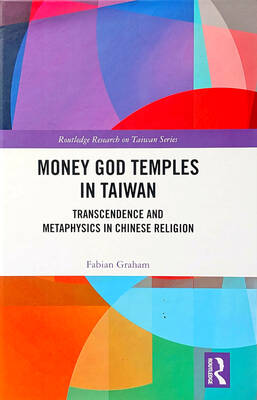
As someone who normally steers clear of books with “transcendence” or “metaphysics” in their subtitles, this reviewer — a casual observer of local belief systems since the 1990s — found Fabian Graham’s Money God Temples in Taiwan a challenging read. Those who’ve only dipped their toes into temple culture will likely need to parse several sections with special care if they’re to keep up with the author, a British ethnographic researcher whose previous books have investigated religious practices among ethnic Chinese in Southeast Asia. This scholarly volume examines a facet of Taiwan’s religious landscape that didn’t exist a century ago, and


 RSS
RSS