


Taiwan in Time: Nov. 28 to Dec. 4
Not many people’s lives change drastically when they are 38 years old.
Four months pregnant with her fifth child, Yu Chen Yue-ying (余陳月瑛) knew nothing about politics when she ran for the Taiwan Provincial Council in 1963 under the orders of her father-in-law, former Kaohsiung County commissioner Yu Teng-fa (余登發).
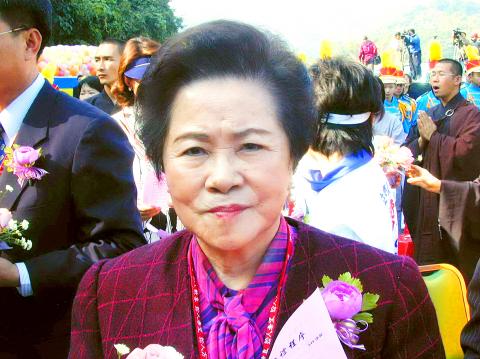
Photo: Hung Cheng-hung, Taipei Times
“I was not prepared at all,” she writes in the book, Memoir of Yu Chen Yue-ying (余陳月瑛回憶錄). “But the strange thing was that faced with such an important task, I did not panic.”
Yu Teng-fa , an independent politician, could not run because he had been dismissed from office and sent to prison in a scandal (Yu Chen writes that he was framed by the government). Because there were guaranteed seats for women in the assembly, Yu wanted to back a female candidate so that not all these seats would go by proxy to the ruling Chinese Nationalist Party (KMT).
“I believe that there must be competition for politics to improve,” Yu Teng-fa says in Yu Chen’s book. “I don’t think my son, daughter or daughter-in-law are better than others. It’s because I can’t find anyone brave enough to compete against the KMT.”
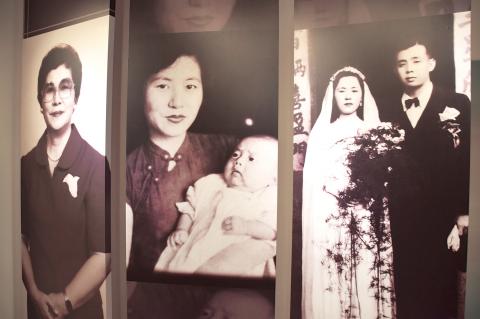
Photo: Su Fu-nan, Taipei Times
After much recruitment, Yu Teng-fa finally found a candidate to run for the assembly — but three days before the registration deadline, she withdrew due to family objections.
“That is why I was suddenly pushed into the role,” Yu Chen writes, as she admits that she won the top vote because of her father-in-law’s influence. But she did not expect that she would run for election and continue to win, remaining in public office for the next 30 years. And in 1985, she earned the distinction of being Taiwan’s first female county commissioner.
LEARNING ON THE FLY
Yu Chen says that her husband advised her to just stay quiet during the assemblies, but she writes that that was something she was “incapable of doing” — especially as part of the opposition.
“I was like a first-time student, I was taking notes and observing how other opposition politicians carried themselves,” she writes.
Her role model was fellow assemblywoman Hsu Shih-hsien (許世賢), who was Taiwan’s first female professor and would go on to become the country’s first female mayor in 1968.
“She always stood her ground and handled matters efficiently. She remained calm and was able to persuade people by reasoning,” Yu Chen writes. “In my 18 years as assemblywoman, I never insulted a politician. If you can’t force people to do things, you try other ways. Solving the problem is most important.”
“Through working for my constituents and seeking advice from my more experienced peers, I quickly learned the ropes of being a politician on my own,” she adds.
Yu Chen writes that she noticed the lack of true democracy in Taiwan during those days, and spoke out when the government decided to make village and borough chiefs appointed instead of elected. She also felt that the provincial government had too much power, and proposed that the provincial governor be elected as well.
She says she focused mostly on the basic problems of society, including farmers’ rights, election fraud and police abusing their power.
“I developed my political style during my first term,” she writes. “I stayed away from higher-level institutional problems, and did not try to fight ideological battles with government officials to highlight that I was part of the opposition. I worked for people’s welfare and their rights.”
Yu Chen ran for reelection in 1967 — this time on her own accord. She served a total of five terms in the assembly, then joined the legislature in 1983. She became Kaohsiung County commissioner in 1985 — following in the footsteps of her father-in-law and brother-in-law Huang You-jen (黃友仁), who were elected in 1960 and 1977, respectively.
The Yu family turned into a political dynasty as Yu Chen’s son, Yu Cheng-hsien (余政憲) succeeded her for two terms and also served as legislator and interior minister. Yu Cheng-hsien’s wife, Cheng Kui-lien (鄭貴蓮), served as a legislator and in the National Assembly.
Yu Chen’s other son and daughter, Yu Cheng-tao (余政道) and Yu Lin-ya (余玲雅), both served in the provincial assembly and as legislators.
Yu Chen left politics for several years after finishing her second term as county commissioner, but in 2000 she was named a senior advisor to then-president Chen Shui-bian (陳水扁), although she resigned in 2003 due to a financial scandal, ending a political career that was not even supposed to have happened.
Taiwan in Time, a column about Taiwan’s history that is published every Sunday, spotlights important or interesting events around the nation that have anniversaries this week.
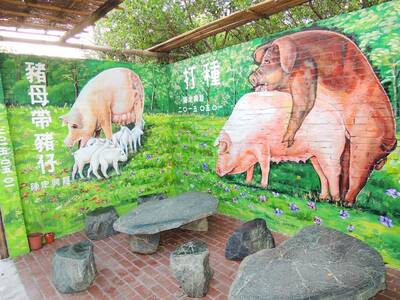
May 6 to May 12 Those who follow the Chinese-language news may have noticed the usage of the term zhuge (豬哥, literally ‘pig brother,’ a male pig raised for breeding purposes) in reports concerning the ongoing #Metoo scandal in the entertainment industry. The term’s modern connotations can range from womanizer or lecher to sexual predator, but it once referred to an important rural trade. Until the 1970s, it was a common sight to see a breeder herding a single “zhuge” down a rustic path with a bamboo whip, often traveling large distances over rugged terrain to service local families. Not only
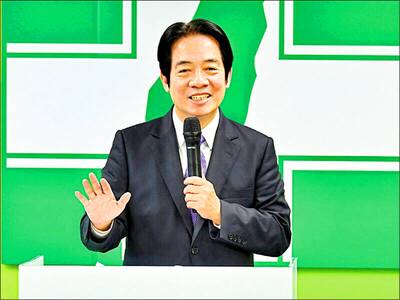
Ahead of incoming president William Lai’s (賴清德) inauguration on May 20 there appear to be signs that he is signaling to the Chinese Communist Party (CCP) and that the Chinese side is also signaling to the Taiwan side. This raises a lot of questions, including what is the CCP up to, who are they signaling to, what are they signaling, how with the various actors in Taiwan respond and where this could ultimately go. In the last column, published on May 2, we examined the curious case of Democratic Progressive Party (DPP) heavyweight Tseng Wen-tsan (鄭文燦) — currently vice premier
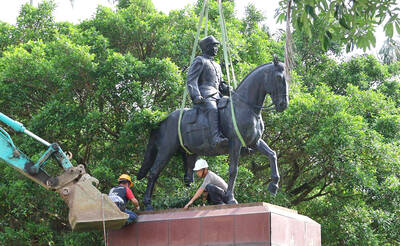
The last time Mrs Hsieh came to Cihu Park in Taoyuan was almost 50 years ago, on a school trip to the grave of Taiwan’s recently deceased dictator. Busloads of children were brought in to pay their respects to Chiang Kai-shek (蔣中正), known as Generalissimo, who had died at 87, after decades ruling Taiwan under brutal martial law. “There were a lot of buses, and there was a long queue,” Hsieh recalled. “It was a school rule. We had to bow, and then we went home.” Chiang’s body is still there, under guard in a mausoleum at the end of a path

Last week the Directorate-General of Budget, Accounting and Statistics (DGBAS) released a set of very strange numbers on Taiwan’s wealth distribution. Duly quoted in the Taipei Times, the report said that “The Gini coefficient for Taiwanese households… was 0.606 at the end of 2021, lower than Australia’s 0.611, the UK’s 0.620, Japan’s 0.678, France’s 0.676 and Germany’s 0.727, the agency said in a report.” The Gini coefficient is a measure of relative inequality, usually of wealth or income, though it can be used to evaluate other forms of inequality. However, for most nations it is a number from .25 to .50


 RSS
RSS