


When the UK painter Francis Bacon died in 1992 at the age of 82 he left everything, valued at over £11 million (US$17.3 million), to John Edwards, a bar manager from London’s poor East End who could neither read nor write. Bacon was gay and was devoted to him, but it seems they never had sex.
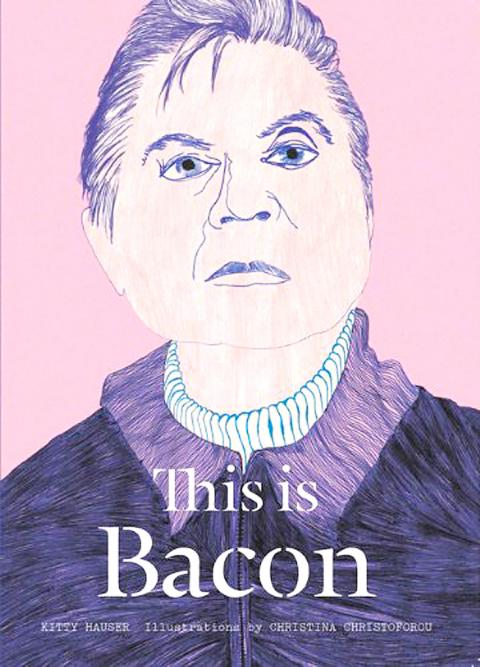
This is Bacon is one of a new series on artists from Laurence King Publishing. They’re each only 80 pages long, and are illustrated by both paintings and skittish designs, in this case by Christina Christoforou. This might sound like dumbing down, but the attractive concept is redeemed from any temptation to go in that direction by an astute text by an art critic, here Kitty Hauser. The entire package is as a result highly attractive.
Bacon, though untrained as a painter and starting late, was a successful artist all his life. London’s Tate Gallery held a retrospective exhibition in 1962, and Paris one in 1971. The day before the latter opened, his long-time lover George Dyer was found dead from an overdose in their hotel room. When fellow UK artist David Hockney offered his condolences at the exhibition’s opening, Bacon apparently replied “You can only laugh or cry.”
There are certain motifs that recur in any description of Bacon’s work. They include Velazquez’s portrait of Pope Innocent X, Van Gogh’s Painter on the Road to Tarascon (destroyed in WWII), the 19th-century photographs by Eadweard Muybridge showing humans and animals in motion, the 1925 Eisenstein film The Battleship Potemkin, and the crucifixion, a traditional subject for European artists.
Bacon saw the crucifixion simply as an act of barbarity that was typical of human behavior. His art has been described as “post-humanist.” Whereas humanists hope for an improvement in behavior following the models of the most admirable human beings, people like Bacon saw brutality as the norm. He used photos a lot as sources for images. What if he’d lived to see the pictures of Abu Ghraib, one critic has mused.
But Bacon hated to find any “moral” or “interpretation” applied to his pictures. He aimed simply to shock, and also to distort, with the result that he didn’t like his friends posing for portraits. He preferred them to stay away and just leave him a photo, embarrassed (the art critic David Sylvester suggested) at the desecration of their faces he was about to perpetrate.
Even so, he sometimes made interpretative comments of his own. On the numerous images of meat in his later work, he said, “If I go into a butcher’s shop I always think it surprising I wasn’t there instead of the animals.” How could he ever compete with the horrors of everyday life, he once asked. And his favorite quotation from the French author Jean Cocteau was “Each day in the mirror I watch death at work.”
There have been several books on Bacon, and there are at least three relevant films. One memorable book by Daniel Farson, an old drinking companion, is entitled The Gilded Gutter Life of Francis Bacon. Of the films, two feature Derek Jacobi. In one, Love is the Devil, he acts Bacon. When he discovers Dyer attempting to break into his studio he’s made to say, “You aren’t much of a burglar, are you. Take your clothes off! Come to bed and you can have whatever you want.” In another film, dating from 2007, Jacobi is heard reading extracts from Bacon’s interviews with Sylvester while the camera pans over hundreds of Bacon paintings. Parts of the actual interviews are available in black-and-white on YouTube under the title “Francis Bacon: Fragments of a Portrait.”
As a gay there was no way Bacon was attracted to pretty boys. He liked working-class bruisers who would teach him a lesson, and in no uncertain manner. “Physical attraction,” Farson quotes him as saying “is destroyed the moment the man shows the slightest aspiration to intelligence.” He was sexually attracted to his father, he recalled once, who, perhaps in response, told the grooms in his stables in Ireland to whip him. He reacted by arranging repeat performances throughout his life.
Critics have been impressed by the way Bacon refers back to the classical past (Velasquez, Van Gogh, the self-portraits of Rembrandt). But his taste was highly selective — he liked the “lovely vibrations of color” in Turner, but Blake meant nothing to him.
This book takes a frank look at both the artist and his work. It even broaches the question of whether Bacon was any good at all, or just an untaught curmudgeon who made grotesque images by copying photos. Current critical opinion, however, sees him as the greatest British painter since Turner.
Whether he should be considered Irish is discussed. He was born there, but grew to hate the place so much that he was reputedly unable to board a plane bound there. (This is a dubious proposition — how ever could it be tested?) His ancestors were radical Protestants, he recalled, and so lived by “a total falseness.” Nevertheless he was attracted to the personalities of these people, often viewed as intransigent bigots, finding them preferable to males of a milder disposition.
Paintings of men screaming or collapsing, a chaotic studio that has been reassembled in Dublin as an art exhibit, a lack of interest in landscape, the most Bohemian of lifestyles in Berlin, London and Tangier, work that “became more and more self-referential” while never going out of fashion — all these are aspects of the iconic figure we know as Francis Bacon.
This is a marvelous little book that combines accessibility to a popular readership with intelligence and acumen. Both individuals and school libraries would benefit from acquiring copies. There are others in the series on Gauguin, Cezanne, Matisse, Dali, Pollock and Warhol.


Taiwan’s English education system is being pulled apart by three opposing forces. Bilingual Nation 2030 pulls students toward English and global communication. Artificial Intelligence (AI) readiness pulls them toward digital judgment, verification and AI-mediated work. But Taiwan’s old exam culture pulls them back toward memorization, grammar drills, timed reading and correct answers. If the education system keeps using old exams to define success, it risks producing graduates who are neither genuinely bilingual nor genuinely AI-ready, but trained for tasks machines can already perform. The first force is Bilingual Nation 2030. Launched in 2018, the policy aimed to “help Taiwan’s workforce connect

“Taiwan’s Opposition Leader Comes to US With a Message Straight Out of Beijing” read a May 31 headline in the Wall Street Journal. Top US administration officials and members of Congress almost certainly read the WSJ, and if there was a bullet point takeaway that people in Washington should absorb ahead of Chinese Nationalist Party (KMT) Chair Cheng Li-wun’s (鄭麗文) arrival in DC on June 9, that headline is it. The last few columns have discussed this very topic, and the timing is not coincidental. While those top officials likely do not read the Taipei Times, judging by the number

With weighty, anxiety-inducing geopolitical topics dominating the headlines, checking in on the wild and weird state of local politics can take some of the edge off. This November’s elections will determine who will be in charge of fixing potholes in your neighborhood, not the potholes in Taiwan’s complicated geopolitical space. Recently, after an online interview with a Taipei-based journalist, I commented that Taipei journalists never go further than the MRT can take them. He laughed and agreed. Naturally, the Taipei mayoral race is eating up much of the press attention. TAIPEI CITY Democratic Progressive Party (DPP) candidate Puma Shen (沈伯洋) has
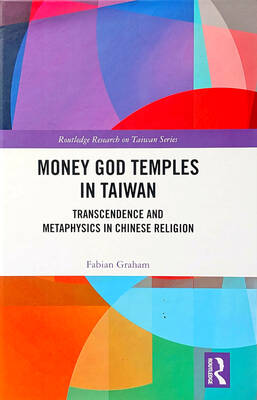
As someone who normally steers clear of books with “transcendence” or “metaphysics” in their subtitles, this reviewer — a casual observer of local belief systems since the 1990s — found Fabian Graham’s Money God Temples in Taiwan a challenging read. Those who’ve only dipped their toes into temple culture will likely need to parse several sections with special care if they’re to keep up with the author, a British ethnographic researcher whose previous books have investigated religious practices among ethnic Chinese in Southeast Asia. This scholarly volume examines a facet of Taiwan’s religious landscape that didn’t exist a century ago, and


 RSS
RSS