


Heart on My Sleeve
Mary Lambert
Capitol

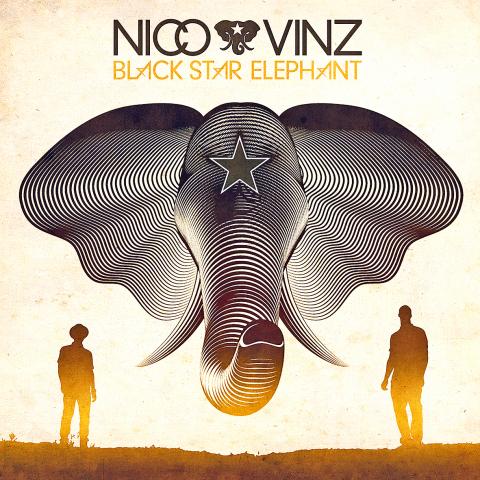
Black Star Elephant
Nico & Vinz
Warner Bros
Sincerity went out of fashion, like, two decades ago, right?
That’s one reason for the paucity of issues-minded pop in recent years. Whatever the real enemy is — capitalism, narcissism or any of their cousins — pop music has become an underused vehicle for un-ironic statements of change, a state of affairs that qualifies Meghan Trainor’s All About That Bass as a real empowerment anthem. Broadly speaking, sloganeering has been exiled to the fringes.
And yet, a couple of times a year, a song penetrates through the self-involved clutter. Last year, it was Same Love, the Macklemore & Ryan Lewis song about marriage equality that might have remained a curio were it not for, first, the duo’s unlikely crossover success preceding its release and, second, the indelible hook written and sung by Mary Lambert. This year it’s Am I Wrong, a bright, Police-esque pop-soul number by the Afro-Norwegian duo Nico & Vinz, singers with clean, burr-less voices and relentless optimism.

For Lambert and Nico & Vinz, who made their initial mark by finding a way to make earnestness something more than a personal crusade, sincerity is its own performance. But their initial success forces a test — can they stick to their causes in the face of pop’s filthy, irresistible lucre?
Nico & Vinz embed their answer to that question in People, a song from Black Star Elephant, their first album released in this country. “If everybody were poor,” the song begins, “we would all be rich.” For a few minutes, the duo then go on to romanticize poverty, or lament the ways in which work takes energy away from family, and love and spiritual purity. It’s numbingly direct, ideologically underfed, and sure, catchy enough.
So goes the rest of this album, which gives the most obvious of platitudes the most glossy of sheens. Nico and Vinz are resolutely positive singers, and to complement that attitude, they’ve opted for production that echoes the neutered global pop of the 1980s, sprinkled with African influences. The album’s social commitments are stronger than its aesthetic commitments, but it doesn’t suffer for that - behind that choice seems to be an understanding that reaching the most really means alienating the fewest. At minimum, it’s the sort of approach that makes sentiments like the refrain of Miracles — “It don’t have to be miracles/The fire’s within our soul” — go down easier.
More so than Nico & Vinz, Lambert uses her soapbox for something beyond mere preaching on Heart on My Sleeve, her major-label debut album. Lambert, too, is a warm singer, but more in a nurturing way — her politics are universal, but also severely personal.
This album is full of the sort of self-lacerating confessional music that was all the rage two decades ago, and now, in a different time, feels both completely foreign and surprisingly refreshing. There’s even a spoken-word interlude. Secrets, the brisk album opener, catalogs a litany of neuroses and flaws in a manner both direct and tongue-in-cheek: “I’m overweight, I’m always late, I’ve got too many things to say.”
Those things become Lambert’s strengths in her music. And while there’s nothing as directly political as Same Love here, there are sly moments of statement-making — her cover of Rick Springfield’s Jessie’s Girl, or the impressive, sensual soul-baring of Rib Cage, a collaboration with Angel Haze and K.Flay. Lambert has made an album that doesn’t wear its politics on its sleeve, and that is its own form of political triumph.
— JON CARAMANICA, NY Times News Service
American Middle Class
Angaleena Presley
Slate Creek/Thirty Tigers
As one-third of the high-test country sisterhood Pistol Annies, Angaleena Presley has honed a reputation for straight talk and sass, putting fresh spin on a formalist mode. Her fellow Annies, Miranda Lambert and Ashley Monroe, are well ahead of her in the solo-career department, but Presley, 38, seems to have taken her time for a reason. American Middle Class, her debut album, comes fully formed, clear about its purpose.
You could call it a concept album, insofar as its 12 songs — all Presley’s, almost half bearing a sole songwriting credit — adhere to the same subject area of hard times and short horizons, of scraping and striving and coming up short. “You sure ain’t rich, and you sure as hell / Ain’t poor enough to get one little break,” Presley belts on the title track, a tribute to her upbringing as a Kentucky coal miner’s daughter.
She sings wryly of a community’s response to prescription drug abuse (Pain Pills) and the related scourge of small-town boredom (Dry County Blues), under the musical cover of country traditionalism. On Grocery Store, she plays out hypotheticals in her mind, making a watchful sport out of empathy. These are sturdy, insightful songs, and Presley, who produced the album with Jordan Powell, presents them well.
She’s a warm, agreeable singer, with neither the flint nor the sheen of a more dynamic peer like Lambert. That limits the size of her audience, but it’s not a problem within the self-contained world of the album.
What is a problem are the handful of songs that recall other, stronger efforts: Knocked Up, with a premise recently tackled by both Lambert and Monroe; Drunk, which evokes Hungover, by another Nashville contemporary, Brandy Clark; Surrender, a ballad written with Luke Laird and Barry Dean, better suited to an upstart like Cassadee Pope. But for now, at least, Presley has her identity locked tight.
— NATE CHINEN, NY Times News Service


Taiwan’s English education system is being pulled apart by three opposing forces. Bilingual Nation 2030 pulls students toward English and global communication. Artificial Intelligence (AI) readiness pulls them toward digital judgment, verification and AI-mediated work. But Taiwan’s old exam culture pulls them back toward memorization, grammar drills, timed reading and correct answers. If the education system keeps using old exams to define success, it risks producing graduates who are neither genuinely bilingual nor genuinely AI-ready, but trained for tasks machines can already perform. The first force is Bilingual Nation 2030. Launched in 2018, the policy aimed to “help Taiwan’s workforce connect

“Taiwan’s Opposition Leader Comes to US With a Message Straight Out of Beijing” read a May 31 headline in the Wall Street Journal. Top US administration officials and members of Congress almost certainly read the WSJ, and if there was a bullet point takeaway that people in Washington should absorb ahead of Chinese Nationalist Party (KMT) Chair Cheng Li-wun’s (鄭麗文) arrival in DC on June 9, that headline is it. The last few columns have discussed this very topic, and the timing is not coincidental. While those top officials likely do not read the Taipei Times, judging by the number

With weighty, anxiety-inducing geopolitical topics dominating the headlines, checking in on the wild and weird state of local politics can take some of the edge off. This November’s elections will determine who will be in charge of fixing potholes in your neighborhood, not the potholes in Taiwan’s complicated geopolitical space. Recently, after an online interview with a Taipei-based journalist, I commented that Taipei journalists never go further than the MRT can take them. He laughed and agreed. Naturally, the Taipei mayoral race is eating up much of the press attention. TAIPEI CITY Democratic Progressive Party (DPP) candidate Puma Shen (沈伯洋) has
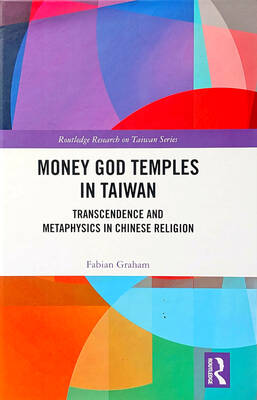
As someone who normally steers clear of books with “transcendence” or “metaphysics” in their subtitles, this reviewer — a casual observer of local belief systems since the 1990s — found Fabian Graham’s Money God Temples in Taiwan a challenging read. Those who’ve only dipped their toes into temple culture will likely need to parse several sections with special care if they’re to keep up with the author, a British ethnographic researcher whose previous books have investigated religious practices among ethnic Chinese in Southeast Asia. This scholarly volume examines a facet of Taiwan’s religious landscape that didn’t exist a century ago, and


 RSS
RSS