


Best known as a celebrity restaurateur whose 1960s mission to change Western attitudes to Chinese food has lasted nearly 50 years, Michael Chow is also a trained painter who, until recently, had not picked up his brushes for decades.
Mr Chow restaurants became glamorous centers for Swinging London, New York’s disco days and today’s Hollywood and art world elite. The man behind them has unveiled his first solo exhibition in Asia, a show he says reflects his complicated relationship with China and the father he last saw when he was 13. Zhou Xinfang (周信芳) was one of China’s best loved stars of Beijing Opera — a discipline combining dance, music, mime, singing and acrobatics — who died in the chaos of the Cultural Revolution.
“Something I had forgotten about, something wiped out of my memory, has been reunited. I didn’t know I could paint that well,” the 74 year-old told AFP in an interview flanked by his imposing mixed-media canvases at Pearl Lam Galleries in Hong Kong. “It’s like me coming home to reclaim my Chinese heritage, and reclaim the name Zhou — my father’s name,” said Chow, who paints under the name Zhou Yinghua.
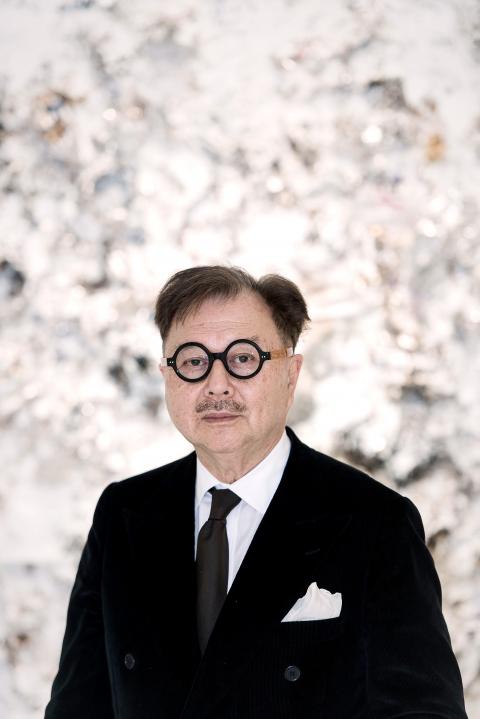
Photo: AFP
Born into a wealthy family in pre-communist Shanghai, Chow enjoyed a privileged upbringing.
Wanting to follow his famous father’s footsteps into theater, he was instead packed off by boat to Britain in 1952 at the age of 13, leaving a life of pampered opulence for boarding school in a bleak, war-ravaged and food-rationed country.
In doing so he avoided the ravages of the 1966-76 Cultural Revolution, unleashed by then-leader Mao Zedong to reassert power after the famines caused by his disastrous Great Leap Forward. The period inflicted myriad personal tragedies and threw society into chaos. Red Guard youths abused their elders — officials, intellectuals, neighbors, relatives, with many targets jailed or killed. While no official figure has been issued, one Western historian estimated half a million people died in 1967 alone.
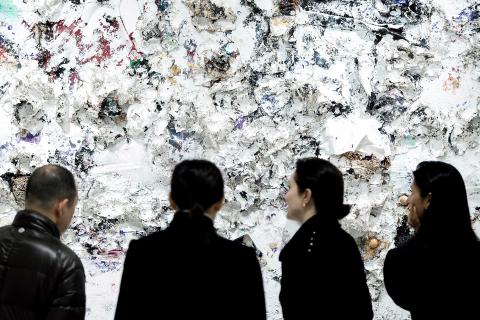
Photo: AFP
Chow says he never saw his father again. He saw his mother Qiu Lilin — whom his show is dedicated to — only once more when she visited him earlier at school. According to the Web site of the Shanghai’s Jingan district government, “Zhou Xinfang was branded as an active counter-revolutionary and so was persecuted together with his wife Qiu Lilin. He died...unavenged.”
MR CHOW IS BORN
Chow stayed in Britain and studied architecture at Central Saint Martins in London before struggling as an artist. He eventually sacrificed his artistic ambitions, beginning what he calls a “50-year radical sabbatical” during which he focused on food and design and later, collecting art.
His first Mr Chow restaurant opened in London in 1968. Its formula of high design, authentic Beijing cuisine, Italian waiters and steep prices was a game-changer at a time when, in Chow’s words, Chinese food was regarded as “the lowest of the low” in the West.
“You couldn’t get lower. It was a terrible, tough period for stereotypes and so there was this need for me to tell the Western world how great China is. The only practical way to do that was through food — thank God Chinese food is great.”
Mr Chow’s success spawned openings across the Atlantic in New York, Miami, Beverley Hills and Malibu. A Las Vegas restaurant is due to open soon. They have always attracted the rich, famous and influential, from the likes of The Beatles to Andy Warhol and Jean-Michel Basquiat in the earlier days to Hollywood royalty, musicians and models.
“We’ve survived 46 years. It’s impossible for a global restaurant to survive for that long, unless the internal will, desire and vision is there,” said Chow. “This need to recognise Chinese culture is beyond food. Food is a means to the end.”
BESPOKE RESTAURATEUR
A part-time actor, Chow also appeared in 1967 James Bond film You Only Live Twice and the Rush Hour series. With three children from four marriages, Chow was briefly married to Grace Coddington, former model and now creative director of American Vogue who starred in the 2009 documentary The September Issue.
In 1992 he married his present wife, Korean fashion designer Eva Chun. She encouraged him in 2012 to paint for the first time since his late teens.
“Food is craft, it has to be the same every time,” said Chow, sporting his trademark, thick-rimmed bespoke glasses.
“Art is different — every time you’re trying to make magic and poetry.”
The large canvasses that make up his Recipe for a Painter show, which runs until March 8, incorporate materials including gold leaf and silver, household trash, acrylic paint, blow-torched metal and broken eggs in what one critic has described as a “fusion of the performative and the painterly.”
“I’m coming home and this exhibition completes my journey, my life,” said Chow. “[Art] has been suppressed for 50 years. Now I am free.”
Meanwhile, his father’s reputation has been rehabilitated in China, which will next year officially mark his 120th birthday.
“My father’s life happened to touch upon 20th century history, a very sad period,” said Chow, who admits to “a lot of emotions” over his parents’ fate. “But I am an optimist,” he said, adding that he sees modern China going through its “teething period.”
“It’s struggle through which we see enlightenment. If it’s handed over on a silver platter, we won’t enjoy the food.”
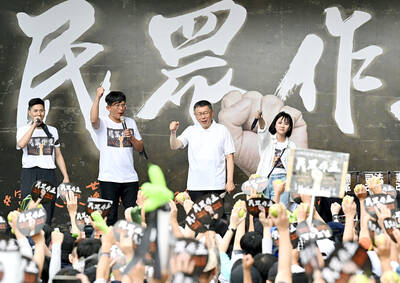
In the next few months tough decisions will need to be made by the Taiwan People’s Party (TPP) and their pan-blue allies in the Chinese Nationalist Party (KMT). It will reveal just how real their alliance is with actual power at stake. Party founder Ko Wen-je (柯文哲) faced these tough questions, which we explored in part one of this series, “Ko Wen-je, the KMT’s prickly ally,” (Aug. 16, page 12). Ko was open to cooperation, but on his terms. He openly fretted about being “swallowed up” by the KMT, and was keenly aware of the experience of the People’s First Party
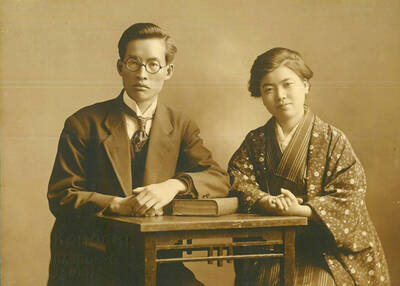
Aug. 25 to Aug. 31 Although Mr. Lin (林) had been married to his Japanese wife for a decade, their union was never legally recognized — and even their daughter was officially deemed illegitimate. During the first half of Japanese rule in Taiwan, only marriages between Japanese men and Taiwanese women were valid, unless the Taiwanese husband formally joined a Japanese household. In 1920, Lin took his frustrations directly to the Ministry of Home Affairs: “Since Japan took possession of Taiwan, we have obeyed the government’s directives and committed ourselves to breaking old Qing-era customs. Yet ... our marriages remain unrecognized,

Not long into Mistress Dispeller, a quietly jaw-dropping new documentary from director Elizabeth Lo, the film’s eponymous character lays out her thesis for ridding marriages of troublesome extra lovers. “When someone becomes a mistress,” she says, “it’s because they feel they don’t deserve complete love. She’s the one who needs our help the most.” Wang Zhenxi, a mistress dispeller based in north-central China’s Henan province, is one of a growing number of self-styled professionals who earn a living by intervening in people’s marriages — to “dispel” them of intruders. “I was looking for a love story set in China,” says Lo,

Standing on top of a small mountain, Kim Seung-ho gazes out over an expanse of paddy fields glowing in their autumn gold, the ripening grains swaying gently in the wind. In the distance, North Korea stretches beyond the horizon. “It’s so peaceful,” says the director of the DMZ Ecology Research Institute. “Over there, it used to be an artillery range, but since they stopped firing, the nature has become so beautiful.” The land before him is the demilitarized zone, or DMZ, a strip of land that runs across the Korean peninsula, dividing North and South Korea roughly along the 38th parallel north. This


 RSS
RSS