


Richard Wagner is among the greatest of Western opera composers, and his masterpiece has to be his four-opera cycle Der Ring des Nibelungen (The Ring of the Nibelungs). Of these, the second, Die Walkure (The Valkyrie) is the most instantly appealing. It’s therefore great news that the National Symphony Orchestra (NSO, 國家交響樂團) has selected it for a fully-staged production in Taipei’s National Theater next month.
The opera consists of three massive acts. Together, the work is so gigantic that two of Taipei’s three performances begin at 6pm. (The Sunday performance starts at 2.30pm but is sold out.)
Most of the opera’s characters are the offspring of Wotan, chief of the Norse gods. In Act One Siegmund, Wotan’s son, arrives exhausted in the house of his brutal brother-in-law Hunding.

Photo Courtesy of NTCH
Hunding swears to fight the visitor to the death the next morning, but Hunding’s wife Sieglinde falls in love with Siegmund, her long-lost brother, and promises to help him. She drugs Hunding, and then shows her brother a magic sword buried in a tree. Siegmund pulls it out with ease, then collapses on Sieglinde in a frenzy of incestuous adoration. Wagner’s apocalyptic music is more than equal to all of this, and Act One of Die Walkure is frequently cited as the high point of Romantic music in any form.
Put briefly, Acts Two and Three see Wotan order one of his other daughters, Brunnhilde, to give the victory to Hunding. Brunnhilde disobeys. As punishment, she is condemned to lose her inherited divinity, and be put to sleep on top of a mountain surrounded by a ring of fire, only to be awakened by a true hero.
This hero will be Siegfried, the offspring of Siegmund and Sieglinde and the subject of the third opera. As it is, Wagner’s “fire music” concludes Die Walkure.
What kind of production will Taiwan see? Director Hans-Peter Lehmann has been responsible for some quasi-abstract opera renditions, but his local set and costume designer, Tsai Hsiu-chin (蔡秀錦), may lead him to something more sumptuous if her production of Strauss’s Salome for the Taipei Symphony Orchestra in 2003 is anything to go by.
Wotan will be sung by Swedish bass-baritone Anders Lorentzon, a stalwart of Gothenburg Opera, while Brunnhilde will be Irmgard Vilsmaier, who is making her debut in the role in Die Walkure here in Taiwan, though she’s already sung the part in Gotterdammerung, the last of the four Ring operas.
Among the local singers, Wotan’s wife Fricka is Weng Jo-pei (翁若珮), who played Suzuki in NSO’s Madama Butterfly in Taipei last year. Sieglinde is Chen Mei-lin (陳美玲), who sang the same role in the semi-staged Ring in Taipei in 2006.
Material is available if you want to prepare in advance. There’s a truly excellent introduction to the Ring operas on YouTube — look for In the Eye of the Ring uploaded by “Ronbeadle.” For DVDs of Die Walkure, the 2010 version from Valencia, Spain, with spectacular visuals (C Major 700708, also available on Blu-ray) and the 1976 Boulez-Chereau production (Philips 070 402-9, with English and Chinese subtitles) are both outstanding.
The production will be sung in German with Chinese and German subtitles. Any of the Ring operas is a massive undertaking, and this Die Walkure is consequently not to be missed.


Taiwan’s English education system is being pulled apart by three opposing forces. Bilingual Nation 2030 pulls students toward English and global communication. Artificial Intelligence (AI) readiness pulls them toward digital judgment, verification and AI-mediated work. But Taiwan’s old exam culture pulls them back toward memorization, grammar drills, timed reading and correct answers. If the education system keeps using old exams to define success, it risks producing graduates who are neither genuinely bilingual nor genuinely AI-ready, but trained for tasks machines can already perform. The first force is Bilingual Nation 2030. Launched in 2018, the policy aimed to “help Taiwan’s workforce connect

“Taiwan’s Opposition Leader Comes to US With a Message Straight Out of Beijing” read a May 31 headline in the Wall Street Journal. Top US administration officials and members of Congress almost certainly read the WSJ, and if there was a bullet point takeaway that people in Washington should absorb ahead of Chinese Nationalist Party (KMT) Chair Cheng Li-wun’s (鄭麗文) arrival in DC on June 9, that headline is it. The last few columns have discussed this very topic, and the timing is not coincidental. While those top officials likely do not read the Taipei Times, judging by the number

With weighty, anxiety-inducing geopolitical topics dominating the headlines, checking in on the wild and weird state of local politics can take some of the edge off. This November’s elections will determine who will be in charge of fixing potholes in your neighborhood, not the potholes in Taiwan’s complicated geopolitical space. Recently, after an online interview with a Taipei-based journalist, I commented that Taipei journalists never go further than the MRT can take them. He laughed and agreed. Naturally, the Taipei mayoral race is eating up much of the press attention. TAIPEI CITY Democratic Progressive Party (DPP) candidate Puma Shen (沈伯洋) has
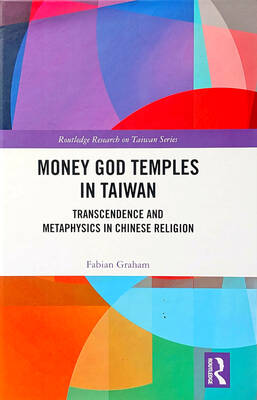
As someone who normally steers clear of books with “transcendence” or “metaphysics” in their subtitles, this reviewer — a casual observer of local belief systems since the 1990s — found Fabian Graham’s Money God Temples in Taiwan a challenging read. Those who’ve only dipped their toes into temple culture will likely need to parse several sections with special care if they’re to keep up with the author, a British ethnographic researcher whose previous books have investigated religious practices among ethnic Chinese in Southeast Asia. This scholarly volume examines a facet of Taiwan’s religious landscape that didn’t exist a century ago, and


 RSS
RSS