

If there were such a thing as a school of rock n’ roll and 88 Balaz (88顆芭樂籽) were enrolled, its members would come away with straight As. The band’s third album, More Handsome Than an Animal (比獸還帥) is a thoroughly satisfying romp full of punk angst, catchy chord changes and raunchy rock, all sung in Mandarin. Bandleader, guitarist and vocalist Lee Chi-ming (李奇明), better known as Ah-Chang (阿強), stands out in Taiwan’s indie rock community as one of its more talented and energetic live performers.
For 88 Balaz fans, More Handsome is more of the same, but better. This ten-track collection is the band’s best recording yet. It feels punchier, tighter and more balanced than their last venture, Man Is Worse Than an Animal When He Is an Animal (比獸還壞). That 2010 release offered plenty of verve and bravado, but the album felt a little bit stuck, as if the band were trying too hard to make every song sound like a rock n’ roll anthem.
More Handsome doesn’t fall short on infectious rock, to be sure, but this time around, the songs come across as more inspired and the lyrics feel like they have more depth. Attitude (態度) is a bread-and-butter blues-rock number that will speak to hardened musicians and rock n’ roll romantics, with its refrain “I’m 30 years old, I’ve got a rock band / My lover left me, I have no money in my pocket (三 十歲的我,有一個搖滾樂隊/愛人跑了,口袋裡沒有什麼錢).”

Then there are lines like this, which could be Ah-Chang offering a few slices of autobiography: “Always thought my lyrics were weird, Always thought my weird songs would fly / I sit in the park drinking and talking about big ideas with friends, then I go home and fight with Mom over what I’m going to do to get by (常常覺得自己寫的歌很怪 常常覺得很怪的歌很帥在公園和朋友喝酒暢談理念 回家和媽媽唬爛未來).
Indeed, Ah-Chang dishes up songs that have quirky and odd lyrics but make for great rock. Jimi and Mary is about a person whose top half is a man (Jimi, who plays drums) and bottom half is a woman (Mary, who plays guitar); its ska-punk interlude would make The Clash proud. The penultimate track, Eat Some Mushrooms to Become Big Mario sounds like a tongue-in-cheek recollection of a psychedelic experience, as well as a tribute to the video game Super Mario Brothers.
The brashness and bratty attitude of the album gets offset by more thoughtful tunes like the noisy ballad Flower’s Ear (花的耳朵), and a dubstep-flavored electronica track, a remix of Bad Temper Fish (脾氣不好的魚, from the previous album), which makes for a surprising but fitting finish.
— David Chen, Staff reporter
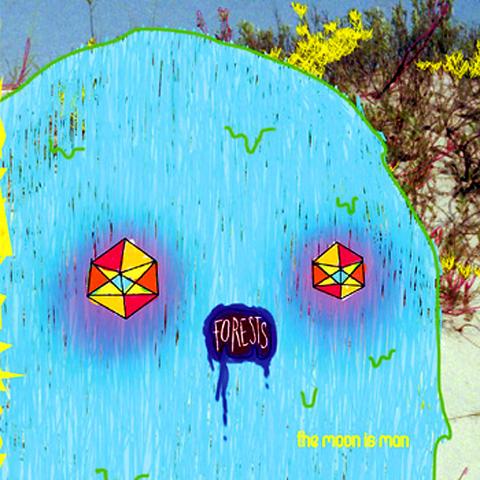
Forests (森林) is a point of pride in Taiwan’s indie rock scene. The trio opened up for Death Cab for Cutie in Taipei in March and left a strong impression on frontman Ben Gibbard, who wrote on his Twitter account that Forests was the “best thing I’ve seen in a long time.”
The praise is deserved, but it should be of no surprise to fans and followers of the band, whose members are behind some of the more interesting projects in Taiwan’s indie rock scene. Drummer Lo Zun-long (羅尊龍) and bassist Tseng Kuo-hung (曾國宏) have another trio, Sunset Rollercoaster (落日飛車), and along with guitarist and vocalist Jon Du (杜澤威), they were part of the brilliant but now-defunct Boyz & Girl.

The Moon Is Man, the band’s debut, contains all elements of the aforementioned groups. Forests’ sound is power-pop punk and noise rock at its core. All three band members sing, with Du leading most tracks, but a lot of the vocals on the album are obscured, intentionally, in reverb and distortion that sounds like it was produced from a cheap vintage radio microphone.
If you can get over such aloofness, then it will be easy to enjoy the album opener, Split Hate Ender, a screeching, vaguely spooky number with a driving pulse. Something Genius is a beautiful mess with menacing riffs and unfettered vocals. Du’s guitar playing alone makes these songs, and the album for that matter, worth a listen. The funky Little Minnow and noirish God as The Devil are great examples of how he skillfully makes guitar distortion sing.
The Moon Is Man, for all the noise and fuzz, is marked overall by a playful, upbeat spirit. The Fool, Bichii, and Why Where You are peppy, practically feel-good, numbers. These songs could be considered the flip-side of the eerie, nightmarish soundscapes the trio produced with Bambam Lin (林以樂) in Boyz & Girl. Lin (who now performs as Skip Skip Ben Ben) and her pip-squeaky voice might have been the perfect foil for Du, Lo and Tseng’s sonic musings. But as Forests, the “Boyz” sound like they are relishing in the freedom of letting loose.
— David Chen, Staff reporter
Mando-pop crooner Kenji Wu (吳克群) is that fascinating instance of an underappreciated singer/songwriter who metamorphosized into a charismatic heartthrob with through-the-roof sexual wattage.
The gifted songwriter was mostly known for penning hits for heavyweight starlets such as Fool (傻瓜) for Landy Wen (溫嵐) and The Wrong One (錯的人) for Elva Hsiao (蕭亞軒). After seven albums, Wu transformed himself into a sex symbol by baring his chiseled chests on the 2010 hit album Love Me, Hate Me (愛我 恨我) with exploding machismo.
On his latest outing How to Deal with Loneliness? (寂寞來了怎麼辦), he opts to put the clothes back on and repositions himself as a lady’s man who has played the field and comes to value the importance of a relationship.
The title track How to Deal with Loneliness? (寂寞來了怎麼辦) is a catchy ballad that establishes Wu as a modern man professing loneliness. The lead single Frolic (胡鬧) tackles the controversial subject of a womanizer who picks up drunk girls at bars for years and then comes to repent his past sins. Don’t Consume My Love (別消費我的愛情) is a dance number that sees Wu condemning one-night-stand and vouching for commitment.
Wu almost upstages the sophistication of Jolin Tsai’s (蔡依林) image evolution by jettisoning his songwriter geek origin to adopt a muscle-bound dreamboat look and then avows that he is a one woman man.
Image shaping machinations aside, the album stands as a pleasant please-all pop confection. Wu is a gifted singer/songwriter who knows how to show off his versatility by speedtracking through rock, electronica, folk, new age and nostalgic Chinese style within one album.
But this conceptually brilliant album sounds a little thin musically. There’s none of the poignant, riveting ballads Wu is acclaimed for in his earlier career. Let’s hope Wu can merge his new-found stardom and sex symbol charisma with his heart-tugging songwriting on his next outing.
— Andrew C.C. Huang, Contributing reporter

Sept. 28 to Oct. 4 Opening in 1971, Singapore’s Wisma Theatre (海燕歌劇院) was entirely modeled after Taiwanese live variety shows, combining singing, dancing and drama. Even its performers were recruited from Taiwan. The formula was an instant hit, selling out on the third night with the crowd fighting outside for tickets. Among its key figures was 31-year-old Chi Li-nan (紀利男), an acclaimed saxophonist and band leader who had entered Taiwan’s live entertainment scene at age 19 with zero musical training. Chi wasn’t even supposed to be there. He had accompanied his girlfriend, pop singer Shang Kuan Ping (上官萍), to negotiations with Wisma’s agent.

Apetition on the Web site of the National Development Council (NDC) arguing that non-citizens receiving National Health Insurance (NHI) should make up payments from their birth to their current age has reached 5,000 signatures last week, the threshold requiring a response. The comments under the petition are predictably odious, proving once again that the Venn diagram of racism and idiocy is a perfect circle. Also last week, the Ministry of the Interior proudly announced that the 400th “high-level professional” was approved for citizenship on Aug. 26. Four hundred carefully selected dual citizens! At that rate, sometime around the year 2600, Taiwan

The tussle between the Chinese Nationalist Party (KMT) and its pro-People’s Republic of China (PRC) allies and fellow travelers, and the pro-Taiwan side in politics is in part a struggle over defining the nation’s agency in international spaces. What kind of agency does Taiwan have? The United Daily News (UDN) recently reported that former National Security Council secretary-general and longtime KMT stalwart Su Chi (蘇起), popularizer of the fake “1992 consensus,” contended that the US was both unable and unwilling to protect Taiwan. He also asserted that the threat from the PRC was rising and that the future depended on the

Serving as interpreter during Culture Minister Li Yuan’s (李遠) visit to Britain offered an unusual view of cultural diplomacy — not as ceremony, but as a series of conversations capable of becoming lasting relationships. During four intensive days, from Sept. 6 to Sept. 9, the delegation moved between museums, arts centers, universities and literary organizations. The program ranged from urban planning and museum access to translation, illustration and contemporary dance. Yet one question connected these encounters: How can an initial meeting become a relationship that lasts? Li described himself as “greedy” about the possibilities. The word was characteristically humorous, but the ambition


 RSS
RSS