


How well should a historian write? That’s a complicated question, but it’s difficult to disagree with George Orwell, who thought that any exemplary book should not only be an intellectual but “also an aesthetic experience.”
Elaine Pagels, a professor of religion at Princeton University, possesses a calm, sane, supple voice. It’s among the reasons readers have stuck with her over a nearly four-decade career, often on hikes through arduous territory, like her commentary on ancient Christian works that were banned from the Bible. She’s America’s finest close reader of apocrypha.
Pagels is best known for The Gnostic Gospels (1979), which won a National Book Award and was named one of the best 100 English-language nonfiction books of the 20th century by the Modern Library. That book spawned a million biblical conspiracy theories, as well as The Da Vinci Code, Dan Brown’s hyperventilating novel. Few seem to hold that against her.

The cool authority of Pagels’ voice serves her almost too well in her new volume, Revelations: Visions, Prophecy, and Politics in the Book of Revelation. She surveys this most savage and peculiar book of the New Testament — an ancient text that is nonetheless, as novelist Will Self has put it, “the stuff of modern, psychotic nightmares” — as if she were touring the contents of an English garden. She’s as unruffled as the heroine of Buffy the Vampire Slayer, who declared in one of that excellent television show’s best episodes, “If the apocalypse comes, beep me.”
Her Revelations is a slim book that packs in dense layers of scholarship and meaning. The Book of Revelation, attributed by Pagels to John of Patmos, is the last book in the New Testament and the only one that’s apocalyptic rather than historical or morally prescriptive. It’s a sensorium of dreams and nightmares, of beasts and dragons. It contains prophecies of divine judgment upon the wicked and has terrified motel-room browsers of the Gideon Bible for decades.
Pagels places the book in the context of what she calls “wartime literature.” John had very likely witnessed the skirmishes in AD 66, when militant Jews, aflame with religious fervor, prepared to wage war against Rome for both its decadence and its occupation of Judea.
She deepens her assessment of the Book of Revelation by opening with a troubled personal note.
“I began this writing during a time of war,” she says, “when some who advocated war claimed to find its meaning in Revelation.”
Because he feared reprisals, John wrote this condemnation of Rome in florid code.
He “vividly evokes the horror of the Jewish war against Rome,” Pagels writes. “Just as the poet Marianne Moore says that poems are ‘imaginary gardens with real toads in them,’ John’s visions and monsters are meant to embody actual beings and events.” For example, most scholars now agree, she says, that the “number of the beast,” 666, spells out Emperor Nero’s imperial name.
The so-called Gnostic Gospels, the subject of Pagels’ breakthrough book, were discovered in 1945 at Nag Hammadi, in Upper Egypt. At that site scholars also found dozens of other previously unknown books of revelation. Among this volume’s central questions, then, is this one: How did John’s book of revelation become the only one included in the New Testament?
Pagels approaches this question from many angles but agrees with those scholars who have suggested that John’s revelations were less esoteric than many of the others, which were aimed at a spiritual elite. John was aiming at a broad public.
The others, she writes, “tend to prescribe arduous prayer, study and spiritual discipline, like Jewish mystical texts and esoteric Buddhist teachings, for those engaged in certain kinds of spiritual quest.”
What’s more, she writes, because John’s revelations end optimistically, in a new Jerusalem, not in total destruction, they speak not just to what we fear but also to “what we hope.”
John’s visions, throughout the centuries, have been applicable to almost every conflict or fit of us-against-the-world madness. Charles Manson read the Book of Revelation before his followers’ rampages; Hitler apparently read himself into the narrative as a holy redeemer, while the rest of the civilized world saw him as the book’s beast.
For a work that contemplates a hell made on Earth, Pagels’ book rarely produces much heat of its own. It drifts above the issues like an intellectual satellite.
One of her great gifts is much in abundance, however: her ability to ask, and answer, the plainest questions about her material without speaking down to her audience. She often pauses to ask things like, “Who wrote this book?” and “What is revelation?” and “What could these nightmare visions mean?” She must be a fiendishly good lecturer.
The Book of Revelation is not prized as being among the best-written sections of that literary anthology known as the New Testament, but Pagels is alive to how its language has percolated through history and literature. Jesus, who appears on a white horse to lead armies of angels into war, will “tread the winepress of the fury of the wrath of God,” John wrote.
This image emerges again in The Battle Hymn of the Republic, the Union’s anthem during the Civil War: “Mine eyes have seen the glory of the coming of the Lord;/He is trampling out the vintage where the grapes of wrath are stored.”
John’s book has caused great mischief in the world, Pagels suggests, but it is a volume that can be clasped for many purposes. It has given comfort to the downtrodden, yesterday and today.
John, Pagels writes, “wants to speak to the urgent question that people have asked throughout human history, wherever they first imagined divine justice: How long will evil prevail, and when will justice be done?”
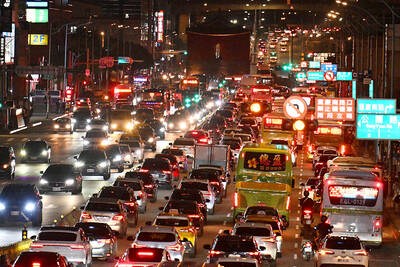
By global standards, the traffic congestion that afflicts Taiwan’s urban areas isn’t horrific. But nor is it something the country can be proud of. According to TomTom, a Dutch developer of location and navigation technologies, last year Taiwan was the sixth most congested country in Asia. Of the 492 towns and cities included in its rankings last year, Taipei was the 74th most congested. Taoyuan ranked 105th, while Hsinchu County (121st), Taichung (142nd), Tainan (173rd), New Taipei City (227th), Kaohsiung (241st) and Keelung (302nd) also featured on the list. Four Japanese cities have slower traffic than Taipei. (Seoul, which has some
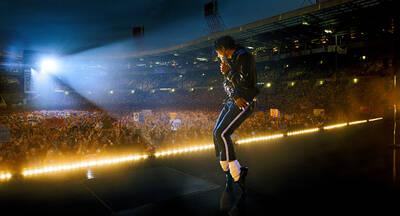
Michael slides a sequin glove over the pop star’s tarnished legacy, shrouding Michael Jackson’s complications with a conventional biopic that, if you cover your ears, sounds great. Antoine Fuqua’s movie is sanctioned by Jackson’s estate and its producers include the estate’s executors. So it is, by its nature, a narrow, authorized perspective on Jackson. The film ends before the flood of allegations of sexual abuse of children, or Jackson’s own acknowledgment of sleeping alongside kids. Jackson and his estate have long maintained his innocence. In his only criminal trial, in 2005, Jackson was acquitted. Michael doesn’t even subtly nod to these facts.
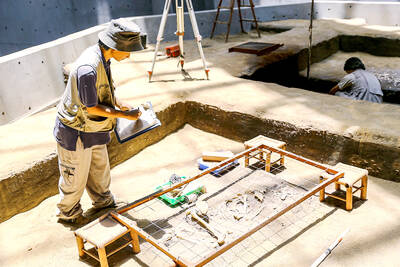
Writing of the finds at the ancient iron-working site of Shihsanhang (十 三行) in New Taipei City’s Bali District (八里), archaeologist Tsang Cheng-hwa (臧振華) of the Academia Sinica’s Institute of History and Philology observes: “One bronze bowl gilded with gold, together with copper coins and fragments of Tang and Song ceramics, were also found. These provide evidence for early contact between Taiwan aborigines and Chinese.” The Shihsanhang Web site from the Ministry of Culture says of the finds: “They were evidence that the residents of the area had a close trading relation with Chinese civilians, as the coins can be

The January 2028 presidential election is already stirring to life. In seven or eight months, the primary season will kick into high gear following this November’s local elections. By this point next year, we will likely know the Democratic Progressive Party (DPP) candidate and whether the Taiwan People’s Party (TPP) will be fielding a candidate. Also around this time, the Chinese Nationalist Party (KMT) will either have already completed their primary, or it will be heading into the final stretch. By next summer, the presidential race will be in high gear. The big question is who will be the KMT’s


 RSS
RSS