


When Steven Spielberg, Ron Howard and Brian Grazer heard about the graphic novel Cowboys and Aliens, the three — all producers of the new big-screen adaptation — wondered why the mashup hadn’t been attempted by someone earlier.
Well, maybe because the conflation of the western and the alien-invasion flick sounds more absurd than shattering. Having aliens invade the unruly, law-bending west seems at best campy. Or is it desperate?
My young partners in viewing — Vincent, 12, and Patrick, 14 — entered the screening divided. Vincent was certain he was attending a train wreck. Patrick was hopeful. It turned out to be one of the summer’s most romping adventures.
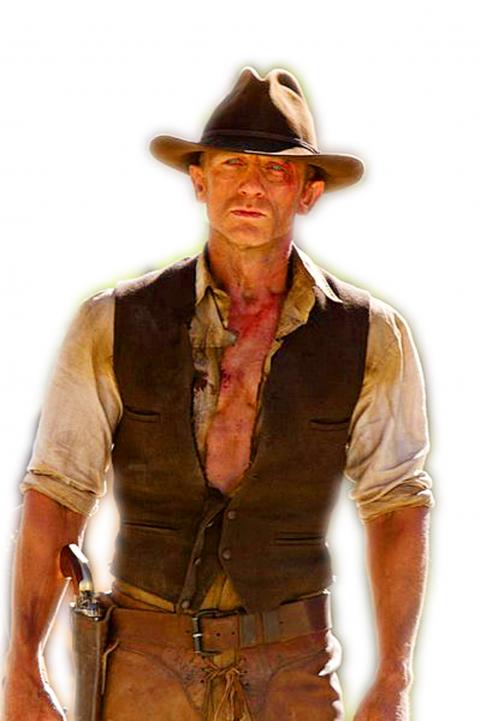
Cowboys & Aliens delivers many of the themes of the western: the mysterious hero of few words, the upstanding but hard-pressed sheriff, the arrogant land baron, the good if toughened woman, the lethal Apache warrior and so on. The film puts these folk at odds with one another, then challenges them to unite and rise to a greater purpose when aliens enter the picture and take their loved ones. Call it alien abduction by high-tech lasso.
Jon Favreau continues to hone his gift for directing popular entertainments made so apparent in Iron Man. Unlike that Robert Downey Jr-dominated ride, this film is a surprisingly wink-free outing. Favreau takes the western seriously. And the alien-invasion aspects of the movie aren’t overblown.
The film unfolds with a rather old-fashioned and much-appreciated sense of story-setting purpose. There is no hurried overture of explosive action, the sort of introduction that has become far too commonplace.
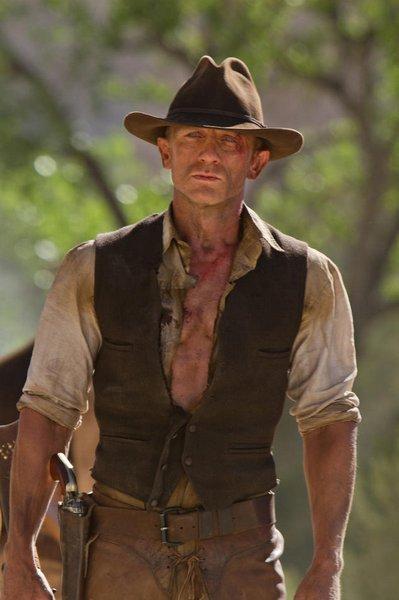
Photo Courtesy of UIP
Instead, a man, portrayed by Daniel Craig, awakens amid dusty scrub and sage. He wears an unusual shackle on his wrist he can’t remove.
Though he can’t recall who he is, others in the town of Absolution (part of the New Mexico Territory) recognize the craggy, laconic stranger. Among them: Sheriff Taggart (Keith Carradine) and Civil War veteran Colonel Woodrow Dolarhyde (Harrison Ford).
A wanted poster spells out the stranger’s identity for the rest of us: Jake Lonergan, “Scourge of the Territories.”
Cowboys & Aliens has the good fortune to have Craig in the role of Lonergan. He brings a gravitas to the role that anchors the whole enterprise. His imperturbable face is weather-worn granite.
Displaying the skill set of a certain British agent nearly a century in the future, Lonergan dispatches a gang of lowlifes with a remarkable efficiency.
Though Craig plays the archetypal loner, the actor is not by himself in giving the film its flinty, fun character.
Embittered town honcho Dolarhyde has a simpering, bullying son named Percy (Paul Dano) and an Indian right-hand man more loyal than blood, portrayed by Adam Beach.
A slim, wide-eyed beauty with a holster hanging over her print dress shadows Lonergan. Played by Olivia Wilde, Ella is enveloped in the same mystery he is.
Clancy Brown gives a fine turn as Meacham, the town’s clergyman. He’s also blessed with some of the film’s better lines. “I’ve seen good men do bad things and bad men do good,” he tells the stranger as he stitches up an unusual wound. It’s not the most profound homily, but there’s some nice truth in it just the same.
Later, when saloon owner Doc (Sam Rockwell) admits to doubts in God, Meacham tells him, “You got to earn his presence, recognize it and act on it.” It’s a graceful bit of dialogue in a movie that moves with steady power but not a lot of cowboy poetry.
Penned by a handful of guys with credentials both impressive (Lost and Star Trek) and suspect (Transformers: Revenge of the Fallen), the screenplay isn’t particularly ambitious.
Cowboys & Aliens is no genre game changer. It is, however, something summer can always use more of: a well-reined blast of smartly crafted fun.
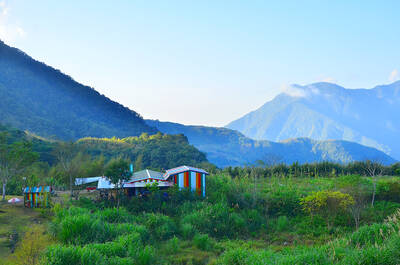
If one asks Taiwanese why house prices are so high or why the nation is so built up or why certain policies cannot be carried out, one common answer is that “Taiwan is too small.” This is actually true, though not in the way people think. The National Property Administration (NPA), responsible for tracking and managing the government’s real estate assets, maintains statistics on how much land the government owns. As of the end of last year, land for official use constituted 293,655 hectares, for public use 1,732,513 hectares, for non-public use 216,972 hectares and for state enterprises 34 hectares, yielding

The small platform at Duoliang Train Station in Taitung County’s Taimali Township (太麻里) served villagers from 1992 to 2006, but was eventually shut down due to lack of use. Just 10 years later, the abandoned train station had become widely known as the most beautiful station in Taiwan, and visitors were so frequent that the village had to start restricting traffic. Nowadays, Duoliang Village (多良) is known as a bit of a tourist trap, with a mandatory, albeit modest, admission fee of NT$10 giving access to a crowded lane of vendors with a mediocre view of the ocean and the trains

For many people, Bilingual Nation 2030 begins and ends in the classroom. Since the policy was launched in 2018, the debate has centered on students, teachers and the pressure placed on schools. Yet the policy was never solely about English education. The government’s official plan also calls for bilingualization in Taiwan’s government services, laws and regulations, and living environment. The goal is to make Taiwan more inclusive and accessible to international enterprises and talent and better prepared for global economic and trade conditions. After eight years, that grand vision is due for a pulse check. RULES THAT CAN BE READ For Harper Chen (陳虹宇), an adviser

Traditionally, indigenous people in Taiwan’s mountains practice swidden cultivation, or “slash and burn” agriculture, a practice common in human history. According to a 2016 research article in the International Journal of Environmental Sustainability, among the Atayal people, this began with a search for suitable forested slopeland. The trees are burnt for fertilizer and the land cleared of stones. The stones and wood are then piled up to make fences, while both dead and standing trees are retained on the plot. The fences are used to grow climbing crops like squash and beans. The plot itself supports farming for three years.


 RSS
RSS