


Spore, released in 2008, was the most over-hyped game in recent memory. Through years of prerelease publicity-mongering, the game’s publisher, Electronic Arts, and its famed designer, Will Wright, managed to convince much of the general public and the gaming world that they had created an “everything simulator.”
Here, the story went, was a game that would capture and reflect the grand sweep of evolution, from cells drifting in the primordial soup all the way to the colonization of the galaxy. Given Wright’s stupendous track record with SimCity and The Sims, lots of folks bought it (the story, that is).
But when Spore finally appeared, the bald truth was that there just wasn’t very much game in the game. It was more akin to a novelty toy: momentarily interesting and vaguely provocative but lacking the challenge and structure required to keep an adult interested for long. You could create all these weird creatures, but there just wasn’t very much to do with them.
Spore never found mass popularity. In 2009 Wright left Electronic Arts, even as it tried to rescue the franchise with an inadequate add-on called Galactic Adventures. I thought that was the last we’d hear of this ambitious yet flawed property.
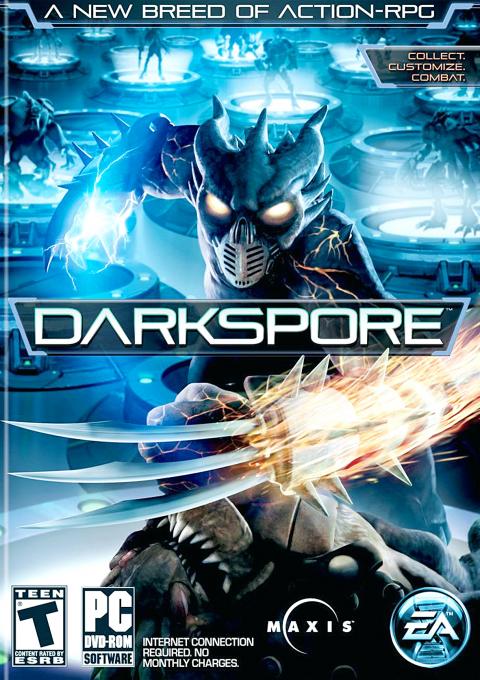
To my pleasant surprise, I was wrong. It has taken three years longer than it should have, but Electronic Arts has finally come up with an enjoyable real game under the Spore umbrella, called Darkspore. Released recently for Windows PCs, Darkspore is an online action-role-playing game that, while hardly groundbreaking, is at least reliably diverting.
The entire action-role-playing genre is about letting players pop on the computer for 20 minutes and make their virtual heroes just a little more powerful by romping through some sort of dungeon without a lot of strategizing and heavy intellectual lifting. You point and click and wipe out a few hundred monsters in swashbuckling style and then count the loot. Rinse and repeat.
In a great game of this sort, that rinsing and repeating might end only when you realize the sun is coming up. Darkspore is not that gripping (which for some people might be a good thing). But for the moment it is probably the best action-role-playing game out there.
The problem for Darkspore is that the moment may not last very long. Most daunting, it seems possible that Blizzard Entertainment, the king of online computer games, could release the long-awaited Diablo III this holiday season. Moreover, some of the original creators of Diablo, who have left Blizzard and created their own company, Runic Games, are expected to release their own action-role-playing-game, Torchlight II, as soon as this summer.
So Darkspore will soon be hard put to compete for the hearts and leisure hours of players who like this sort of thing. But on its own merits it is a solid effort. It will certainly stay on my hard drive, and I’m sure I’ll keep playing it from time to time.
Unlike most action-role-playing games, which are set in medieval fantasy worlds, Darkspore is nominally science fiction set in outer space. Of course bad guys are trying to take over the universe, and you have to stop them. There is more than a bit of Pokemon in Darkspore in that there are 100 different hero characters you can unlock over the course of the game, each with its own special abilities.
From your personal menagerie you assemble teams of three creatures. You control only one hero at a time, while the other two are “off the board.” But if, say, your quick, slashing guy is low on health, you can swap out tag-team-style for, say, a big, slow tank character (or a long-range “magic” character or whatever else).
As in all games of this sort, the key to the playing is randomization. Every time you enter a battlefield, the foes will be a bit different, and, more important, the treasure they drop after they are defeated is random. The landscapes and characters look great, and the online networking has worked very well (which is to say, reliably).
But there’s plenty that holds this game back as well. The interface between missions is confusing and poorly designed. The story is irrelevant. Much more devastating, you can’t trade items among players, so there is no economy. Your buddy might find an incredible weapon for your favorite hero, but you can’t exchange it, which is, to put it mildly, bogus.
The overall game progression also seems slightly imbalanced. If you just plug along, doing each level once, you will find that the levels eventually become too hard for you. So you may have to go back and “grind,” repeating levels you’ve already completed, to gain enough power to resume your progression through the various worlds. That can be frustrating.
But for all its faults, Darkspore is by far the best game to come out of the Spore property. After all the hype, the franchise has finally delivered a real game worth playing.

It is a soulful folk song, filled with feeling and history: A love-stricken young man tells God about his hopes and dreams of happiness. Generations of Uighurs, the Turkic ethnic minority in China’s Xinjiang region, have played it at parties and weddings. But today, if they download it, play it or share it online, they risk ending up in prison. Besh pede, a popular Uighur folk ballad, is among dozens of Uighur-language songs that have been deemed “problematic” by Xinjiang authorities, according to a recording of a meeting held by police and other local officials in the historic city of Kashgar in

The Directorate-General of Budget, Accounting and Statistics (DGBAS) told legislators last week that because the Chinese Nationalist Party (KMT) and Taiwan People’s Party (TPP) are continuing to block next year’s budget from passing, the nation could lose 1.5 percent of its GDP growth next year. According to the DGBAS report, officials presented to the legislature, the 2026 budget proposal includes NT$299.2 billion in funding for new projects and funding increases for various government functions. This funding only becomes available when the legislature approves it. The DGBAS estimates that every NT$10 billion in government money not spent shaves 0.05 percent off

Dec. 29 to Jan. 4 Like the Taoist Baode Temple (保德宮) featured in last week’s column, there’s little at first glance to suggest that Taipei’s Independence Presbyterian Church in Xinbeitou (自立長老會新北投教會) has Indigenous roots. One hint is a small sign on the facade reading “Ketagalan Presbyterian Mission Association” — Ketagalan being an collective term for the Pingpu (plains Indigenous) groups who once inhabited much of northern Taiwan. Inside, a display on the back wall introduces the congregation’s founder Pan Shui-tu (潘水土), a member of the Pingpu settlement of Kipatauw, and provides information about the Ketagalan and their early involvement with Christianity. Most

The People’s Republic of China (PRC) was out in force in the Taiwan Strait this week, threatening Taiwan with live-fire exercises, aircraft incursions and tedious claims to ownership. The reaction to the PRC’s blockade and decapitation strike exercises offer numerous lessons, if only we are willing to be taught. Reading the commentary on PRC behavior is like reading Bible interpretation across a range of Christian denominations: the text is recast to mean what the interpreter wants it to mean. Many PRC believers contended that the drills, obviously scheduled in advance, were aimed at the recent arms offer to Taiwan by the


 RSS
RSS