


All About Love
Girl-on-girl romance that sees respected director Ann Hui (許鞍華) squander her talent with a by-the-numbers attempt at a shocker that pairs Sandra Ng (吳君如) with Vivian Chow (周慧敏) as long separated lovers who, after toying with heterosexual love, or at least sex, discover that what they really long for is each other. The film’s feminist agenda is handled without subtlety and its attempts at humor fall flat.
Strike Out (三振)
Taiwanese baseball melodrama that packs more testosterone than game play. Strike Out presents the usual array of pop idols, with boys pretending to be tough and girls attempting to be innocent, and the whole shebang coming off like a cheap television soap opera. And the story, of course, is all about love. The film’s theme tune was composed by Yao Yuan-hao (姚元浩, aka How Yao), who also stars alongside a minor league lineup of aspiring talents.
Don Quixote (魔俠傳之唐吉可德)
One of two films opening this week inspired by Cervantes’ tale of a misguided knight and his sidekick Sancho Panza. This version, directed by Ah Gan (阿甘), has the story transplanted to Tang Dynasty China and presented in 3D. The main selling point of this film seems to be its big budget and the presence of Karena Lam (林嘉欣) in her first period costume drama role. She serves as the film’s Dulcinea. Don Quixote seems squarely aimed at China’s domestic market and is unlikely to be worthy of attention for anybody else.
Donkey Xote
Originally scheduled for release in September, this 2007 Spanish animation, now dubbed into English, has finally reached these shores. This is an unashamed rip-off of the Shrek series — though based on the Cervantes novel — with a trailer that announces that this film is “from the producers who saw Shrek,” a joking reference to its stylistic plagiarism of that successful franchise. Even the Donkey of the title is a bit too familiar.
Skyline
Aliens are back, and once again their intentions aren’t the best. In Skyline, simply looking at the massive alien spacecraft looming on the horizon is enough to get you sucked up into the stratosphere. The film, which takes ideas and images from War of the Worlds and Independence Day, among others, isn’t original, but there are plenty of special effects. Directed by effects specialists the Brothers Strause, who brought us the universally panned AVPR: Aliens vs Predator: Requiem (2007).
Two in the Wave (Deux de la Vague)
French documentary about the tempestuous friendship between Jean-Luc Godard and Francois Truffaut. Born within two years of each other, the two grew up to be leaders of French New Wave cinema, made some of the most enduring classics of that movement, and subsequently saw their friendship tested by the political upheavals of 1968. Features archive footage of many of the great and good of French cinema including Charles Aznavour, Jean-Paul Belmondo, Jacqueline Bisset, Jean Cocteau, Anna Karina and others.
Where Got Ghost (嚇到笑)
From the Singaporean director Loeng Zi Koeng (梁智強), who brought as the two Money Not Enough (錢不夠用) films that send up the city-state’s materialistic culture. Loeng’s latest effort, Where Got Ghost, which adds traditional Chinese ghost story elements to the mix, was made from three shorts. The humor is broad and somewhat labored, and there are more laughs than gasps.
Bleach: The DiamondDust Rebellion
Bleach: The DiamondDust Rebellion is the second movie in the Bleach manga-based anime series. Set in a futuristic samurai world in which a young man with the powers of a “death god” has to protect humans from a variety of powerful enemies, this is hectic, violent anime, with lots of big video-game style battles and bizarrely kitted out warriors.
The 2010 Golden Horse Film Festival (2010台北金馬影展)
The country’s largest film festival, which this year boasts a bulging lineup of feature, documentary, animation, short and experimental films divided into 10 categories and 31 sub-categories, is now in its third, and last, week. Cannes-winning director Apichatpong Weerasethakul from Thailand and Bruce Davis, who has served as the executive director of The Academy of Motion Picture Arts and Sciences for more than 20 years, will attend forums next week. The week ahead is dedicated to a retrospective on Eric Rohmer. The program includes the French auteur’s two early series, Six Moral Tales and Comedies and Proverbs, as well as his feature debut The Sign of Leo (1959).
Festival films are being shown on six screens at three movie theaters: Shin Kong Cineplex (新光影城), 36 Xining S Rd, Taipei City (台北市西寧南路36號), Ambassador Theatre (國賓影城) at Breeze Center (微風廣場), 7F, 39, Fuxing S Rd Sec 1, Taipei City (台北市復興南路一段39號7樓) and Ambassador Theatre (國賓影城) at Spring Center (長春廣場), 176 Changchun Rd, Taipei City (台北市長春路176號).
Tickets cost NT$230 per screening (NT$200 for students with ID and people with disabilities), available through 7-Eleven ibon kiosks. For more information, visit the festival’s bilingual Web site at www.goldenhorse.org.tw.


Taiwan’s English education system is being pulled apart by three opposing forces. Bilingual Nation 2030 pulls students toward English and global communication. Artificial Intelligence (AI) readiness pulls them toward digital judgment, verification and AI-mediated work. But Taiwan’s old exam culture pulls them back toward memorization, grammar drills, timed reading and correct answers. If the education system keeps using old exams to define success, it risks producing graduates who are neither genuinely bilingual nor genuinely AI-ready, but trained for tasks machines can already perform. The first force is Bilingual Nation 2030. Launched in 2018, the policy aimed to “help Taiwan’s workforce connect

“Taiwan’s Opposition Leader Comes to US With a Message Straight Out of Beijing” read a May 31 headline in the Wall Street Journal. Top US administration officials and members of Congress almost certainly read the WSJ, and if there was a bullet point takeaway that people in Washington should absorb ahead of Chinese Nationalist Party (KMT) Chair Cheng Li-wun’s (鄭麗文) arrival in DC on June 9, that headline is it. The last few columns have discussed this very topic, and the timing is not coincidental. While those top officials likely do not read the Taipei Times, judging by the number

With weighty, anxiety-inducing geopolitical topics dominating the headlines, checking in on the wild and weird state of local politics can take some of the edge off. This November’s elections will determine who will be in charge of fixing potholes in your neighborhood, not the potholes in Taiwan’s complicated geopolitical space. Recently, after an online interview with a Taipei-based journalist, I commented that Taipei journalists never go further than the MRT can take them. He laughed and agreed. Naturally, the Taipei mayoral race is eating up much of the press attention. TAIPEI CITY Democratic Progressive Party (DPP) candidate Puma Shen (沈伯洋) has
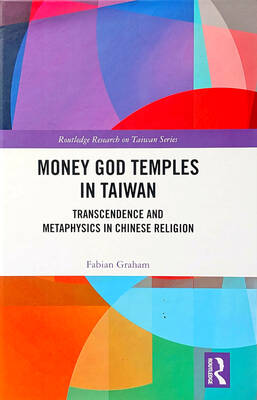
As someone who normally steers clear of books with “transcendence” or “metaphysics” in their subtitles, this reviewer — a casual observer of local belief systems since the 1990s — found Fabian Graham’s Money God Temples in Taiwan a challenging read. Those who’ve only dipped their toes into temple culture will likely need to parse several sections with special care if they’re to keep up with the author, a British ethnographic researcher whose previous books have investigated religious practices among ethnic Chinese in Southeast Asia. This scholarly volume examines a facet of Taiwan’s religious landscape that didn’t exist a century ago, and


 RSS
RSS