


Their bare-chested bodies painted in rich red, Himba women sing and dance in villages untouched by modernity since their ancestors settled on the Angola-Namibia border 200 years ago.
Then the cameras click, and a European tourist in a floral print joins the circle of dancers, while her fellow travelers from an air-conditioned tour bus browse beaded jewelry for sale among the cone-shaped huts made of wood, mud and cattle dung.
The Himbas number fewer than 30,000, their communities straddling the remote border region where they have survived colonialism, wars and droughts with their ancient traditions intact.

photo: AFP
Now they’re earning bits of money by opening their communities for tourism, in the process changing the dynamics of the culture on display for visiting foreigners.
“Tourists, which mostly come from Europe, want to see people on their own, see how they do their ochre color and cook,” said Himba guide Matirepo Tjiras.
“The problem is that these visits disturb the village life,” he said. “Women stop what they’re doing to come and sell handcrafts.”
Children skip school to beg for sweets when they see tour buses arrive, he added.
Other Namibians scorn the Himba for maintaining their traditional ways, seen as backward in an age of ever-encroaching supermarkets and cellphones.
But tourists are fascinated by the Himba traditional way of life, and during winter months foreigners arrive daily in the village of Ohungumure to peek into their huts and marvel at their semi-nomadic lives.
“The problem is not with the tourists but with us. We have to organize ourselves,” said Kakarandua Mutambo, a local Red Cross official who founded an orphanage in nearby Opuwo.
“People are not thinking of developing any infrastructure for the community.”
Tourism has brought some development — it’s the country’s third-largest industry, with nearly one million visitors a year.
“Tourists want to get to know our culture,” said 19-year-old Veuzuvamuani, as her baby suckled below the large shell on her necklace. “They bring us things to eat, buy necklaces and pay to take a photo.”
That money allows her to visit her mother in hospital, buy blankets or maize meal to cook their staple porridge, she said.
Namibia has created a dozen “protected zones” in this region, and plans another for the nearby town of Opuwo. About 15 percent of Namibia’s land falls under these zones first created in 1995 to grant local communities the right to exploit natural resources.
The money is then managed by the community and can be used to repair wells or build schools, according to the environment ministry.
But many local chiefs don’t like to share the earnings with mor distant communities.
“We met to build a well, but no one wanted to share their money,” said one family leader, Tuaseuapi Mbinge.
Other efforts aiming to spread the gains from tourism to more people include a plan by the Franco-Namibian association to raise funds for a cultural center near Opuwo.
But one manager at a nearby hotel wants to stop visits to the village completely.
“I will prefer not to do the Himba tour,” said Andrew Lesch, saying that if the visits stopped, it would “help them to become more independent.”

It seems every few days one bumps into one of those “real man” comments in which Taiwan is urged to “face reality” or similar, and “make a deal,” with the speaker implying that soon it will be too late. “Deal” advocates always present themselves as having a superior grip on reality, and the manly ability to make the “hard choice.” Their testosterone-laden language often echoes that of Taiwan sellout advocates. Note that such commentary always specifies a process (“make a deal, work with, make progress”), never the end state of what occupation by a violent authoritarian colonialist state will entail. In

There are shadowy cabals plotting to sell out Taiwan to be annexed by China, by invasion if necessary. Fortunately, they are buffoons. In 2019, former Bamboo Union gangster and founder of the China Unification Promotion Party (CUPP), Chang An-le (張安樂, colorfully known as “White Wolf”), led a protest at the Legislative Yuan against comments made by then-premier Su Tseng-chang (蘇貞昌) that in the event of an attack by China, he would never surrender, but would protect the nation by fighting to the end, even if he only had a broom. Chang had party members bring a wooden casket that they
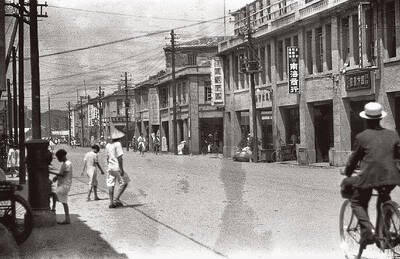
June 1 to June 7 "If all Taiwanese were as afraid of dying as you, then what would happen?” Physician Shih Chiang-nan (施江南) reportedly said this to his wife Chen Chiao-tung (陳焦桐) after she urged him to stop intervening on behalf of Taiwanese soldiers stranded overseas after serving in the Japanese Army during World War II. Shih had clashed with high-ranking officials over the issue, engaged in several heated arguments with Taiwan governor-general Chen Yi (陳儀) and allegedly shouted at general Ko Yuan-fen (柯遠芬), chief of staff of the Taiwan Garrison Command, over

Food prices have often played a major role in Taiwan’s history. The first major wave of migration from China occurred in 1628. A moderate drought, the Ming Dynasty maritime ban that prohibited fishing and trading (intended to reduce piracy) and a temporary tax, conspired to exhaust local resources, leading to famine in Fujian Province. The famed pirate and trader Zheng Zhilong (鄭芝龍), scooped up starving people from Fujian and transported them across the Taiwan Strait, where they settled under the Dutch. Two factors enabled Zheng. First, by 1624 he had settlements around today’s Beigang (北港) in Yunlin County with a small


 RSS
RSS