


VIEW THIS PAGE In 1974 Tehching Hsieh (謝德慶), a young Taiwanese performance artist working as a seaman, walked down the gangplank of an oil tanker docked in the Delaware River and slipped into the US. His destination: Manhattan, center of the art world.
Once there, though, Hsieh found himself ensnared in the benumbing life of an illegal immigrant. With the downtown art scene vibrating around him, he eked out a living at Chinese restaurants and construction jobs, feeling alien, alienated and creatively barren until it came to him: He could turn his isolation into art. Inside an unfinished loft, he could build himself a beautiful cage, shave his head, stencil his name onto a uniform and lock himself away for a year.
Thirty years later Hsieh’s Cage Piece is on display at the Museum of Modern Art as the inaugural installation in a series on performance art. But formal recognition of Hsieh, who is now a 58-year-old US citizen with spiky salt-and-pepper hair, has been a long time coming.
For decades he was almost an urban legend, his harrowing performances — the year he punched a time clock hourly, the year he lived on the streets, the year he spent tethered by a rope to a female artist — kept alive by talk.
The talk was cultish, flecked with reverence for the conceptual purity and physical extremity of Hsieh’s performances in the late 1970s and early 1980s. But he himself seemed to have vanished. “Tehching was a bit like a myth,” said Klaus Biesenbach, chief curator of MoMA’s department of media.
All along, however, Hsieh was invisible in plain sight, meticulously archiving his artistic portfolio as he went about the business of “dealing with life,” as he put it.
For 14 years, until he received amnesty in 1988, his immigration status, or lack of status, had informed his art, but it also made him an outsider, enduringly. His work was rarely collected, displayed or studied, and he eventually quit making art entirely.
“My work is kind of unknown, and I am not an artist anymore,” he said in his thickly accented English, which is fluent but limited, often making him sound terse.
Sipping green tea in his minimally furnished loft above a 99-Cent Plus shop in Clinton Hill, Brooklyn, Hsieh pushed across his kitchen table a history of performance art that mentions him only in a sentence. “I don’t want to say it was race,” he said, noting that he has long been reticent to promote his work.
But Alexandra Munroe, senior curator of Asian art at the Solomon R. Guggenheim Museum, had no such compunctions, given what she described as a historical disregard for nonwhite artists in the avant-garde. “Why was Tehching left out?” she said. “Because he was Chinese.”
This winter, owing to renewed interest in performance art, new passion for contemporary Chinese art and the coinciding interests of several curators, Hsieh’s moment of recognition has arrived from many directions at once.
The one-man show at MoMA runs through May 18. The Guggenheim is featuring his time-clock piece in The Third Mind: American Artists Contemplate Asia, 1860-1989 through April 19. MIT Press is about to release Out of Now, a large-format book devoted to his “lifeworks.” And United States Artists, an advocacy organization, has awarded Hsieh US$50,000, his first grant.
The roots of Hsieh’s lifelong questioning lie in southern Taiwan, where his little-known artistic odyssey began. There he grew up one of 15 children of an authoritarian father with five wives. But he was doted on by his mother.
“We were not really a poor family,” he said during a long interview, at the end of which he was joined by his radiantly serene wife, Qinqin Li, an elementary school art teacher who emigrated from Beijing after meeting Hsieh there in 2001. Li is, Hsieh noted, 24 years his junior and his third wife.
In Taiwan Hsieh’s father, who ran a small trucking company, did not consider art a practical profession. Nonetheless Hsieh studied with a private painting teacher throughout his childhood, until in 1967 he dropped out of high school to devote himself to art. Taiwan in that era was relatively cosmopolitan. Hsieh wore his hair long, listened to rock ’n’ roll and read Nietzsche, Kafka and Dostoyevsky.
Next, three years of compulsory military service exposed Hsieh to the kind of rigor and regimentation that later governed his performance pieces.
When he left the army, he had his first solo show, but he had already become more interested in the act of painting than in the product. One of his final paintings, Paint — Red Repetitions, was executed in four minutes when he swirled a circle of red on each page of a sketchbook. “I became empty,” he said. “I just moved my hand.”
After that Hsieh sought new ways to express himself, ultimately buying a Super 8 camera and training it on his new medium: himself.
Though he had not yet learned of Yves Klein or seen Leap Into the Void, the 1960 photomontage that purported to show that French artist swan-diving off a rooftop, he tried a version of it for real in 1973. He recorded himself jumping from a second-story window to the sidewalk — and breaking both his ankles.
Biesenbach said he believed Jump Piece to be brilliant, an early indicator of Hsieh’s willingness to give his life to art. But Hsieh now considers it immature, an unfortunate harbinger of future self-destructive pieces, like Half-Ton, in which he let himself be crushed beneath Sheetrock, or Throw Up, in which he ate fried rice until he vomited.
While he was recovering from his jump, Hsieh set his sights on leaving Taiwan, deciding to train as a merchant mariner so that he could emigrate by ship. In 1974 he boarded the oil tanker that gradually made its way to the US. Hsieh jumped ship near Philadelphia. He hailed a taxi and paid the driver US$150 to take him to New York City.
During his first long winter in New York the elation faded. Hsieh shared a compatriot’s unheated apartment and fell into the menial work that would sap his creative energy for four years, until he conceived of Cage Piece. Back in Taiwan Hsieh’s mother, who was baffled by his art, helped support that project with US$10,000 and one condition: “Don’t be a criminal.”
In the fall of 1978 Hsieh, then 28, constructed his cell-like cage of pine dowels inside a loft in Tribeca. He furnished it with a cot, a sink and a bucket. Before he shut himself inside, he issued a terse manifesto, typed on white paper: “I shall NOT converse, read, write, listen to the radio or watch television until I unseal myself on September 29, 1979.”
Hsieh’s loft mate, Cheng Wei Kuong, who had studied with the same painting teacher in Taiwan, brought his food and removed his waste. After weeks of beef and broccoli, Hsieh said, he wordlessly threw one meal to the floor when it was delivered; later he felt bad about that.
Each day Hsieh scratched a line in the wall with his fingernail, which made 365 hatch marks at the end. Each day, with his hair infinitesimally longer, he stood on his traced footprints to be photographed.
After Hsieh emerged, people seemed “like wolves,” he said. At first he retreated to the cage to feel safe. Eventually he packed the cage and accompanying artifacts in a crate, revealing early confidence that his work was worth preserving.
Hsieh then embarked on a second grueling performance, the punching of the time clock. He again issued a statement, shaved his head, donned a uniform and toyed with what Munroe called an “iconic modern form,” the worker as automaton, “straight out of Marxism 101.”
During that year Hsieh essentially denied himself sleep, given the self-imposed requirement to punch the clock hourly. To do so he needed multiple alarm clocks attached to amplifiers to penetrate his befogged brain. Hsieh put himself, Munroe said, in “a mindful state of delirium that forced confrontation with time itself”; he also generated a “physical model of time passing” with 8,760 timecards.
That year Hsieh felt like Sisyphus, he said, engaged in a futile task that nonetheless gave his life purpose and structure. To this day, he said, “wasting time is my concept of life,” clarifying: “Living is nothing but consuming time until you die.”
In the third test of his own endurance Hsieh moved out of his loft to spend a year on the streets. Vowing never to enter a “building, subway, train, car, airplane, ship, cave, tent,” he took on an extreme form of homelessness, believing: “You have to make the art stronger than life so people can feel it. Like Franz Kafka says, you have to take an ax” to the frozen sea in “people’s hearts.”
That year it was the East River that froze. Hsieh, wandering with his backpack, treated Chinatown as his kitchen and the Hudson River as his bathroom; he slept in drained swimming pools, on cardboard mats and in garbage cans.
Using a tripod, Hsieh documented his homelessness in striking photographs, the only original documentation that he ever sold. Because he was performing in public, he attracted more attention that year than previously. Word traveled backed to Taiwan, upsetting his family, he said, because “some people say I should go to mental hospital.”
Linda Montano, a feminist performance artist drawn to what she called the “soulful” posters advertising his outdoor performance, sought him out just when Hsieh was looking for an attachment, literally. Having explored constraints of time and space he wanted to examine human bonds. He proposed, and Montano accepted, that they connect themselves at the waist with a 2.4m rope for a year. The artists slept in twin beds — touching was not permitted — and tried to go about their separate lives attached, which involved a constant tug of war. They often did not get along.
“I was more like a cobra, without feeling,” he said. “She was more emotional.”
In his year with Montano, which began July 4, 1983, Hsieh was exposed to the art world as never before because she was a part of it. His next one-year project was to avoid that world completely, to “go in life” without seeing, making or talking about art. And his sixth and final piece, his most inscrutable, was a “13-years plan” to make art but not show it publicly.
During this time he tried to exile himself more deeply inside America by “disappearing” to Alaska, but he made it only as far as Seattle, where, working low-wage jobs, he felt as if he were fresh off the boat once again. Giving up after six months, he moved back to New York, got his green card, worked in construction and sold 96 of his early paintings to a Taiwanese collector for US$500,000. He used much of the money to buy an abandoned building in Williamsburg, Brooklyn, converting it into an artists’ residence, which he managed.
At the end of the 13 years, on his 49th birthday, which happened to fall precisely at the turn of the millennium, he issued a statement in collage form, using cut-out letters, that said: “I kept myself alive. I passed the Dec. 31, 1999.”
Afterward he sold his Williamsburg building, bought and renovated the loft in Clinton Hill, traveled with more frequency to China, married Li and eventually worked with the curators interested in shaping his legacy.
But, having lived in such a “persistent exile” from art that he could not return to it, as he said in his book, he declared his life as an artist over and left others to grapple with what that meant.
Munroe made an attempt: “Maybe he was a man choosing art as a tool to demonstrate a certain philosophical set of conditions, and it served his purpose, so he doesn’t need it anymore. I think he’s bigger than art on some level. I think — I’ll be really extreme here — that he killed art so he could transcend it.”
Perhaps. Or, perhaps, Hsieh said, with a wisp of a — sad? — smile: “I am not so creative. I don’t have many good ideas.” VIEW THIS PAGE

Taiwan’s English education system is being pulled apart by three opposing forces. Bilingual Nation 2030 pulls students toward English and global communication. Artificial Intelligence (AI) readiness pulls them toward digital judgment, verification and AI-mediated work. But Taiwan’s old exam culture pulls them back toward memorization, grammar drills, timed reading and correct answers. If the education system keeps using old exams to define success, it risks producing graduates who are neither genuinely bilingual nor genuinely AI-ready, but trained for tasks machines can already perform. The first force is Bilingual Nation 2030. Launched in 2018, the policy aimed to “help Taiwan’s workforce connect

It seems every few days one bumps into one of those “real man” comments in which Taiwan is urged to “face reality” or similar, and “make a deal,” with the speaker implying that soon it will be too late. “Deal” advocates always present themselves as having a superior grip on reality, and the manly ability to make the “hard choice.” Their testosterone-laden language often echoes that of Taiwan sellout advocates. Note that such commentary always specifies a process (“make a deal, work with, make progress”), never the end state of what occupation by a violent authoritarian colonialist state will entail. In

“Taiwan’s Opposition Leader Comes to US With a Message Straight Out of Beijing” read a May 31 headline in the Wall Street Journal. Top US administration officials and members of Congress almost certainly read the WSJ, and if there was a bullet point takeaway that people in Washington should absorb ahead of Chinese Nationalist Party (KMT) Chair Cheng Li-wun’s (鄭麗文) arrival in DC on June 9, that headline is it. The last few columns have discussed this very topic, and the timing is not coincidental. While those top officials likely do not read the Taipei Times, judging by the number
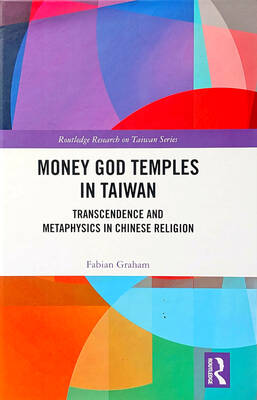
As someone who normally steers clear of books with “transcendence” or “metaphysics” in their subtitles, this reviewer — a casual observer of local belief systems since the 1990s — found Fabian Graham’s Money God Temples in Taiwan a challenging read. Those who’ve only dipped their toes into temple culture will likely need to parse several sections with special care if they’re to keep up with the author, a British ethnographic researcher whose previous books have investigated religious practices among ethnic Chinese in Southeast Asia. This scholarly volume examines a facet of Taiwan’s religious landscape that didn’t exist a century ago, and


 RSS
RSS