


traveling gnome! Treeson, a vinyl figure that looks like a cross between a snowman and a durian fruit, is a new muse for toy collectors and photographers around the world — and an advocate for environmental awareness, too.
Like the wayward garden gnome in the French hit film Amelie, fans take photos of their Treeson toys in front of different landmarks — the Kremlin, the British Museum, the Petronas towers in Kuala Lumpur — and share them on the Internet with other devotees.
Treeson was born in 2005 when Hong Kong-based graphic designer Bubi Au Yeung (歐陽潔盈) published illustrated stories on her Web site Milkjar.com about the character, a woodland creature who is befriended by a lonely boy after his forest home is destroyed by loggers.
The following year, Crazy Label, then a fledgling designer toy company founded by Andy Woo (胡國光), a former Mattel senior project engineer, turned Treeson into a 15cm-tall vinyl figure. Treeson’s career as muse to many came about accidentally after Au Yeung and Woo posted photos of the toy to their personal accounts on the photo-sharing site Flickr.com, catching the attention of collectors.
“People are attracted to Treeson not only because he encourages people to protect the environment, but also because his story underscores the importance of friendship,” says Eric Sun (孫梓評), a writer who adapted Au Yeung’s tales for Treeson and Other Stories, which was published last summer and features photos by Treeson fans from around the world.
The original line of Treeson toys was supposed to be a one-time release, but the initial run of 500 figures quickly sold out, spurred by the online buzz. Since then, 13 different versions of Treeson figures have been produced in limited series, including Baby Treeson and a glow-in-the-dark Firefly Treeson.
Irina Troitskaya, a Russian artist whose photos were published in Treeson and Other Stories, caught her first glimpse of the character in Au Yeung’s photos soon after the figure was launched and was taken with Treeson’s “lovely smile,” optimism and his story’s eco-friendly stance. Treeson tagged along with Troitskaya on a trip to her hometown, and she started taking photos of their outings.
“Treeson has the most adorable smile and seems always glad to go out for a walk. It’s important to have such a friend, especially in the Russian winter,” Troitskaya wrote in an e-mail.
Treeson’s popularity stems in large part from the appeal of Au Yeung’s first story about the character. Written in the form of a children’s picture book, the deceptively simple tale nonetheless manages to combine the themes of alienation and redemption through love.
In the story, readers find out that Treeson was orphaned when loggers chopped down the forest of trees that had raised him (hence his name). He is discovered and befriended by an unhappy little boy named Ren, who is neglected by his parents and snubbed by his peers. The two lonely souls comfort one another and make a discovery that leads to an ending so bittersweet and unexpected that to give it away would be cruel.
Au Yeung’s characters and their back stories are “on the surface very cute, but we are actually seeing the world through her eyes. I think they are thought-provoking, because the characters make you smile, but they also make you sad and you can relate to their story,” Woo says.
Au Yeung was inspired to create Treeson after she read reports about the negative impact of deforestation while working at an environmental non-profit.
Ren is a human (ren is the Chinese word for person), but Treeson is not his pet, Au Yeung says.
“Ren represents humans and Treeson is a symbol of nature, because Treeson is a creature. But I didn’t want to characterize him as an animal, because humans are creatures, too. I wanted them to be equal, because humans don’t always respect nature,” Au Yeung says.
Au Yeung has always been attracted to stories that mix sweetness with a hint of melancholy.
Her favorite stories when she was growing up included Casper, the cartoon about the ghost of a little boy, and Snowman, the Raymond Briggs book and film about a boy whose snowman comes to life and becomes his best friend, only to melt away when the days grow warmer.
“I like the atmosphere, the mood of being sad or alone. Treeson is very cute and loveable and people would expect him to be always smiling or happy. But I like to put him in the reverse situation and see how he behaves in a sad world,” Au Yeung says.
Au Yeung first started drawing when she was 5 years old on the pages of telephone directories because her parents could not afford to buy her brand-new sketchpads. She drew the things she saw around her: tables, chairs, cups and cartoon characters. When Au Yeung was 10, she started writing and illustrating her own stories; her first work was a comic book that documented how her older sister was teasing her. Au Yeung studied art in secondary school, but at university she picked a practical major, information science.
Just as she had with her telephone directory sketchpads, however, Au Yeung found a way to continue her art while she was working. Using her computer programming skills, Au Yeung built Milkjar.com and wrote an e-card program that allows visitors to send her illustrations to their friends from the Web site. Au Yeung also promoted her work in online art forums, where she met Woo, who had just founded Crazy Label.
“Before I founded my own company, my plan was to produce my own figure designs, but once I saw Bubi’s drawings, I just loved them and changed my mind,” Woo says.
After the toy’s official launch at the 2006 Taipei Toy Festival, it was named the best toy of the year by influential designer toy blog Plastic and Plush and similarly honored by Toysrevil, another blog, and Format magazine, an online publication about urban style.
The popularity of the Treeson figures came as a surprise to Au Yeung, who says she had expected to release just one line of Treeson toys. But his popularity among toy collectors and photographers, as well as his green agenda, spurred Au Yeung on.
Before becoming a Treeson fan, Troitskaya says she was worried about the amount of plastic bags she got at supermarkets, but rarely refused them. However, after reading a Treeson story, she says, “I felt able to say ‘no’ when they tried to pack my food in plastic and collected the right amount of reusable fabric shopping bags. I still use them.” And Treeson practices what he preaches — Crazy Label is packaging its new line of Treeson figures in non-woven fabric instead of plastic.
“I never thought that Treeson would remain in production, but I wanted to return the love to people who love Treeson,” Au Yeung says. “I talked to Andy about it and we found that Treeson can be a medium to promote something important.”

Taiwan’s English education system is being pulled apart by three opposing forces. Bilingual Nation 2030 pulls students toward English and global communication. Artificial Intelligence (AI) readiness pulls them toward digital judgment, verification and AI-mediated work. But Taiwan’s old exam culture pulls them back toward memorization, grammar drills, timed reading and correct answers. If the education system keeps using old exams to define success, it risks producing graduates who are neither genuinely bilingual nor genuinely AI-ready, but trained for tasks machines can already perform. The first force is Bilingual Nation 2030. Launched in 2018, the policy aimed to “help Taiwan’s workforce connect

It seems every few days one bumps into one of those “real man” comments in which Taiwan is urged to “face reality” or similar, and “make a deal,” with the speaker implying that soon it will be too late. “Deal” advocates always present themselves as having a superior grip on reality, and the manly ability to make the “hard choice.” Their testosterone-laden language often echoes that of Taiwan sellout advocates. Note that such commentary always specifies a process (“make a deal, work with, make progress”), never the end state of what occupation by a violent authoritarian colonialist state will entail. In

There are shadowy cabals plotting to sell out Taiwan to be annexed by China, by invasion if necessary. Fortunately, they are buffoons. In 2019, former Bamboo Union gangster and founder of the China Unification Promotion Party (CUPP), Chang An-le (張安樂, colorfully known as “White Wolf”), led a protest at the Legislative Yuan against comments made by then-premier Su Tseng-chang (蘇貞昌) that in the event of an attack by China, he would never surrender, but would protect the nation by fighting to the end, even if he only had a broom. Chang had party members bring a wooden casket that they
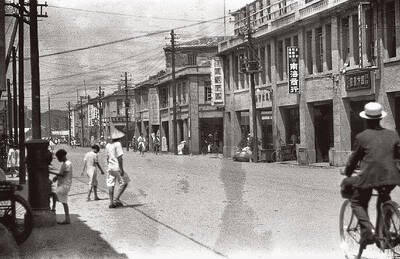
June 1 to June 7 "If all Taiwanese were as afraid of dying as you, then what would happen?” Physician Shih Chiang-nan (施江南) reportedly said this to his wife Chen Chiao-tung (陳焦桐) after she urged him to stop intervening on behalf of Taiwanese soldiers stranded overseas after serving in the Japanese Army during World War II. Shih had clashed with high-ranking officials over the issue, engaged in several heated arguments with Taiwan governor-general Chen Yi (陳儀) and allegedly shouted at general Ko Yuan-fen (柯遠芬), chief of staff of the Taiwan Garrison Command, over


 RSS
RSS