


Described across the Internet as “beautiful, eloquent indie pop,” the music of Montreal-based group Stars resonates with underground music fans in Taiwan.
Advance tickets are selling well for the band’s show at The Wall (這牆) in Taipei on Monday, according to Sky Tai (戴杏芳), a manager at White Wabbit Records (小白兔唱片). The show wraps up a tour of Australia, Japan and Singapore in support of their latest EP, Sad Robots.
Stars made their breakthrough along with a wave of popular Canadian groups including Arcade Fire and Broken Social Scene. They were nominated for Canada’s Juno Awards for their albums Heart in 2004 and Set Yourself on Fire in 2005.
Three of Stars’ members are part of Broken Social Scene, which performed in Taipei in March of last year, and the two groups share a liking for ornate pop arrangements and quirky sounds from electric guitars and synthesizers. But Stars’ music is less abstract and often has an atmosphere of dark romance and drama, notably played out in male/female vocal duets between Torquil Campbell and Amy Millan, who Tai says is a major attraction for Taiwanese fans.
The band employs catchy, melodic hooks, but their brand of pop shies away from the mainstream. Many of their songs contain narratives with poetic leanings — songs like Reunion and What I’m Trying to Say from Set Yourself on Fire, have chorus refrains with a lyrical cadence that owes a debt to The Smiths.
Since it formed in 2001, the band’s sound has ranged from 1980s synth pop and electronica to guitar rock. Their repertoire of mostly original songs has also included covers such as Bruce Springsteen’s Hungry Heart and the Yeah Yeah Yeah’s Modern Romance.
But one band member is ambivalent about the “indie-rock” label. In an interview with the Singaporean music blog Power of Pop, bassist Evan Cranley said, “We’ve always tried to rise above that title. We’re a pop band with a conscience. We make home movies for people’s lives.”
Pop’s potential for melodrama appeals to Campbell, a former stage and television actor. On the band’s Web site, he remarks on making the band’s full-length 2007 album In Our Bedroom After the War. “What is the darkest possible situation that I could try to turn into a beautiful pop song?” he said. “That was sort of my mission with this record. If you could make horror movies that were like love stories, that would be my ultimate genre.”


Taiwan’s English education system is being pulled apart by three opposing forces. Bilingual Nation 2030 pulls students toward English and global communication. Artificial Intelligence (AI) readiness pulls them toward digital judgment, verification and AI-mediated work. But Taiwan’s old exam culture pulls them back toward memorization, grammar drills, timed reading and correct answers. If the education system keeps using old exams to define success, it risks producing graduates who are neither genuinely bilingual nor genuinely AI-ready, but trained for tasks machines can already perform. The first force is Bilingual Nation 2030. Launched in 2018, the policy aimed to “help Taiwan’s workforce connect

“Taiwan’s Opposition Leader Comes to US With a Message Straight Out of Beijing” read a May 31 headline in the Wall Street Journal. Top US administration officials and members of Congress almost certainly read the WSJ, and if there was a bullet point takeaway that people in Washington should absorb ahead of Chinese Nationalist Party (KMT) Chair Cheng Li-wun’s (鄭麗文) arrival in DC on June 9, that headline is it. The last few columns have discussed this very topic, and the timing is not coincidental. While those top officials likely do not read the Taipei Times, judging by the number

With weighty, anxiety-inducing geopolitical topics dominating the headlines, checking in on the wild and weird state of local politics can take some of the edge off. This November’s elections will determine who will be in charge of fixing potholes in your neighborhood, not the potholes in Taiwan’s complicated geopolitical space. Recently, after an online interview with a Taipei-based journalist, I commented that Taipei journalists never go further than the MRT can take them. He laughed and agreed. Naturally, the Taipei mayoral race is eating up much of the press attention. TAIPEI CITY Democratic Progressive Party (DPP) candidate Puma Shen (沈伯洋) has
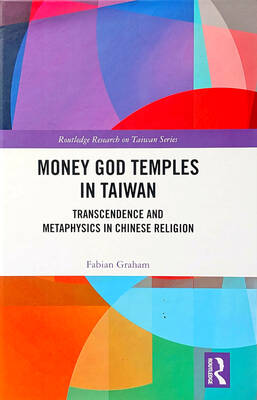
As someone who normally steers clear of books with “transcendence” or “metaphysics” in their subtitles, this reviewer — a casual observer of local belief systems since the 1990s — found Fabian Graham’s Money God Temples in Taiwan a challenging read. Those who’ve only dipped their toes into temple culture will likely need to parse several sections with special care if they’re to keep up with the author, a British ethnographic researcher whose previous books have investigated religious practices among ethnic Chinese in Southeast Asia. This scholarly volume examines a facet of Taiwan’s religious landscape that didn’t exist a century ago, and


 RSS
RSS