


Right now things couldn’t be better for Diana Krall.
The Canadian-born chanteuse took her 21-month-old twins on tour this summer (they’re currently on tour with their dad, Krall’s husband Elvis Costello) and just several weeks ago she was putting the final touches on her upcoming album.
“I’m so busy being a mom and I just made probably the best record of my career ... I’m so proud of it, and I’m so happy with it, it’s the best experience I’ve had making a record,” said Krall in a telephone interview last week.
The friendly and talkative Krall was nursing a slight cold as she spoke from Hong Kong, one stop on a three-week tour of Asia that concludes tomorrow night at the Taipei International Convention Center (台北國際會議中心大會堂).
But it hasn’t all been smooth sailing for the 44-year-old Grammy-winning pianist and singer, despite her steady rise to stardom in the jazz and pop world over the past decade. Krall suffered a personal setback with the death of her mother in 2002, an experience she described as “devastating.”
But now she’s back with a new album, due out next year, which she describes as a “love letter” to her husband, one with a “very Brazilian romantic, super late-night” mood. The album includes songs recorded with a 50-piece orchestra, conducted by her long-time collaborator, Claus Ogerman, who is renowned for his work with Brazilian composer Antonios Carlos Jobim.
The album will also showcase Krall’s sultry contralto, which has won her legions of fans, both in the jazz and pop worlds. “You think I was smoke and scotch-infused then, wait ’til you hear me now,” she joked about her voice.
And tomorrow night, that signature voice will no doubt charm Taipei audiences, with Krall doing what she does best: singing standards from the Great American Songbook, as well as the occasional obscure tune, all rendered in the spirit of legends such as Peggy Lee, Frank Sinatra and Nat King Cole.
“I’m playing repertoire, stuff that hasn’t been recorded. [I’m] just having a ball playing with my musicians, playing with really swingin’ happy standards, and just enjoying myself,” she said.
Krall tried her hand at songwriting with Costello on her 2004 release Girl in the Other Room, but said that while she valued the experience, right now, it’s not for her.
“If I want to be a songwriter, I want to be on the level of Joni Mitchell or Elvis Costello … and that’s just never going to happen,” she said laughing. “I’m just going to stick to my knitting … to what I’m comfortable with, and what I enjoy, and what I feel my strengths are.”
Many of those strengths lie in Krall’s distinctive renditions of songs by everyone from Irving Berlin to Tom Waits. As a jazz vocalist, however, it irks her to be described as someone that sings “covers.” “I know it’s not meant in a [bad way], but it’s just more of a misunderstanding,” she sighs.
“The easiest way for me to describe it is that I’m an actor ... I find it the most satisfying creative challenge for me to take something that’s well-known, take the lyrics, to find out my own story in them, whether I can relate to it as a character or as something very personal.”
In striving to put the “personal” into a song, Krall has been inspired by Louis Armstrong, Nat King Cole, and Frank Sinatra. “They were all great artists — but they were also great entertainers,” she said.
“Every male crooner, female crooner, you know, quote unquote, wants to be Frank Sinatra. The missing link is that they try to emulate all the snappy, ‘hey, I’m the hip rat pack’ qualities, but nobody can floor them like [he can]. Nobody can just destroy you with a rendition of Only the Lonely or In the Wee Small Hours of the Morning,” she said.
Once Krall finds a song she likes, she says it may take years before the right inspiration comes to perform or record it.
And some tunes seem to never leave her repertoire. “I’ve been singing Case of You [by Joni Mitchell] every night for the last six years, and I’m never tired of it … I still find it interesting to interpret and challenging all at the same time.”
“So I think I look for the things that are interesting harmonically and lyrically and also that are fun to play on, like Frim Fram Sauce [by Nat King Cole] or something like that, that sort of satisfies the swingin’ jazz side.”
In offering advice to aspiring musicians, Krall acknowledges that it can be tough. “I think it’s really difficult for young artists now, whatever kind of music they choose, because there’s such a wealth of history now … There’s so much to check out now … you could spend your whole life listening to Bob Dylan … With jazz, it has to be a combination of: you have to do your homework, and then you have to be able to feel it.”
Then she pauses. “I don’t know … just go into it with honesty, and you’ll be ok,” she said.
Krall says she’s looking forward to returning to Taipei, given that she and Costello “had a ball” on their last visit, despite the rain. After her Taipei show, she heads back home for a brief rest, and then to South America, where she will record a live DVD in Rio de Janeiro.
Supporting Krall tomorrow night are Anthony Wilson on guitar, Robert Hurst on bass and Karriem Riggins on drums.


Taiwan’s English education system is being pulled apart by three opposing forces. Bilingual Nation 2030 pulls students toward English and global communication. Artificial Intelligence (AI) readiness pulls them toward digital judgment, verification and AI-mediated work. But Taiwan’s old exam culture pulls them back toward memorization, grammar drills, timed reading and correct answers. If the education system keeps using old exams to define success, it risks producing graduates who are neither genuinely bilingual nor genuinely AI-ready, but trained for tasks machines can already perform. The first force is Bilingual Nation 2030. Launched in 2018, the policy aimed to “help Taiwan’s workforce connect

“Taiwan’s Opposition Leader Comes to US With a Message Straight Out of Beijing” read a May 31 headline in the Wall Street Journal. Top US administration officials and members of Congress almost certainly read the WSJ, and if there was a bullet point takeaway that people in Washington should absorb ahead of Chinese Nationalist Party (KMT) Chair Cheng Li-wun’s (鄭麗文) arrival in DC on June 9, that headline is it. The last few columns have discussed this very topic, and the timing is not coincidental. While those top officials likely do not read the Taipei Times, judging by the number

With weighty, anxiety-inducing geopolitical topics dominating the headlines, checking in on the wild and weird state of local politics can take some of the edge off. This November’s elections will determine who will be in charge of fixing potholes in your neighborhood, not the potholes in Taiwan’s complicated geopolitical space. Recently, after an online interview with a Taipei-based journalist, I commented that Taipei journalists never go further than the MRT can take them. He laughed and agreed. Naturally, the Taipei mayoral race is eating up much of the press attention. TAIPEI CITY Democratic Progressive Party (DPP) candidate Puma Shen (沈伯洋) has
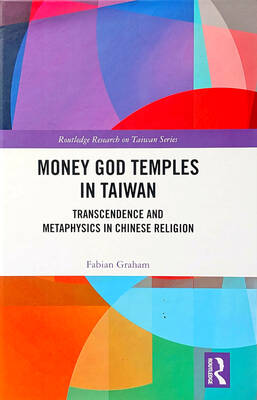
As someone who normally steers clear of books with “transcendence” or “metaphysics” in their subtitles, this reviewer — a casual observer of local belief systems since the 1990s — found Fabian Graham’s Money God Temples in Taiwan a challenging read. Those who’ve only dipped their toes into temple culture will likely need to parse several sections with special care if they’re to keep up with the author, a British ethnographic researcher whose previous books have investigated religious practices among ethnic Chinese in Southeast Asia. This scholarly volume examines a facet of Taiwan’s religious landscape that didn’t exist a century ago, and


 RSS
RSS