


What do you get when you mix house, hip-hop, electro, 1980s retro, rock, club, dance, Motown, rave music and samples from television and movies together? An evening with superstar DJ Jesse Tittsworth, playing his own modified version of Baltimore club style on the Taipei leg of his Asian tour.
It’s music for the post-MTV, blog savvy generation. In an interview on Monday night, Tittsworth said, “music is changing. Everything is very instant gratification, very blog, very iPod … . I kind of feel we are nearing the end of the album days, so I think that delay between what’s in an artist’s head and what is in the audiences’ ears is decreasing.”
What this creates is very energetic, danceable music that utilizes not only rhythm, tempo and bass to get the crowd moving, but memory and association. A Tittsworth set consists of pumping music that has samples and bits of songs mixed in that are sure to tweak memories of high school dance parties and early MTV experiences.
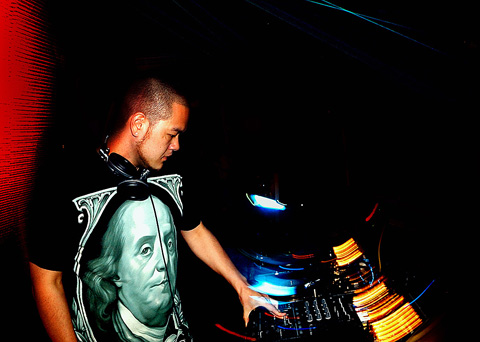
PHOTO: COURTESY OF RICK HIRTLE
“Deejaying is mainly a combination of what the crowd will allow me to get away with and what I’m trying to accomplish,” Tittsworth said. “There are certain things that I’m trying to accomplish or a feeling; there might be a particular rave tune or electro tune going through my head and depending on whether or not I feel they are ready for that, I might try to build into that based on what they are familiar with. I mix it really fast.”
Lyrics from Queen, a-ha and Nirvana are mashed together with SpongeBob SquarePants samples and killer beats to create a musical style that is catchy, engaging, and amusing to listen and dance to.
What takes Tittsworth’s sound beyond kitsch or cheesiness is the skill with which it is mixed, and the fact that the crowd is being played by the DJ in a way that is almost psychologically unnerving. “You’re studying human interaction. You’ve got a song, and you give it a second, do they like it?” he said. “You push it harder, see where it naturally leads. If they didn’t like it, is it too new? Too old? Too fast? Too slow? I’m constantly observing the crowd. Sometimes I over-think. With the technology it’s so easy to mix so fast.”
Conversing with Tittsworth is as fast-paced and divergent as listening to his music. He samples thoughts, moving from topic to topic effortlessly.
When commiserating on my having recently quit smoking he was compassionate and informative, and told me about the cilia which may be growing back in my lungs. The next minute he recounts a tour tale involving his partner in crime, Dave Nada, and a steaming defecation on a hotel room floor. He cackled gleefully. “I think it’s only a matter of time before our tour videos end up like Jackass videos,” he says.
When he talks about his decade-long involvement with producing and how playing music influences his day-to-day life, he becomes contemplative and serious: “You become a human sampler, where anything you hear, you think about how it applies to music. That clicking sound of the crosswalk in Europe, the thing for blind people, you start to here it in a song — weird little things like that.”
Tittsworth recently made a song out of the sound of a record skipping. “Someone bumps the table and it’s me on the mic yelling ‘stop bumping the table,’ then the skip becomes the beat,” he says.
Listed in URB Magazine as one of its top 100 artists to watch out for in 2007, he has released eight critically acclaimed club records.
His mother is Taiwanese, but he grew up in his father’s homeland, the US, and honed his skills playing between Washington, DC, and Baltimore. Though this is his second tour in Asia, it’s his first time playing in Taiwan.
Tittsworth enjoys sampling more than playing music, and wants to indulge his penchant for bizarre food experiences while he’s here, which in other locales has so far included horse sushi, sheep testicles, silk worms, scorpions, larva eggs, which he said were “nasty,” and chicken embryo (“feathery”). He wants to try stinky tofu, and said in closing: “Tiger penis is no better for you than any other penis, nutritionally speaking. I just want to try new things.”
DJ Tittsworth joins Marcus Aurelius, Stereo:Types, and Kid Killy tonight at The Zoo, 68 Daguan Rd, Taichung City (台中市南屯區大觀路68號), from 11pm to 5am. Tomorrow, he spins at Vibe, B1, 155, Jinshan S Rd Sec 5, Taipei City (台北市金山南路一段155號B1) from 11pm. Admission and one drink are NT$350 at the Zoo and NT$400 at Vibe.
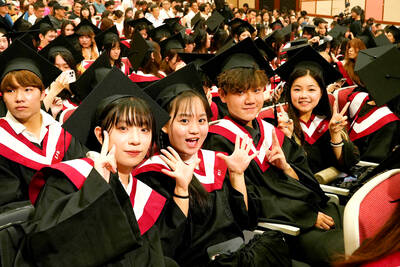
Taiwan’s English education system is being pulled apart by three opposing forces. Bilingual Nation 2030 pulls students toward English and global communication. Artificial Intelligence (AI) readiness pulls them toward digital judgment, verification and AI-mediated work. But Taiwan’s old exam culture pulls them back toward memorization, grammar drills, timed reading and correct answers. If the education system keeps using old exams to define success, it risks producing graduates who are neither genuinely bilingual nor genuinely AI-ready, but trained for tasks machines can already perform. The first force is Bilingual Nation 2030. Launched in 2018, the policy aimed to “help Taiwan’s workforce connect

It seems every few days one bumps into one of those “real man” comments in which Taiwan is urged to “face reality” or similar, and “make a deal,” with the speaker implying that soon it will be too late. “Deal” advocates always present themselves as having a superior grip on reality, and the manly ability to make the “hard choice.” Their testosterone-laden language often echoes that of Taiwan sellout advocates. Note that such commentary always specifies a process (“make a deal, work with, make progress”), never the end state of what occupation by a violent authoritarian colonialist state will entail. In

“Taiwan’s Opposition Leader Comes to US With a Message Straight Out of Beijing” read a May 31 headline in the Wall Street Journal. Top US administration officials and members of Congress almost certainly read the WSJ, and if there was a bullet point takeaway that people in Washington should absorb ahead of Chinese Nationalist Party (KMT) Chair Cheng Li-wun’s (鄭麗文) arrival in DC on June 9, that headline is it. The last few columns have discussed this very topic, and the timing is not coincidental. While those top officials likely do not read the Taipei Times, judging by the number
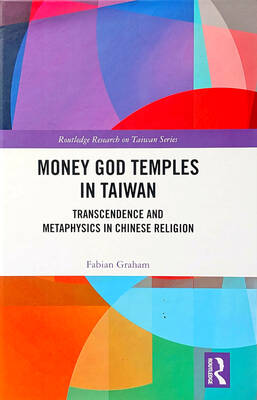
As someone who normally steers clear of books with “transcendence” or “metaphysics” in their subtitles, this reviewer — a casual observer of local belief systems since the 1990s — found Fabian Graham’s Money God Temples in Taiwan a challenging read. Those who’ve only dipped their toes into temple culture will likely need to parse several sections with special care if they’re to keep up with the author, a British ethnographic researcher whose previous books have investigated religious practices among ethnic Chinese in Southeast Asia. This scholarly volume examines a facet of Taiwan’s religious landscape that didn’t exist a century ago, and


 RSS
RSS