


Christmas arrived a few days late for the paparazzi tailing lady killer-turned-boozehound David Tao (陶吉吉) - but it was worth the wait.
Much to the delight of the nation's tabloid journalists, the pop idol has been lighting it up with great frequency ever since last year's string of widely reported flings with mixed-race models. It was only a matter of time before the handsome barfly got caught making a fool out of himself.
That came sooner than expected. Last Friday night, after a bender at the uber-trendy Barcode lounge in Taipei's Xinyi District, Tao's taxi driver dropped him off at a nearby police station because the booze-addled star was unable to recall where he lived.

PHOTO: TAIPEI TIMES
Obviously more than a few sheets to the wind, Tao became a little too friendly with local law enforcement, engaging in amiable antics like high-fiving, incessant small talk, and fawning over officers who just wanted the inebriated star to stand still. Tao's lively display of drunkenness even included calling the Next magazine paparazzo who had been called to record the silly scene his "bro."
The late-night farce ended with an unexpected grand finale when Tao tried to show his gratitude by planting a kiss on a woman who had been dispatched to escort him home.
In a more touching turn of events, Selina - she of girl band S.H.E - is said to have found herself a new Prince Charming after years of failed romances with showbiz peers such as Alan Luo (羅志祥), Mickey Huang (黃子佼), the aforementioned David Tao and Wang Lee-hom (王力宏).

PHOTO: TAIPEI TIMES
The 26-year-old starlet's marriage prospects look to have improved greatly ever since the arrival of square-looking, suit-wearing lawyer boyfriend Chang Cheng-chung (張承中), who won the star's affection after two years of persistent wooing.
Selina is evidently a cheap date, at least that's the conclusion drawn by Next's first expose on their until-now well-hidden relationship. Evidently, a plebian dinner with her 37-year-old beau at a Formosa Chang's (鬍鬚張) franchise - they had minced fatty pork over rice (魯肉飯) - was romantic enough for the pop idol.
Moving on now to news about intellectual property, no sooner did the crooners of boy band Lollipop (棒棒堂) release their first album than they were exposed as a (boy) band of copycats. The guys from the Channel V variety show had plagiarized around 90 percent of their lyrics and music video content, it seems, from Japanese acts News and Hey! Say! Jump.
Then again, who expected originality from a bunch of pretty faces with voice coaches whose only talents are knowing how to grin deliciously and act cute?
This week's New Year Eve's celebrations once again saw a legion of stars answering the call to see off the old year. Hard-working rockers Champion (強辯) topped the rest, rushing to five concerts across the nation on the night of Dec. 31, 2007. ABT idol Wang Lee-hom earned second place with three performances, from Tainan to Kaohsiung.
However Wang had it easy. He only had to take the High Speed Rail to his shows. Shin (信), of Shin Band (信樂團), however, took a much more circuitous route involving a scooter, Taipei's MRT, the High Speed Rail and, finally, a car to travel from Taipei to Yunlin.
Seeing idols cash in on publicly-funded New Year's bashes is all very well and good, but Pop Stop can't help but wonder just when our city and county governments will come up with a year-end celebration that's more inspiring than a litany of sickly sweet pop tunes.


Taiwan’s English education system is being pulled apart by three opposing forces. Bilingual Nation 2030 pulls students toward English and global communication. Artificial Intelligence (AI) readiness pulls them toward digital judgment, verification and AI-mediated work. But Taiwan’s old exam culture pulls them back toward memorization, grammar drills, timed reading and correct answers. If the education system keeps using old exams to define success, it risks producing graduates who are neither genuinely bilingual nor genuinely AI-ready, but trained for tasks machines can already perform. The first force is Bilingual Nation 2030. Launched in 2018, the policy aimed to “help Taiwan’s workforce connect

“Taiwan’s Opposition Leader Comes to US With a Message Straight Out of Beijing” read a May 31 headline in the Wall Street Journal. Top US administration officials and members of Congress almost certainly read the WSJ, and if there was a bullet point takeaway that people in Washington should absorb ahead of Chinese Nationalist Party (KMT) Chair Cheng Li-wun’s (鄭麗文) arrival in DC on June 9, that headline is it. The last few columns have discussed this very topic, and the timing is not coincidental. While those top officials likely do not read the Taipei Times, judging by the number

With weighty, anxiety-inducing geopolitical topics dominating the headlines, checking in on the wild and weird state of local politics can take some of the edge off. This November’s elections will determine who will be in charge of fixing potholes in your neighborhood, not the potholes in Taiwan’s complicated geopolitical space. Recently, after an online interview with a Taipei-based journalist, I commented that Taipei journalists never go further than the MRT can take them. He laughed and agreed. Naturally, the Taipei mayoral race is eating up much of the press attention. TAIPEI CITY Democratic Progressive Party (DPP) candidate Puma Shen (沈伯洋) has
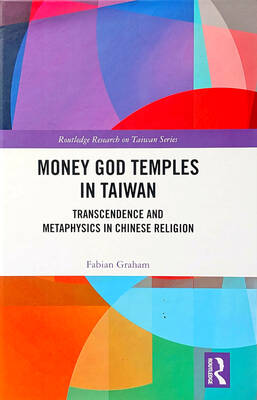
As someone who normally steers clear of books with “transcendence” or “metaphysics” in their subtitles, this reviewer — a casual observer of local belief systems since the 1990s — found Fabian Graham’s Money God Temples in Taiwan a challenging read. Those who’ve only dipped their toes into temple culture will likely need to parse several sections with special care if they’re to keep up with the author, a British ethnographic researcher whose previous books have investigated religious practices among ethnic Chinese in Southeast Asia. This scholarly volume examines a facet of Taiwan’s religious landscape that didn’t exist a century ago, and


 RSS
RSS