


The name Alcott tends to be associated with Louisa May, the world-famous writer raised in this Boston suburb and best known for her classic novel, Little Women.
But Louisa's father was a man of considerable fame, too.
A onetime superintendent of Concord's public schools, Bronson Alcott was the founder of the Concord School of Philosophy, a private summer academy for adults that drew people from around the country to its lectures and freewheeling exchange of ideas.
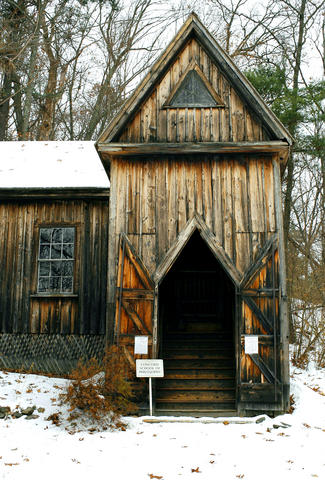
PHOTO: NY TIMES NEWS SERVICE
Opened in 1879, the school lasted only nine years. But during its relatively short life it won substantial acclaim. To this day, it is regarded as one of the earliest models of what is now known as continuing education.
Its five-week terms ran from July to August, and classes originally were held in Orchard House, the Alcott family home. When enrollment exceeded expectations and more space was needed, courses were moved to a barn-like building behind the house. The sparsely furnished, minimally decorated wood structure still stands today.
The school offered a series of classes and lectures - Alcott preferred to call them "conversations" - on topics that included the origin of evil, eternal life, Platonic philosophy, the human body, education, the nation, memory, the birth of American literature, "the making of freedom," and philanthropy and public charities. There were also courses on Greek, Spanish, Italian and German art. The discussions often tilted toward the philosophical, and students were encouraged to share their views.
In its first season, the school enrolled about 400 students, three-quarters of whom came from outside the town, according to Concord: Historic, Literary and Picturesque, an 1885 book authored by George B. Bartlett. Those early participants, who ranged from teachers to clergymen to artists to social reformers, came from at least 22 states, Bartlett wrote.
A Connecticut native, Alcott began his professional life as a salesman before becoming a teacher, and his educational philosophies were far ahead of their time. He was fascinated by how people learn, and devoted himself to changing traditional methods, which were rooted in the maxim that children should speak only when spoken to.
Alcott took a radically different approach. He believed that students should be treated with respect and kindness, not beaten regularly to keep them in line. He allowed them to ask questions in class, a policy some other teachers considered inappropriate. He incorporated art, music, nature studies, field trips and physical education into his curricula; he encouraged self-expression and prodded students to keep journals.
Louisa once described his classroom methods: "My father taught in the wise way which unfolds what lies in the child's nature, as a flower blooms, rather than crammed it, like a Strasbourg goose, with more than it could digest."
Among some intellectuals, including Ralph Waldo Emerson, his dear friend and loyal supporter, Alcott was praised as an innovator. But he clashed philosophically with other educators, and some parents, troubled by what they viewed as his permissive attitude, removed their children from his tutelage.
"He was known as an experimenter in education," said Jan Turnquist, executive director of the Orchard House, which runs lectures, musical events and cultural programs at the Concord School of Philosophy each summer. "He'd get an idea and hold firm to it, and people like Emerson thought he was a genius - but he could rub people the wrong way because he didn't compromise well."
In his late 70s, after many years of teaching children, Alcott turned his attention to adults. Adamant that learning was a lifelong process, he opened the Concord School of Philosophy to "perpetuate new trends in American thought," according to The Concord School of Philosophy: A Short History, by Julie Dapper. His academy promoted creative thinking and the study of transcendentalism, a philosophy that shunned materialism, focused on the search for truth, and taught that humans were meant to live in harmony with nature.
"It was quite a concept," Turnquist said of the school. "He was always pushing the envelope."
When Alcott died on March 4, 1888, the school died with him; it closed in July of that year after a memorial service in his honor. But his commitment to never-ending learning lives on.
"Bronson Alcott always seemed to be good at stirring up in people the idea that you can aspire to more, that you can be yourself but at the same time read about Aristotle and the ancient Greeks and then talk about modern society and where we are headed," Turnquist said. "He really helped make Concord the setting of the literary flowering of New England."


Taiwan’s English education system is being pulled apart by three opposing forces. Bilingual Nation 2030 pulls students toward English and global communication. Artificial Intelligence (AI) readiness pulls them toward digital judgment, verification and AI-mediated work. But Taiwan’s old exam culture pulls them back toward memorization, grammar drills, timed reading and correct answers. If the education system keeps using old exams to define success, it risks producing graduates who are neither genuinely bilingual nor genuinely AI-ready, but trained for tasks machines can already perform. The first force is Bilingual Nation 2030. Launched in 2018, the policy aimed to “help Taiwan’s workforce connect

“Taiwan’s Opposition Leader Comes to US With a Message Straight Out of Beijing” read a May 31 headline in the Wall Street Journal. Top US administration officials and members of Congress almost certainly read the WSJ, and if there was a bullet point takeaway that people in Washington should absorb ahead of Chinese Nationalist Party (KMT) Chair Cheng Li-wun’s (鄭麗文) arrival in DC on June 9, that headline is it. The last few columns have discussed this very topic, and the timing is not coincidental. While those top officials likely do not read the Taipei Times, judging by the number

With weighty, anxiety-inducing geopolitical topics dominating the headlines, checking in on the wild and weird state of local politics can take some of the edge off. This November’s elections will determine who will be in charge of fixing potholes in your neighborhood, not the potholes in Taiwan’s complicated geopolitical space. Recently, after an online interview with a Taipei-based journalist, I commented that Taipei journalists never go further than the MRT can take them. He laughed and agreed. Naturally, the Taipei mayoral race is eating up much of the press attention. TAIPEI CITY Democratic Progressive Party (DPP) candidate Puma Shen (沈伯洋) has
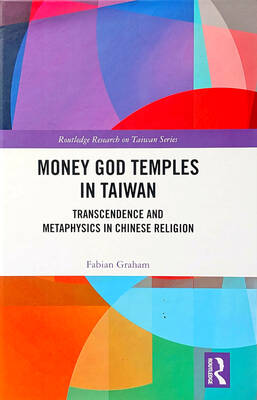
As someone who normally steers clear of books with “transcendence” or “metaphysics” in their subtitles, this reviewer — a casual observer of local belief systems since the 1990s — found Fabian Graham’s Money God Temples in Taiwan a challenging read. Those who’ve only dipped their toes into temple culture will likely need to parse several sections with special care if they’re to keep up with the author, a British ethnographic researcher whose previous books have investigated religious practices among ethnic Chinese in Southeast Asia. This scholarly volume examines a facet of Taiwan’s religious landscape that didn’t exist a century ago, and


 RSS
RSS