


Director Wang Quan'an's (王全安) Tuya's Marriage (圖雅的婚事), which follows the troubles of a young shepherdess in fast-changing rural China, won the top Golden Bear award at the annual Berlin film festival, while a Taiwanese director won the festival's gay film prize.
Tuya's Marriage was chosen from among 22 competitors at the festival by a seven-member jury led by Taxi Driver screenwriter Paul Schrader.
“A very beautiful dream has become reality for me here,” director Wang said after receiving the Golden Bear statuette on Saturday. He said he believed the award “will bring good fortune to Chinese cinema.” The movie stars Yu Nan (余男) as Tuya, a herdswoman on the steppe of Inner Mongolia trying to resist pressure to leave her pastures and move to the city as China's industry expands.
She and her handicapped husband, Bater, decide to get divorced after she falls ill, and Tuya seeks a respectable new husband who can look after Bater and her two children. An old classmate appears to fill that role, and he persuades Tuya and the children to move to town.
”You see in the film how things disappear — cultural things as well — through this rapid economic expansion,” Wang, speaking through an interpreter, said at a news conference.
The best actor award went to Argentina's Julio Chavez for his role in director Ariel Rotter's El Otro (The Other) as Juan, a man who decides to take on a new identity amid a crisis triggered by his wife's pregnancy and his father's illness.
Best actress was Germany's Nina Hoss for her role in Yella, directed by Christian Petzold. Hoss plays the heroine of the film's title, a young woman who quits her job and broken marriage and moves from eastern Germany to the west, and is increasingly haunted by voices and sounds from the past.
US-born Israeli director Joseph Cedar won the best director award for Beaufort, depicting the fear and futility felt by soldiers guarding a famed military outpost in southern Lebanon just before Israel's withdrawal from that country in 2000.
“It seems pretty obvious that we're against war and that war is horrible — hopefully there's something in my film that gives insight into a more specific nature of how absurd combat ... is,” Cedar said.
Taiwanese director Zero Chou (周美玲) won the festival's gay film prize, the Teddy, for her film Spider Lilies (刺青) about the love affair between two women in the Internet age.
The Berlinale's top prize has often gone to less heralded productions such as Tuya's Marriage, which was one of two Chinese entries at this year's festival. Last year's Golden Bear went to Grbavica, a film by Jasmila Zbanic on the aftermath of the Bosnian war.
On Saturday, the cast of Robert De Niro's The Good Shepherd — which traces the origins of the CIA through the eyes of one of its earliest agents, played by Matt Damon — won the festival's award for an outstanding artistic contribution, but the movie missed out on the top prizes.
Other US entries — including Steven Soderbergh's The Good German and Gregory Nava's Bordertown, starring Jennifer Lopez — came away empty-handed. So did a strong contingent of four films by French directors — including Olivier Dahan's La Vie en Rose and Francois Ozon's English-language Angel. The award for best music went to Scottish director David Mackenzie for Hallam Foe. South Korean director Park Chan-wook's I'm a Cyborg, But That's OK was honored as a work of particular innovation.
The Berlin festival, in its 57th edition this year, opened on Feb. 8 and ended yesterday.
The previous Golden Bear winners from China were Xie Fei (謝飛) in 1993 for his movie Women from the Lake of Scented Souls (香魂女), and Zhang Yimou (張藝謀) for Red Sorghum (紅高粱) in 1988.


Taiwan’s English education system is being pulled apart by three opposing forces. Bilingual Nation 2030 pulls students toward English and global communication. Artificial Intelligence (AI) readiness pulls them toward digital judgment, verification and AI-mediated work. But Taiwan’s old exam culture pulls them back toward memorization, grammar drills, timed reading and correct answers. If the education system keeps using old exams to define success, it risks producing graduates who are neither genuinely bilingual nor genuinely AI-ready, but trained for tasks machines can already perform. The first force is Bilingual Nation 2030. Launched in 2018, the policy aimed to “help Taiwan’s workforce connect

“Taiwan’s Opposition Leader Comes to US With a Message Straight Out of Beijing” read a May 31 headline in the Wall Street Journal. Top US administration officials and members of Congress almost certainly read the WSJ, and if there was a bullet point takeaway that people in Washington should absorb ahead of Chinese Nationalist Party (KMT) Chair Cheng Li-wun’s (鄭麗文) arrival in DC on June 9, that headline is it. The last few columns have discussed this very topic, and the timing is not coincidental. While those top officials likely do not read the Taipei Times, judging by the number

With weighty, anxiety-inducing geopolitical topics dominating the headlines, checking in on the wild and weird state of local politics can take some of the edge off. This November’s elections will determine who will be in charge of fixing potholes in your neighborhood, not the potholes in Taiwan’s complicated geopolitical space. Recently, after an online interview with a Taipei-based journalist, I commented that Taipei journalists never go further than the MRT can take them. He laughed and agreed. Naturally, the Taipei mayoral race is eating up much of the press attention. TAIPEI CITY Democratic Progressive Party (DPP) candidate Puma Shen (沈伯洋) has
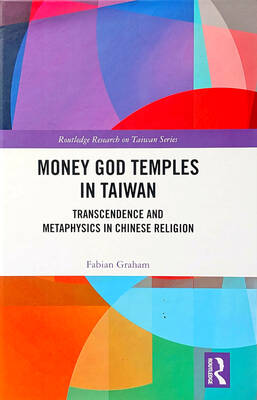
As someone who normally steers clear of books with “transcendence” or “metaphysics” in their subtitles, this reviewer — a casual observer of local belief systems since the 1990s — found Fabian Graham’s Money God Temples in Taiwan a challenging read. Those who’ve only dipped their toes into temple culture will likely need to parse several sections with special care if they’re to keep up with the author, a British ethnographic researcher whose previous books have investigated religious practices among ethnic Chinese in Southeast Asia. This scholarly volume examines a facet of Taiwan’s religious landscape that didn’t exist a century ago, and


 RSS
RSS