


Their names may not be as widely known as Formula 1 drivers like David Coulthard and Michael Schumacher, but Asia's lesser-known, yet equally car-savvy rally and racing car drivers will be out in force and chasing the checkered flag in downtown Taipei this weekend when they compete in the International Gymkhana Grand Prix (國際金卡那大獎賽).
Organized jointly by the popular on-line car publi-cation Motoring Fans (玩車友) and the Chinese Taipei Motorsport Association (中華賽車會) the event is sponsored by Hyundai Motors and has the backing of the governing body of international motorsports, the Federation Internationale de l'Automobile (FIA). The gymkhana will take place in Taipei at the Sungshan Tobacco Factory (
In all, over 50 drivers from more then 10 Asian countries including Taiwan, Philippines, Hong Kong, Macau, South Korea, Thailand, Singapore and Sri Lanka will be setting out to prove who is the best wheelman.
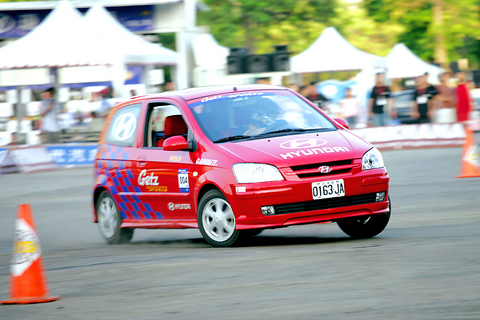
PHOTO COURTESY OF CTMSA
It is the Japanese drivers who are expected to steal the show this year, as the team includes a couple of drivers from the international circuit. The drivers to watch out for are Super Touring Car champion Tetsuya Yamano and rally driver Masaki Nishihara.
While high-speed circuit racing is not on the agenda this weekend the event will still test the drivers ability to maneuver their customized four-wheeled chariots as precisely as possible through a series of specially designed events intended to test the driver's skills behind the wheel.
Divided into half a dozen categories, the two-day competition includes several types of slalom course: The autotest, which tests the driver's ability to swing the car through 180 degrees and 360 degrees from a standing start, autocross races through a series of S-bends and speed tests on straight runs over 100m.
As it is a car show there will also be prizes for the best-looking cars, the drivers of which will no doubt be mobbed by the equally attractive showgirls.
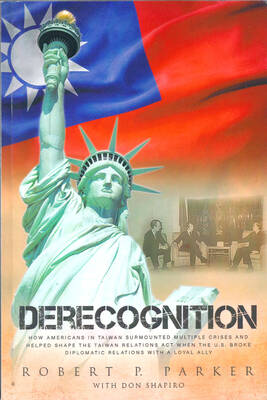
One of the biggest sore spots in Taiwan’s historical friendship with the US came in 1979 when US president Jimmy Carter broke off formal diplomatic relations with Taiwan’s Republic of China (ROC) government so that the US could establish relations with the People’s Republic of China (PRC). Taiwan’s derecognition came purely at China’s insistence, and the US took the deal. Retired American diplomat John Tkacik, who for almost decade surrounding that schism, from 1974 to 1982, worked in embassies in Taipei and Beijing and at the Taiwan Desk in Washington DC, recently argued in the Taipei Times that “President Carter’s derecognition
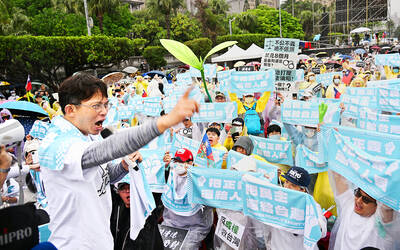
This year will go down in the history books. Taiwan faces enormous turmoil and uncertainty in the coming months. Which political parties are in a good position to handle big changes? All of the main parties are beset with challenges. Taking stock, this column examined the Taiwan People’s Party (TPP) (“Huang Kuo-chang’s choking the life out of the TPP,” May 28, page 12), the Democratic Progressive Party (DPP) (“Challenges amid choppy waters for the DPP,” June 14, page 12) and the Chinese Nationalist Party (KMT) (“KMT struggles to seize opportunities as ‘interesting times’ loom,” June 20, page 11). Times like these can
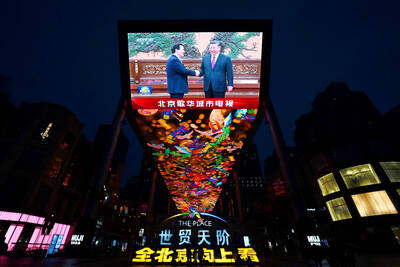
Dr. Y. Tony Yang, Associate Dean of Health Policy and Population Science at George Washington University, argued last week in a piece for the Taipei Times about former president Ma Ying-jeou (馬英九) leading a student delegation to the People’s Republic of China (PRC) that, “The real question is not whether Ma’s visit helps or hurts Taiwan — it is why Taiwan lacks a sophisticated, multi-track approach to one of the most complex geopolitical relationships in the world” (“Ma’s Visit, DPP’s Blind Spot,” June 18, page 8). Yang contends that the Democratic Progressive Party (DPP) has a blind spot: “By treating any
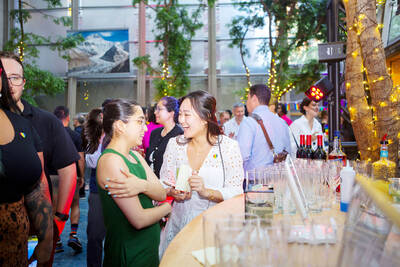
You can tell a lot about a generation from the contents of their cool box: nowadays the barbecue ice bucket is likely to be filled with hard seltzers, non-alcoholic beers and fluorescent BuzzBallz — a particular favorite among Gen Z. Two decades ago, it was WKD, Bacardi Breezers and the odd Smirnoff Ice bobbing in a puddle of melted ice. And while nostalgia may have brought back some alcopops, the new wave of ready-to-drink (RTD) options look and taste noticeably different. It is not just the drinks that have changed, but drinking habits too, driven in part by more health-conscious consumers and


 RSS
RSS