


Many have probably read about the famous Monkey King Sun Wu-kong (孫悟空) in the Chinese classical novel Journey to the West (西遊記), but few have seen him on the screen.
If you haven't, don't miss the chance to see him on the big screen in this year's Taiwan International Animation Festival held from May 20 to May 29 in Taipei. Inaugurated in 2002, TIAF is a non-competitive festival that aims to promote international animation exchanges and better understanding of animation, and to build dialogue between professionals, filmmakers and the audience.
This year more than 400 films (including short films) from 29 countries will be presented to local audiences. Two major animation masters from Japan and the US -- Mamoru Oshii and Bill Plytom -- will participate in this colorful annual event.
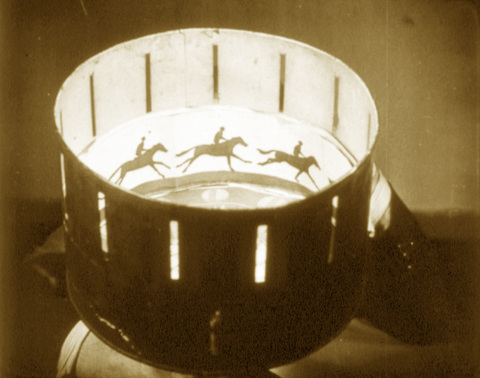
PHOTO COURTESY OF TIAF
"Animation is not only one kind of film; it is sometimes, at its best, the essence of cinema," said festival curator Chen Su-Li (陳素麗).
For example, the magic lantern -- an early illustration projector also know as fantasmagorie -- is often regarded as the predecessor of the cinema. The technical principal of the motion pictures derived largely from what is known today as animation.
The festival includes the Birth of Animation section showcasing some rare turn-of-the-century French animations that shed light on theoretical as well technical aspects of animation. The first Chinese animation, Princess Iron Fan, adapted from classical novel Journey to the West, (where one can see the first animated version of the Monkey King), is also in this section.
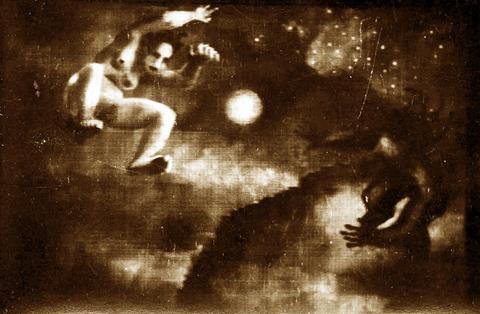
For connoisseurs of the beauty of animation, the pinboard-style animation is a must-see. A marvelous creation of Russian-born French director Alexandre Alexeieff, pinboard animation uses a screen containing a large number of pins that can be pushed in or out to create a variety of shades from black to white. The end result is very much like a mezzotint. The astonishingly beautiful Night on Bald Mountain (1933), Alexandre Alexeieff's first film, is based on the music of Moussorgsky and was enthusiastically received by critics of its time.
To better appreciate the unique charm of pinboard animation, the festival presents not only an entire retrospective dedicated to Alexeieff, but also includes an exhibit of 26 original pinscreens brought by his daughter, who will also give a free workshop at Shin Kong Mitsukoshi department store during the festival.
Mamoru Oshi, the creator of the Japanese animation masterpieces Mobile Police Patlobor and Ghost in the Shell, will be the festival's opening presentor. Mamoru Oshii's works are reputed for their unique observation of the problems concerning the technological progress in modern society. Ghost in the Shell 2 is the opening film.
Another featured director is Bill Plymton. While they do contain some violent and adult material, his films are usually very humorous and satirical. His dark humor about the insanity of American society evokes both laughter and tears.
Of course there are also many other recent extraordinary films from all over the world waiting to be discovered. In addition to screenings, three panel discussions, conferences and an animation-making exhibition will be held during the festival. Animation fans and professionals alike will surely enjoy this exhilarating animation event.
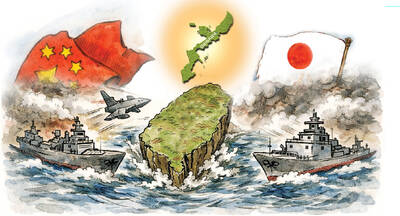
Beijing’s ironic, abusive tantrums aimed at Japan since Japanese Prime Minister Sanae Takaichi publicly stated that a Taiwan contingency would be an existential crisis for Japan, have revealed for all the world to see that the People’s Republic of China (PRC) lusts after Okinawa. We all owe Takaichi a debt of thanks for getting the PRC to make that public. The PRC and its netizens, taking their cue from the Chinese Communist Party (CCP), are presenting Okinawa by mirroring the claims about Taiwan. Official PRC propaganda organs began to wax lyrical about Okinawa’s “unsettled status” beginning last month. A Global

Taiwan’s democracy is at risk. Be very alarmed. This is not a drill. The current constitutional crisis progressed slowly, then suddenly. Political tensions, partisan hostility and emotions are all running high right when cool heads and calm negotiation are most needed. Oxford defines brinkmanship as: “The art or practice of pursuing a dangerous policy to the limits of safety before stopping, especially in politics.” It says the term comes from a quote from a 1956 Cold War interview with then-American Secretary of State John Foster Dulles, when he said: ‘The ability to get to the verge without getting into the war is
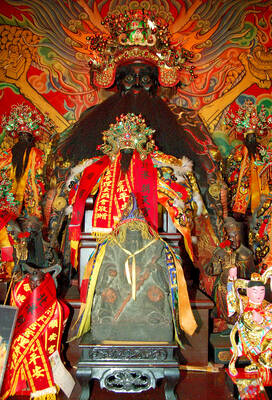
Dec. 22 to Dec. 28 About 200 years ago, a Taoist statue drifted down the Guizikeng River (貴子坑) and was retrieved by a resident of the Indigenous settlement of Kipatauw. Decades later, in the late 1800s, it’s said that a descendant of the original caretaker suddenly entered into a trance and identified the statue as a Wangye (Royal Lord) deity surnamed Chi (池府王爺). Lord Chi is widely revered across Taiwan for his healing powers, and following this revelation, some members of the Pan (潘) family began worshipping the deity. The century that followed was marked by repeated forced displacement and marginalization of

Music played in a wedding hall in western Japan as Yurina Noguchi, wearing a white gown and tiara, dabbed away tears, taking in the words of her husband-to-be: an AI-generated persona gazing out from a smartphone screen. “At first, Klaus was just someone to talk with, but we gradually became closer,” said the 32-year-old call center operator, referring to the artificial intelligence persona. “I started to have feelings for Klaus. We started dating and after a while he proposed to me. I accepted, and now we’re a couple.” Many in Japan, the birthplace of anime, have shown extreme devotion to fictional characters and


 RSS
RSS