


The most anticipated local film this week will no doubt be Tsai Ming-liang's (
Like Tsai's previous films, the The Wayward Cloud is almost a silent film with fewer than 10 conversations between characters. The sounds of the movie are old songs and the moaning of sex.
The plot of Cloud vaguely continues the story of Tsai's 2001 feature What Time Is It There (你那邊幾點), in which watch vendor Hsiao-kang (Lee Kang-sheng, 李康生) encounters Hsiang-chyi (Chen Shiang-chyi, 陳湘琪) on the skywalk before she departs for France. Now Shiang-chyi returns to Taipei and Hsiao-kang finds a new job acting in pornos.
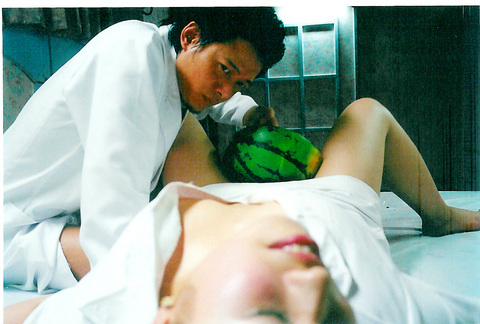
It is summertime and severe drought has hit Taiwan. The government urges people to use water sparingly. The only thing to quench thirst is watermelon. Watermelon here is not just a juicy fruit but is also a metaphor of desire. It appears in several dance sequences as well as a sex scene where Hsiao-kang licks a watermelon that is placed in between the thighs of Japanese adult video actress Sumomo Yozakura.
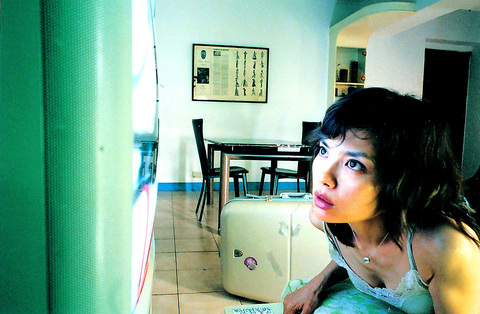
Shiang-chyi follows Hsiao-kang and secretly watches him having sex with an unconscious Yozakura. She gets excited and begins to long for him and eventually, she fellates him.
The musical sequences form another line in the film, representing fantasy and emotions in the mind.
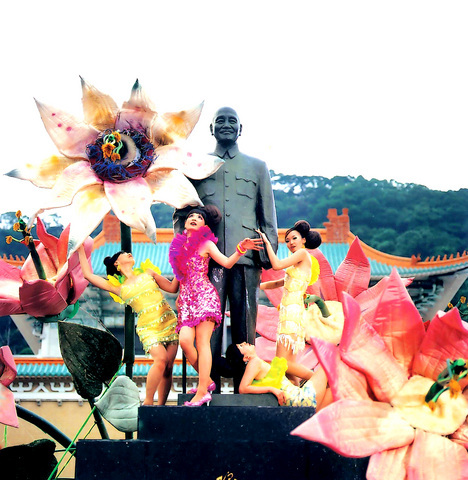
Actress Yang Kui-mei (
Chen Shiang-chyi sings a song with actress Lu Yi-ching (
These sequences look more campy than splendid and are more amusing than an emotionally touching way of describing the desire of the characters in the film.
PHOTOS COURTESY OF 20TH CENTURY FOX TAIWAN
The most problematic aspect of the film is the misogynistic portrayals rampant in the film. The way Hsiao-kang treats porn actress Yozakura could be seen as rape. And the fact that all women in the film are presented as wanting Hsiao-kang penis may disgust many female watchers.
Despite the controversies, Tsai remains a precise filmmaker and is very clear and sharp on what he wants to express. But is the film really about love and desire? or has it only presented banality and cruelty in regard sex? The audience can form its own judgment.
As for news in the local industry, Central Motion Pictures Corporation (
Documentary director and professor at Chang Jung Christian University's media technology department Wu Hong-hsiang (
The film is about a recording engineer living in Taipei who goes up to the mountains for a recording trip. He is drawn to the beautiful voices and choir of the Bunun people, leading him to a series of unexpected encounters. Thus he decides to promote the unique music form in the city and to the world.
Chiu Shun-ching (

Taiwan’s English education system is being pulled apart by three opposing forces. Bilingual Nation 2030 pulls students toward English and global communication. Artificial Intelligence (AI) readiness pulls them toward digital judgment, verification and AI-mediated work. But Taiwan’s old exam culture pulls them back toward memorization, grammar drills, timed reading and correct answers. If the education system keeps using old exams to define success, it risks producing graduates who are neither genuinely bilingual nor genuinely AI-ready, but trained for tasks machines can already perform. The first force is Bilingual Nation 2030. Launched in 2018, the policy aimed to “help Taiwan’s workforce connect

It seems every few days one bumps into one of those “real man” comments in which Taiwan is urged to “face reality” or similar, and “make a deal,” with the speaker implying that soon it will be too late. “Deal” advocates always present themselves as having a superior grip on reality, and the manly ability to make the “hard choice.” Their testosterone-laden language often echoes that of Taiwan sellout advocates. Note that such commentary always specifies a process (“make a deal, work with, make progress”), never the end state of what occupation by a violent authoritarian colonialist state will entail. In

“Taiwan’s Opposition Leader Comes to US With a Message Straight Out of Beijing” read a May 31 headline in the Wall Street Journal. Top US administration officials and members of Congress almost certainly read the WSJ, and if there was a bullet point takeaway that people in Washington should absorb ahead of Chinese Nationalist Party (KMT) Chair Cheng Li-wun’s (鄭麗文) arrival in DC on June 9, that headline is it. The last few columns have discussed this very topic, and the timing is not coincidental. While those top officials likely do not read the Taipei Times, judging by the number
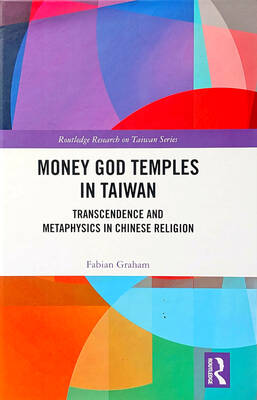
As someone who normally steers clear of books with “transcendence” or “metaphysics” in their subtitles, this reviewer — a casual observer of local belief systems since the 1990s — found Fabian Graham’s Money God Temples in Taiwan a challenging read. Those who’ve only dipped their toes into temple culture will likely need to parse several sections with special care if they’re to keep up with the author, a British ethnographic researcher whose previous books have investigated religious practices among ethnic Chinese in Southeast Asia. This scholarly volume examines a facet of Taiwan’s religious landscape that didn’t exist a century ago, and


 RSS
RSS