


Saveurs, the brainchild of jocular French chef Patrick Cabirol, is one of only a handful of French restaurants in Taipei that serves genuine French fare that is both prepared and cooked by a genuine Frenchman. It also boasts a hard core of French and Francophile patrons, which is a pretty good indicator as to just how genuinely French Cabirol's culinary creations are.
Saveurs' minimalist design blends the ambience of fine dining with the coziness of a small family-run restaurant. But while the joint's homeliness is one of its charms, it is, of course, only a minor consideration. It is the quality of the food that has made the restaurant such a hit with both lunch and dinner diners since its opening last June.
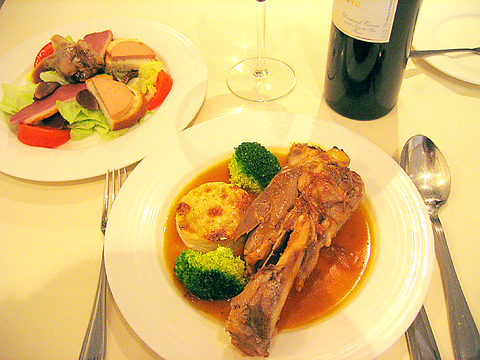
PHOTO: GAVIN PHIPPS, TAIPEI TIMES
The menu is small but solid and offers diners the chance to enjoy a selection of home-style cooking from the Perigueux region of France, an area renowned for its truffles, duck, goose and cepes mushrooms.
Entrees include cheese or seafood crepes (NT$180) and the delicious and varied Landaise salad (NT$350), which incorporates confit of duck, goose liver mousse, duck breast and duck gizzard. Those looking to splurge on a more luxuriant entree should go for the fois gras. Priced at NT$900, it might seem expensive, but if one is searching for the real Perigueux experience it is not to be missed.
The main courses include the rich and flavorful lamb shank served with tomato and carrot sauce (NT350), confit of duck leg (NT$350), duck with honey (NT$350), veal (NT$500), fillet mignon with cepes mushroom sauce (NT$650) and the special fillet mignon with pan-fried duck liver and truffles (NT$900).
In addition to the a la carte menu, diners can also opt for one of three set meals priced from NT$550 to NT$1,250. Popular with those looking to save a dollar or two, the set menus offer the chance to savor some of Cabirol's mouthwatering combinations.
For those looking for an economical yet satisfying luncheon, Saveurs is probably one of the most gratifying places to be found in Taiwan. For a mere NT$300, diners get soup, an entree, a choice of at least three main courses, dessert and tea or coffee. The lunch special has become such a hit that it has made Saveurs one of the very few diners in Taipei where advance booking on any given weekday is a must.
Be it an economical lunch or a fulfilling dinner, no meal at Saveurs should be considered complete without sampling Cabirol's outstanding chocolate moelleux (NT$180). The moelleux, with its souffle-like chocolate sponginess and soft runny-chocolate-sauce-filled center is served on a bed of rich vanilla cream, which has become its trademark.

By global standards, the traffic congestion that afflicts Taiwan’s urban areas isn’t horrific. But nor is it something the country can be proud of. According to TomTom, a Dutch developer of location and navigation technologies, last year Taiwan was the sixth most congested country in Asia. Of the 492 towns and cities included in its rankings last year, Taipei was the 74th most congested. Taoyuan ranked 105th, while Hsinchu County (121st), Taichung (142nd), Tainan (173rd), New Taipei City (227th), Kaohsiung (241st) and Keelung (302nd) also featured on the list. Four Japanese cities have slower traffic than Taipei. (Seoul, which has some

In our discussions of tourism in Taiwan we often criticize the government’s addiction to promoting food and shopping, while ignoring Taiwan’s underdeveloped trekking and adventure travel opportunities. This discussion, however, is decidedly land-focused. When was the last time a port entered into it? Last week I encountered journalist and travel writer Cameron Dueck, who had sailed to Taiwan in 2023-24, and was full of tales. Like everyone who visits, he and his partner Fiona Ching loved our island nation and had nothing but wonderful experiences on land. But he had little positive to say about the way Taiwan has organized its

Michael slides a sequin glove over the pop star’s tarnished legacy, shrouding Michael Jackson’s complications with a conventional biopic that, if you cover your ears, sounds great. Antoine Fuqua’s movie is sanctioned by Jackson’s estate and its producers include the estate’s executors. So it is, by its nature, a narrow, authorized perspective on Jackson. The film ends before the flood of allegations of sexual abuse of children, or Jackson’s own acknowledgment of sleeping alongside kids. Jackson and his estate have long maintained his innocence. In his only criminal trial, in 2005, Jackson was acquitted. Michael doesn’t even subtly nod to these facts.
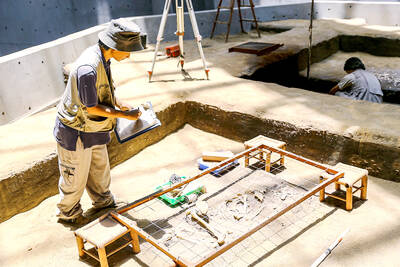
Writing of the finds at the ancient iron-working site of Shihsanhang (十 三行) in New Taipei City’s Bali District (八里), archaeologist Tsang Cheng-hwa (臧振華) of the Academia Sinica’s Institute of History and Philology observes: “One bronze bowl gilded with gold, together with copper coins and fragments of Tang and Song ceramics, were also found. These provide evidence for early contact between Taiwan aborigines and Chinese.” The Shihsanhang Web site from the Ministry of Culture says of the finds: “They were evidence that the residents of the area had a close trading relation with Chinese civilians, as the coins can be


 RSS
RSS