


Hong Kong is not a place you immediately associate with literature. There is certainly a significant interest in culture there these days, but by and large it's more often perceived as a business and commercial center, albeit good for shopping. But here, out of the blue, comes something really very
extraordinary.
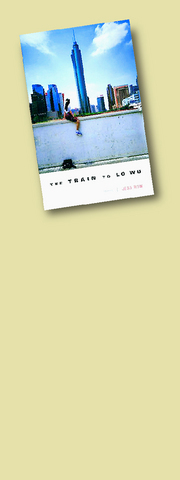
These seven short stories about Hong Kong people by a young American writer are not only subtle, skilful, and above all exceptionally thoughtful: They could well be the finest fiction ever to have appeared in English about the city. It's no exaggeration to say that The Train to Lo Wu is comparable in many ways with James Joyce's Dubliners, equally disillusioned stories about another city where things are not always what they seem.
The title story is as good a place to begin as any. It's an insightful treatment of and tentative cross-border love affair. Lo Wu is the crossing point between Hong Kong and the rest of China. It's also the gateway to China's boom town of Shenzhen. Paradoxically, perhaps, the title doesn't refer to someone leaving Hong Kong, but to somebody going back there.
Harvey, the Hong Kong narrator, is approached in Shenzhen by a girl called Lin, an orphan from a remote province. Soon they are meeting on a weekly basis, firstly in the lobby of the Shenzhen Shangri-La, later in a room he rents on the waterfront.
Harvey is a thoughtful loner. He loves windsurfing and is known to his friends as "flying fish." What he craves, and sometimes finds in the waves and the wind, is peace. He gives Lin a copy of The Dream of the Red Chamber but she returns it in disgust. What have novels got to do with her? She dreams of one day setting up a private kindergarten where she can cater to all the needs of at least a small number of children. The two agree she would never manage to get a visa to live in Hong Kong, so Harvey suggests they emigrate to Canada or Australia, using his money, and then move to Hong Kong from there.
But Lin rejects his offer. Pity isn't love, she says, and what's more it doesn't turn into it. They part, and Harvey takes the train back to Lo Wu to seek peace alone on the gray ocean.
The story has all the muted, understated irony of the film Lost in Translation (itself heavily dependent on the old black-and-white film Brief Encounter). The theme is similar as well. Harvey does love Lin, whatever she says, but they can't make a life together because of differences of circumstances, both economic and cultural, that in the event prove too great to bridge.
These are extremely sophisticated stories, but on occasion bizarre ones as well. The opening tale, for instance, features a school teacher who encounters a young student who claims she can hear the sounds emitted by bats. But in reality she is interpreting these sounds as the cries of her dead mother. The story reaches a crisis one night on the roof of her apartment building where the girl, believing it's her mother's spirit that's flying above the streets below, feels a compulsion to join her.
Another story, For You, is particularly interesting because it features an American working in Hong Kong who tries to escape an unhappy marriage by doing a stint as a Buddhist monk in Seoul. Jess Row's whole attitude toward life in these stories could be seen as having something in common with Buddhist detachment, and so his attitude toward Buddhist practice will, you feel, be fascinating to discover.
The main character here is externally the clumsy Westerner. Meditation is physically painful for him, and he can barely keep awake on the cold Korean mornings. "Make friends with pain," a fellow practitioner advises him, "then you'll never be lonely."
I may have misunderstood it, but this tale seems like a complex exercise in discriminations, a foray into a Buddhist hall of mirrors, attempting to map the Buddhist options without coming to any conclusion. It appears to end with a question mark, in common with many of the tales in Joyce's collection. As the author writes elsewhere in the book "... it may be that stories do not have to have endings we understand, any more than human lives do. Perhaps beginnings are enough."
The story Heaven Lake manages the fictional conjuring trick of combining pages as brutal and tension-filled as something out of The Sopranos with a references to Bach's Suites for Unaccompanied Cello and Aristotle's Nicomachean Ethics. But this is getting to be par for the course for this quite exceptional writer.
All these stories feature a
different protagonist, and each is both vividly and carefully imagined. In one it's an African-American who arrives in Hong Kong bearing bad news to a corporate colleague. In another it's a painter whose work is going out of fashion, and who has in addition broken a leg in Chiang Mai.
But in every case the problems are internalized, and each story examines a state of inner conflict where memory and actuality, or the heart and the mind, are in some ways in conflict. There isn't a melodramatic or a tawdry moment anywhere in the exceptionally fine tales, and the author's understated, economical prose style informs them all.
This book contains the best fiction I have ever encountered originating from Hong Kong. All seven stories have been published before as single items, albeit "in different form," but as a collection this book constitutes an astonishingly impressive debut.


Taiwan’s English education system is being pulled apart by three opposing forces. Bilingual Nation 2030 pulls students toward English and global communication. Artificial Intelligence (AI) readiness pulls them toward digital judgment, verification and AI-mediated work. But Taiwan’s old exam culture pulls them back toward memorization, grammar drills, timed reading and correct answers. If the education system keeps using old exams to define success, it risks producing graduates who are neither genuinely bilingual nor genuinely AI-ready, but trained for tasks machines can already perform. The first force is Bilingual Nation 2030. Launched in 2018, the policy aimed to “help Taiwan’s workforce connect

“Taiwan’s Opposition Leader Comes to US With a Message Straight Out of Beijing” read a May 31 headline in the Wall Street Journal. Top US administration officials and members of Congress almost certainly read the WSJ, and if there was a bullet point takeaway that people in Washington should absorb ahead of Chinese Nationalist Party (KMT) Chair Cheng Li-wun’s (鄭麗文) arrival in DC on June 9, that headline is it. The last few columns have discussed this very topic, and the timing is not coincidental. While those top officials likely do not read the Taipei Times, judging by the number

With weighty, anxiety-inducing geopolitical topics dominating the headlines, checking in on the wild and weird state of local politics can take some of the edge off. This November’s elections will determine who will be in charge of fixing potholes in your neighborhood, not the potholes in Taiwan’s complicated geopolitical space. Recently, after an online interview with a Taipei-based journalist, I commented that Taipei journalists never go further than the MRT can take them. He laughed and agreed. Naturally, the Taipei mayoral race is eating up much of the press attention. TAIPEI CITY Democratic Progressive Party (DPP) candidate Puma Shen (沈伯洋) has
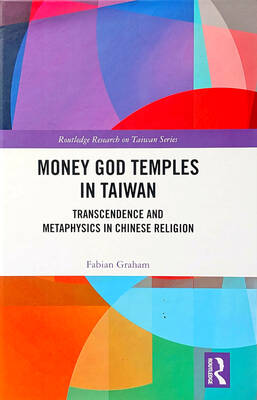
As someone who normally steers clear of books with “transcendence” or “metaphysics” in their subtitles, this reviewer — a casual observer of local belief systems since the 1990s — found Fabian Graham’s Money God Temples in Taiwan a challenging read. Those who’ve only dipped their toes into temple culture will likely need to parse several sections with special care if they’re to keep up with the author, a British ethnographic researcher whose previous books have investigated religious practices among ethnic Chinese in Southeast Asia. This scholarly volume examines a facet of Taiwan’s religious landscape that didn’t exist a century ago, and


 RSS
RSS