


To celebrate the second anniversary of Taipei's Hakka Affairs Commission, a small exhibition featuring painter Zeng Ying-qi and photographer Chi Kuo-chang (紀國章) titled Peony in the Wind -- the Splendor of Taipei's Hakka Culture is now showing at the Taipei Hakka Cultural Hall until April 15.
Billed as an exhibition showcasing Taiwanese artists "dedicated to creating fresh Hakka culture [who] break through the restrictions of cultural stereotypes to present new, non-traditional Hakka art," it turned out to be a letdown, as it seemed to be false advertising on two counts: the exhibition space and the art on view.
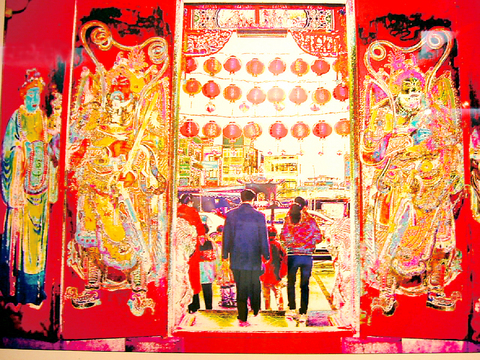
The Taipei Hakka Cultural Hall sounds impressive, but it is located in the outer hallway near the elevator banks by the Hakka Affairs Commission office stationed in Taipei City Hall. It does not have its own room and is merely the passageway to get to other offices, exits and restrooms.
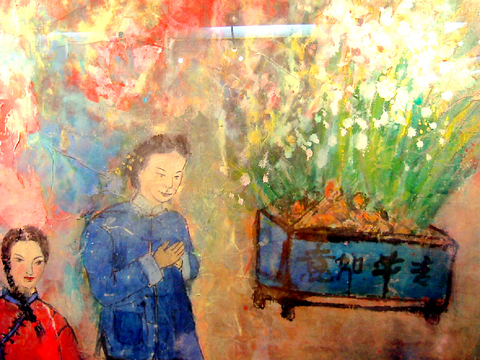
The catalog introduction by Taipei Mayor Ma Ying-jeou (
A lounge area for drinking tea was nowhere to be seen, but there was a hot water machine near the elevator, so bring your own tea bags.
Even though it is not a typical art viewing space, the office staff are quite friendly and eager to provide information, brochures and magazines about Hakka life. So the artwork on display may not be so impressive or there may not be such a comfortable place to chat, but the opportunity to learn about the culture is well worth the trip if you're interested in aspects of anything Hakka, such as finding out that they originally came from central China and that wherever they emigrated to, they still retained the tradition of working the fields in good weather and studying in bad.
The peony is the metaphor for the blossoming of Hakka culture in the midst of the strong winds of other cultures. Best-known for their mountain songs, this exhibition shows some traditional aspects of their lives.
Spotlights shine on the six framed color ink paintings by Zeng, making it a bit difficult to see the imagery due to the glare of the lights. The paintings show slices of life such as a nice Hakka girl wearing a traditional blue and white robe while wistfully holding a paper parasol in an overwhelming field of larger-than-life pink peonies.
In another, the heads of the three bearded mountain kings stare out from a field of peonies. The three mountain kings were the protectors of Hakka migrants as they represented the three mountains of Guangdong, China. And when the Hakka came to Taiwan, low-lying fertile grounds were already inhabited so they had to settle in mountainous areas, thus making the mountain gods a very important spiritual symbol for them.
In Taiwan, Taoyuan, Hsinchu, Miaoli, and Taichung were favored spots for Hakka settlements. Photographer Chi Kuo-chang (who is also showing his photos at the Nanjing East Road FNAC until Feb. 20) tries to capture those moments of contemporary life for those Taiwanese Hakka in Taipei.
The photos and paintings on view do not "break through the restrictions of cultural stereotypes to present new, non-traditional Hakka art" as promised, but seem to be more of the same old, same old.
Exhibition notes:
What: Peony in the Wind -- the Splendor of Taipei's Hakka Culture (
Where: Taipei Hakka Culture Gallery (
When: Monday through Friday, 9am to 6pm. Until April 15.
Telephone: (02) 2720 8889
On the Web: www.hakka.taipei.gov.tw

Taiwan’s English education system is being pulled apart by three opposing forces. Bilingual Nation 2030 pulls students toward English and global communication. Artificial Intelligence (AI) readiness pulls them toward digital judgment, verification and AI-mediated work. But Taiwan’s old exam culture pulls them back toward memorization, grammar drills, timed reading and correct answers. If the education system keeps using old exams to define success, it risks producing graduates who are neither genuinely bilingual nor genuinely AI-ready, but trained for tasks machines can already perform. The first force is Bilingual Nation 2030. Launched in 2018, the policy aimed to “help Taiwan’s workforce connect

“Taiwan’s Opposition Leader Comes to US With a Message Straight Out of Beijing” read a May 31 headline in the Wall Street Journal. Top US administration officials and members of Congress almost certainly read the WSJ, and if there was a bullet point takeaway that people in Washington should absorb ahead of Chinese Nationalist Party (KMT) Chair Cheng Li-wun’s (鄭麗文) arrival in DC on June 9, that headline is it. The last few columns have discussed this very topic, and the timing is not coincidental. While those top officials likely do not read the Taipei Times, judging by the number
With weighty, anxiety-inducing geopolitical topics dominating the headlines, checking in on the wild and weird state of local politics can take some of the edge off. This November’s elections will determine who will be in charge of fixing potholes in your neighborhood, not the potholes in Taiwan’s complicated geopolitical space. Recently, after an online interview with a Taipei-based journalist, I commented that Taipei journalists never go further than the MRT can take them. He laughed and agreed. Naturally, the Taipei mayoral race is eating up much of the press attention. TAIPEI CITY Democratic Progressive Party (DPP) candidate Puma Shen (沈伯洋) has
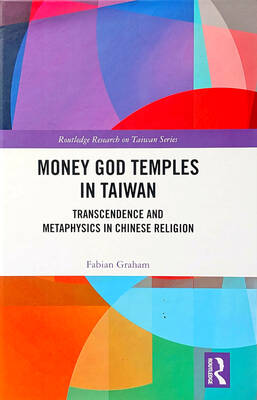
As someone who normally steers clear of books with “transcendence” or “metaphysics” in their subtitles, this reviewer — a casual observer of local belief systems since the 1990s — found Fabian Graham’s Money God Temples in Taiwan a challenging read. Those who’ve only dipped their toes into temple culture will likely need to parse several sections with special care if they’re to keep up with the author, a British ethnographic researcher whose previous books have investigated religious practices among ethnic Chinese in Southeast Asia. This scholarly volume examines a facet of Taiwan’s religious landscape that didn’t exist a century ago, and


 RSS
RSS