


Rahmatullah trudged toward his village with his donkey, as men across Afghanistan have done for centuries. But in this century, men in Jeeps and on motorbikes were passing him by.
So this year the 37-year-old father of three, speaking in front of the village mosque and its mullah, said he would join his neighbors in growing poppies to harvest Afghanistan's most lucrative cash crop, opium.
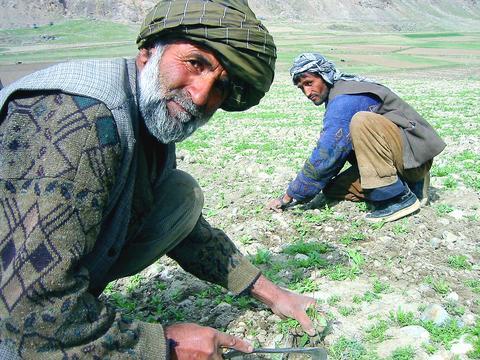
PHOTO: NY TIMES
His hierarchy of dreams is all sketched out. First he will pay off some US$1,200 in debt. Then he will build a house to replace the one room he shares with his family, then buy cows for plowing.
"Then, if I get richer, I'll buy a car," he finished, eyes agleam.
Across Afghanistan, opium cultivation is surging, defying all efforts of the Afghan government and international officials to stop it. Officials are predicting that land under poppy cultivation will rise by 30 percent or more this year, possibly yielding a record crop.
Last year the country produced almost 4,000 tonnes -- three-fourths of the world's opium -- in 28 of its 32 provinces. The trade generated US$1 billion for farmers and US$1.3 billion for traffickers, according to the UN, which is more than half of Afghanistan's national income.
The expansion of the trade presents a gathering threat to the new democratic government and a severe challenge to the US and international forces here. As opium production underpins ever more of Afghanistan's economic life, from new business growth to home construction, officials fear that the economic and political risks of uprooting it will only increase.
Anti-drug war
But US officials, reluctant to open a new front in the campaign against terror or engage in an anti-drug war here, are also conflicted about how aggressively to combat the trade.
Zalmay Khalilzad, the US ambassador, said in a recent interview that with Afghanistan's elections approaching -- they are now scheduled for September -- "the politics of it may require not to go too harsh" with eradication.
To the chagrin of Afghan and international officials, the narcotics industry has far outpaced the legal reconstruction of Afghanistan, with a capitalist intensity they would otherwise applaud.
It has lured private capital for investment and created a transparent free-market system. With their satellite phones, farmers in distant Kandahar, a rival source of poppies in the south, know almost in real time about changing weather conditions here in this northeastern province, Badakshan, and adjust prices accordingly.
`The company'
Landowners and traffickers offer credits to farmers willing to grow poppies. Trafficking has linked Afghanistan to the global economy. Poppies even brought the first real industry here, a heroin processing laboratory that villagers estimated had operated for six months to a year before it was destroyed by Afghan and British forces in January. One local referred to it as "the company."
Afghanistan's opium production peaked under the Taliban, who partly financed their movement from the profits. But in July 2000 the Taliban banned opium cultivation, to the distress of many farmers, and the price soared.
Many experts say the ban was simply meant to drive the price up, amounting to an effective cornering of the market for the Taliban and others who had amassed stockpiles.
British and Afghan officials are now counting on mullahs to spread the word that it is haram, or forbidden, under Islam to cultivate opiates. But interviews in many villages found that such preachings were ignored. Other mullahs were growing it themselves.
For many Afghans, poppies have allowed for piety. A UN report on Afghanistan's opium economy noted that 85 percent of opium traders surveyed had performed the hajj, the pilgrimage to Mecca that is incumbent on every Muslim but too costly for most Afghans.
The growth in opium production is among the gravest threats facing the administration of President Hamid Karzai.
It has corrupted the government from bottom to top, including governors and cabinet officials, according to senior Afghan and US officials.
US and Afghan officials say opium is financing regional warlords and local militias, the Taliban and the fighters loyal to Gulbuddin Hekmatyar, and possibly al-Qaeda.
Even as some US officials remain wary of fighting the spread of opium too aggressively, others have been critical of the British, who have taken the lead against the drug trade here, for being too soft and slow on eradicating poppy crops. A British plan in 2002 to compensate farmers for eradication is widely seen to have acted as a "perverse incentive" to grow, as one official put it.
Citing the link between narcotics and terrorism, UN and British officials are urging the US-led military alliance to take on laboratories and traffickers.
The Americans, who will put US$73 million toward anti-drug operations in Afghanistan this year, say such an approach will simply send the laboratories over the border to places like Pakistan's tribal areas, while doing nothing to stop the surge in new cultivation.
But a US official also pointed out that many of those in the drug trade "are the guys who helped us liberate this place in 2001" from the Taliban and on whom the US military continues to rely in its hunt for the Taliban and al-Qaeda.
"The military just does not want to go down that road," he said.
Ideally, officials say, eradication efforts would focus on wealthy landowners growing poppies, not poor farmers. But many struggling farmers have become sharecroppers on the vast fields of the rich and would share the punishment, just as they share the profit.
The US forces have so far limited their intervention against traffickers and laboratories to encounters as they come across them in the course of other military action.
But Lieutenant General David Barno, the commander of the US-led forces, said in March that his troops were finding growing connections between extremism and drugs, which could augur a more assertive approach to the drug trade.
Trafficking pays
Afghan commando units, with British support, have recently raided as many as 30 laboratories in Nangarhar province, often meeting well-armed resistance. A US A-10 attack plane shelled "the company" -- the processing laboratory near here -- when the British and Afghan commandos raided that site.
As the effort to treat the laboratories as targets increases, officials expect violence to rise. US officials say raids on laboratories have already provoked conflict among drug traffickers convinced that their competitors informed on them.
Recent fighting in the Argo district prompted the removal of the governor and police chief after officials in Kabul, the capital, concluded that the two men were working for rival traffickers.
The opium trade is transforming life in Argo, a remote district in Badakshan where a cover of green poppies climbs up steep, desolate hills. The street that runs through the bazaar is mud, but the US$200 television sets in the stalls glitter.
In the last four years, said Abdul Rahman, 18, poppies provided his family with a motorbike, a television, an electric generator, a VCR and a CD player -- and a new house to hold it all. Last year his family accumulated US$4,000 in poppy profits.
Badakshan, here in the north, lays bare narcotics' distorting economic effects. Poppy cultivation has driven up dowry prices, and raised the cost of labor so much so that wheat was not harvested last year.
So many people are building new homes and businesses with their poppy profits that Atiqullah, 23, a mason, said his daily rate had doubled.
Joining the outlaws
Criminal calculation is partly driving the spread of the drug trade. Residents of Pashtun-inhabited regions long known for poppy growing have turned into outlaw Johnny Appleseeds, crossing the country with loans, expertise and seedpods to generate more opium for heroin laboratories, US and UN officials and Afghan farmers say.
But a calculus of human longing is also at work. With the price of opium stubbornly stuck at more than US$135 a pound, no legal crop can compete.
"We see in Daryan" -- a district thick with poppies -- "other people getting rich," said Rahmatullah, who like many Afghans uses one name. "Their life is better. We want to make our life better, too."
Today, growing poppies is less about survival -- as it was during a drought in this country -- than about upward mobility. It is about a new consumer class and an even larger class of aspirants to it.
"Those who had a donkey have a motorbike," said Ahmed Shah, a young farmer in Badakshan. "Those who had a motorbike have a car. Those who have one wife want a second one."


Taiwan’s English education system is being pulled apart by three opposing forces. Bilingual Nation 2030 pulls students toward English and global communication. Artificial Intelligence (AI) readiness pulls them toward digital judgment, verification and AI-mediated work. But Taiwan’s old exam culture pulls them back toward memorization, grammar drills, timed reading and correct answers. If the education system keeps using old exams to define success, it risks producing graduates who are neither genuinely bilingual nor genuinely AI-ready, but trained for tasks machines can already perform. The first force is Bilingual Nation 2030. Launched in 2018, the policy aimed to “help Taiwan’s workforce connect

“Taiwan’s Opposition Leader Comes to US With a Message Straight Out of Beijing” read a May 31 headline in the Wall Street Journal. Top US administration officials and members of Congress almost certainly read the WSJ, and if there was a bullet point takeaway that people in Washington should absorb ahead of Chinese Nationalist Party (KMT) Chair Cheng Li-wun’s (鄭麗文) arrival in DC on June 9, that headline is it. The last few columns have discussed this very topic, and the timing is not coincidental. While those top officials likely do not read the Taipei Times, judging by the number

With weighty, anxiety-inducing geopolitical topics dominating the headlines, checking in on the wild and weird state of local politics can take some of the edge off. This November’s elections will determine who will be in charge of fixing potholes in your neighborhood, not the potholes in Taiwan’s complicated geopolitical space. Recently, after an online interview with a Taipei-based journalist, I commented that Taipei journalists never go further than the MRT can take them. He laughed and agreed. Naturally, the Taipei mayoral race is eating up much of the press attention. TAIPEI CITY Democratic Progressive Party (DPP) candidate Puma Shen (沈伯洋) has
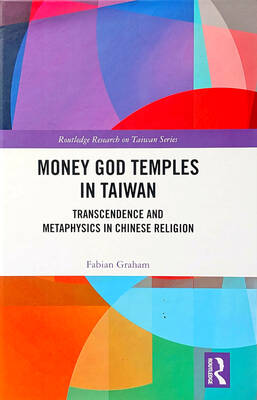
As someone who normally steers clear of books with “transcendence” or “metaphysics” in their subtitles, this reviewer — a casual observer of local belief systems since the 1990s — found Fabian Graham’s Money God Temples in Taiwan a challenging read. Those who’ve only dipped their toes into temple culture will likely need to parse several sections with special care if they’re to keep up with the author, a British ethnographic researcher whose previous books have investigated religious practices among ethnic Chinese in Southeast Asia. This scholarly volume examines a facet of Taiwan’s religious landscape that didn’t exist a century ago, and


 RSS
RSS