


Going to the seaside? Most people would probably think of Taiwan's three major resorts: Penghu, Kenting or the Northeast Coast. Holidaymakers now have another choice in Dapeng Bay, Pingtong County.
The only natural lagoon in Taiwan and the second largest coastal lagoon, Dapeng Bay has long been veiled in mystery, having served for the last 63 years as a military base, and been off limits to the public. In recent years, the government has gradually opened up areas formally reserved for the military, using some of these to promote tourism -- so the beautiful landscape of Dapeng Bay is finally being more beneficially exploited.
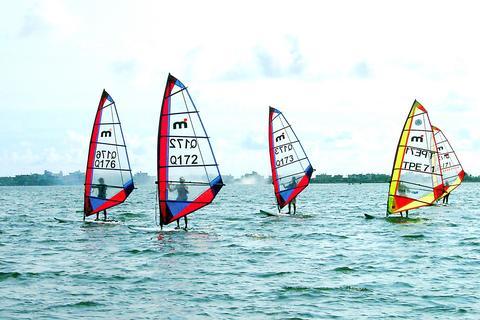
PHOTO: YU SEN-LUN, TAIPEI TIMES
The resort is currently being promoted through the Dapeng Bay Water Sports Festival (
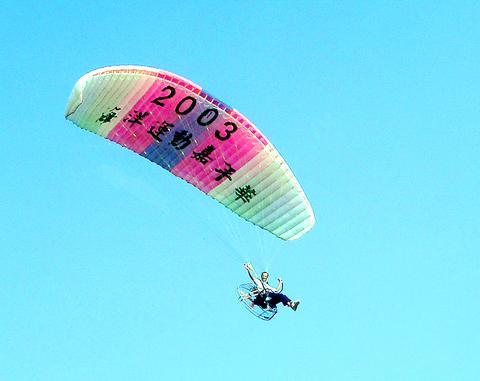
PHOTO: YU SEN-LUN, TAIPEI TIMES
Dapeng Bay is located near the harbor city of Donggang (
To get an understanding of the rich geographic and ecological environment of Dapeng Bay, its best to take a "lagoon ecology boat trip" from Renpeng Sea Water Farm (
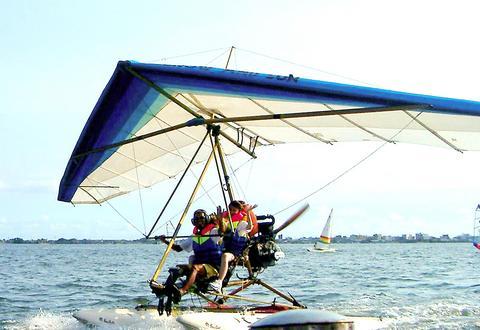
PHOTO: YU SEN-LUN, TAIPEI TIMES
The boat trip (NT$150 per person) takes about half an hour and takes you around the whole of Dapeng Bay lagoon. On the short cruise, you can view a large area of black mangroves growing in the tidal flats and stop at Oyster Shell Island, which, as its name suggests, is largely made up of piled up oyster shells, cast away by oyster farmers over the last half century. On the island, crabs and shrimps are abundant, especially the famous Sakura shrimp. The trip also teaches you how to catch sea crabs in a traditional manner.
The administration of Dapeng Bay National Scenic Area (
While beautiful nature is being promoted, the people who are behind the current Ocean Athletic Feast are in fact the cabinet-level National Council for Physical Fitness and Sports (
According to a spokesperson for the Pingtong County Government, the council decided to develop the bay as another center for water sports in Southern Taiwan. "After the huge success of Ilan's International Children's Folklore and Folk Game Festival, many local governments wanted to follow suite to set up a festival to boost local tourism."
Now the bay area has been built into a dock area filled with boats, canoes and watercycles. And beside the dock, there is a giant airplane-shaped building under construction. This is designed to be a restaurant and to symbolize that the area was a former airforce base. Now, available water sports include bumping boats (NT$100 per boat/hour), watercycles (NT$100 per boat/hour), canoeing (NT$150 per canoe/hour), dragon boats (NT$50 per seat/hour), sailing (NT$150 per person/hour) and rafting (NT$150 per boat/hour).
Various competitions will be held through August. Between Aug. 1 to Aug. 7 there are sail boat races and beach volleyball matches. From Aug. 8 to 14 there are canoeing adventures. And from Aug. 22 to Aug. 28, there will be a water-skiing performances as well as water-skiing competitions.
When you've had enough of the water sports, there is plenty to do on land. The former military camp at Dapeng Bay is worth a visit. It served as a sea plane and kamakzi base during WWII. The seaplane port could accommodate 40 planes at one time. The base was taken over by the US military after the war and it became a factory producing parts and equipment for airplanes.
Although Dapeng Bay became a National Scenic Area in 1997, it was not until May this year that the Pingdong County government, together with NCPFS, began actually utilizing the bay area.
You can still see the tunnels, the command center, and air raid shelters of the former camp, which are just 10 minutes walk away from the bay. You can even see the strafe marks on the iron doors of the tunnels.
To take part in the Dapeng Bay Water Sports Festival, the most convenient way is to take a package trip organized by the Pintong County Government which is available through the EZ Travel Web site. A two-day trip from Taipei, including the Kenting Star Express Train (a special tourism train going directly to Pingtong), hotel, meals and tickets for three water sports are priced between NT$6,500 to NT$9,900. A one-day trip from Kaohsiung station is priced at just NT$1,500, including bus fare and meals. If you are driving to Dapeng Bay and don't require a package deal, you can still get discount coupons for water sports through the Internet, with NT$555 covering entrance and a number of activities.

Ajay Verma, a consultant gastroenterologist at Kettering general hospital in Northamptonshire, says our gut is a “complex machine.” “It is constantly providing us with the nutrition we need, initially to grow and develop, and then for us to survive, thrive and repair from injury and illness.” How can we keep it functioning well? Put simply: “Make sure what you put into it is balanced, and that you clear out its waste products adequately,” Verma says. “In a general gastroenterology clinic, the most common conditions we see are irritable bowel syndrome (IBS), gastroesophageal reflux disease, inflammatory bowel disease and constipation,” says Nisha
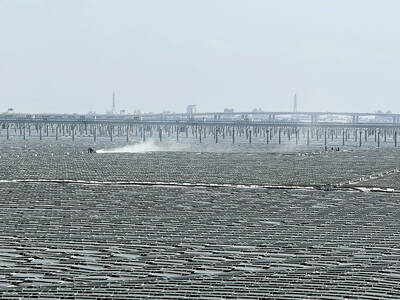
The arithmetic is straightforward and uncomfortable. By the end of 2025, Taiwan had committed itself to a 50-30-20 electricity mix — half natural gas, 30 per cent coal, 20 per cent renewables. The Ministry of Economic Affairs’s (MOEA) own monthly energy reports tell a different story. Natural gas reached 47.8 per cent of generation last year. Coal stood at 35.4 per cent, comfortably above its target ceiling. Renewables came in at 13.1 per cent, well short of the 20 per cent Taipei had pledged a decade earlier. Installed renewable capacity reached roughly half of the 12 gigawatts (GW) the government

Last week US President Donald Trump was asked by a reporter whether he would speak on the phone to the President of Taiwan. “l’ll speak to him. I speak to everybody. We have that situation very well in hand,” Trump said. This marked the second time in a couple of weeks he had said he would talk to the President of Taiwan. In 2016 he famously took a call from then-president Tsai Ing-wen (蔡英文), when he was president-elect. Despite warnings that the apocalypse was nigh because of a phone call, the world quickly forgot about the conversation between two democratically-elected presidents.

May 25 to May 31 Few believed that apples could be cultivated on a commercial scale in Taiwan’s high mountains. When horticulturalist Cheng Chao-hsiung (程兆熊) first proposed the idea in 1955, both American and Taiwanese colleagues dismissed it as implausible, arguing that temperate fruit could not be reliably grown on a subtropical island, especially on rugged terrain. However, it was this terrain in the Central Mountain Range where many Chinese Civil War veterans were resettled in the late 1950s. With limited job prospects and no family in Taiwan, they were placed on cooperative farms aimed toward self-sufficiency. Some say the conditions


 RSS
RSS