


For many Taiwanese who have not visited Kenting for years, there will be culture shock when you visit this southernmost Taiwan town. You will be surprised at the rampant stores, restaurants, pubs, clubs and street vendors, mostly packaged with exotic flair: Thai restaurants, sarong shops and southeast Asian accessories stands. "Kenting has changed a lot!" was my first reaction when seeing the famous tourist spot for the first time in four years.
Last weekend was one of the busiest of the year in Kenting, with the annual rock concert Spring Scream in its ninth year and at least three other dance parties held on concurrent days. "It's like every foreigner on the island has come to Kenting," said a fellow Taipei resident.
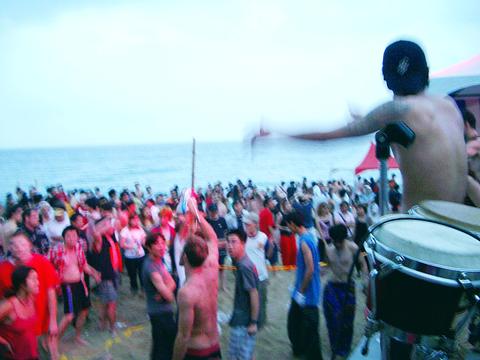
There was an electronic dance party held at the long stretch of beach known as Dawan (
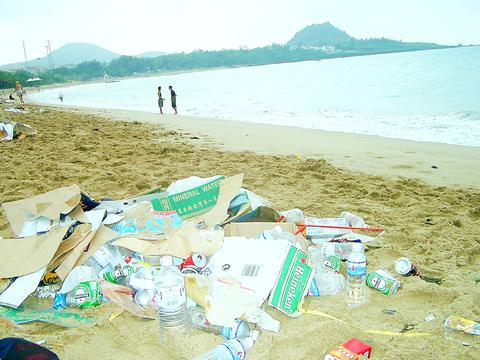
"Kenting is looking more and more like Bali," said Catherine Chen (
And on Sunday morning, the last day of the spring break weekend, a car accident occurred on Kenting Rd. A van, trying to avoid vendors occupying the road, accidentally hit a pedestrian woman from behind. She was flipped in the air and over the van. The scene was sudden and horrifying and immediately aroused a crowd who gather to help the injured woman.
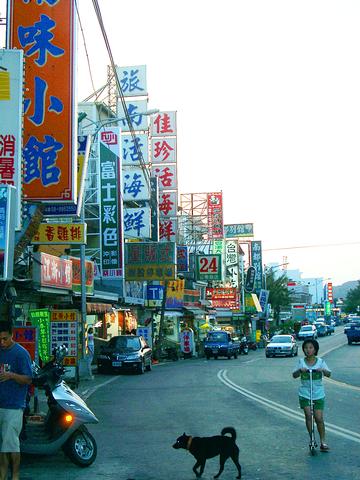
PHOTO: YU SEN-LUN, TAIPEI TIMES
"There's too much traffic! ... The road should have been pedestrianized a long time ago! ... There has been talk about it for years, but the construction has never started," were comments from the gathering crowd of locals.
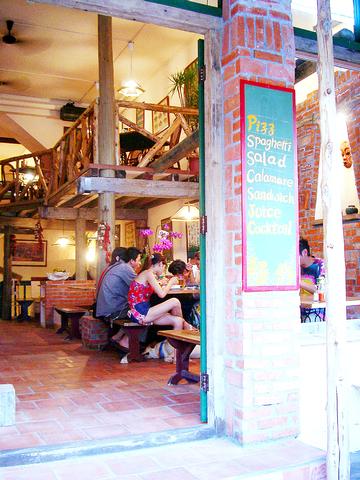
PHOTO: YU SEN-LUN, TAIPEI TIMES
"Kenting has developed too fast and it's become much uglier," said Catrina Chou (
Chou is not the only one who sees the resort town this way. Didi Yi (
Once a small fishing village, Kenting is now a town of changing faces and has the potential to become an international seaside resort. But the unbridled pace of development has also undermined the town's future tourism prospects.
Kenting was given its Chinese name some 200 years ago when Ching-dynasty governor Shen Pao-chen (
It was a simple village where people would fish and grow sisal and onions. But the beautiful scenery of the area soon became well known. Surrounded on three sides by the Taiwan Strait, Bashi Channel and the Pacific Ocean, the peninsula claims a vast array of physical features, from coral reef coastlines, rocky shores and sand beaches, to hills, lakes, forests and sand dunes. In the early days of Japanese occupation, Kenting was regarded as the "crown pearl" tourist site of Taiwan.
In 1982, much of the area formally became Taiwan's first national park, ranging from Gueishan (
"Kenting has always been the place where different foreign cultures come. We [Kenting residents] are used to it!" said Charles Tsai (
The first international hotel to enter Kenting was Caesar Park (凱撒飯店) 16 years ago, which was originally a Japanese-invested, five-star hotel. In a way, Caesar can be seen as an early bridge for the international community to the town.
In the early days of Caesar Park, a Swiss chef from the hotel's Italian restaurant began teaching locals to make pizza, which later resulted in the first pizza restaurant in town. The restaurant attracted both locals and foreigners and a few years later became Amy's Cucina, now one of the more popular restaurants on Kenting road. A wooden signboard out front offers pasta, pizza, sandwiches and drinks.
"This is a sign of progress," said Jose Chuang, co-owner of Amy's Cucina and Catrina Chou's husband, referring to the prosperity of businesses along Kenting Rd. Chuang said that nine years ago he was a windsurfer who frequently came to Kenting.
"Since I loved this place, I thought, `Why not set up a life here where I could have my own cafe and surf everyday?'" Chuang said. Chuang doesd not think of Amy's as anything out of the ordinary. "Kenting needs places like ours," he said.
Another hot-spot restaurant is Warung DiDi, which opened 10 years ago. Being the first restauranteur to offer southeast Asian food (Malay, Singaporean and Thai), the Brunei-Chinese Didi Yi said she and her French husband Marco Marcelo were also watersports lovers. She said they enjoy owning a small business while being able to enjoy a sea-side life.
"In the first year, local people were very curious about our store but not used to the sour and spicy tastes," Yi said. But as more and more Taiwanese began travelling to southeast Asia, Yi said the store gained greater popularity.
"Later, after Spring Scream began, foreigners began helping our business," she said. Now DiDi's has become so popular that the house is strictly reservation-only on busy weekends.
Yi is also one of the pioneers of bringing tropical-flavored products to Kenting. Ten years ago, wearing a sarong on the street was an uncommon scene, but for the Brunei-raised Yi, a sarong is the staple garment for tropical life. "Kenting has been crowded with T-shirt stores, but we were among the first ones to import sarongs from Bali," she said. Now, almost every store or stand on the main road carries sarongs.
Along with the influx of tourists has come the hotel chains. Five years ago, Howard Plaza Hotels and Ritz Hotels also built in Kenting, becoming the town's second and third five-star hotels.
According to Lee Yeng-sen (
"Kenting has three `manys' -- many hotels, many convenience stores and many street vendors," said Chuang. "A lot of the vendors even come from neighboring townships or counties," he added. "In the past ten 10 years, many Kenting locals have made a fortune. Most of them don't even know how they made it."
As tourism started booming and the fishing industry declined, Kenting became a land of opportunity for locals to involve themselves in the tourism industry.
"It is sad to see that some of the beautiful scenery of Kenting is vanishing," said Catherine Chen. For example, she said, Hsiaowan (
The same is happening at Nanrenshan, a valley with a variety of geological features. "I could once see hundreds of butterflies in the valley, now I'd feel luck if I found two or three," Chen said.
The planning and management of Kenting's tourism industry seems to lag behind the speed of development, a common view held by Kenting locals, be they they restaurant owners, hotel executives or community leaders.
A solution to the traffic problem has been put off for the past two years, said community leader Tsai. The National Park Headquarters proposed the plan to pedestrianize the main road, but it was opposed by many owners of stores along the road who feared losing business. The plan has yet to be acted on.
Jet skis and water cycles were finally legalized earlier this year, but it has not yet been determined where such sports can take place. Divers currently share the same water with jet skis.
According to Lee Yeng-sen, superintendent of Kenting National Park, the headquarters have set up two sewage treatment plants near the sea to purify water from hotels before expelling it into the ocean. And in July of this year, the headquarters will take charge of issuing construction licenses for new buildings in the area. It is expected that the issuing of new licenses will be tightened. "We will set up a more uniform building style for the streets, while trying to highlight the special landscape of Kenting," said Lee.
These projects, for many Kenting dwellers, need to be done urgently. Because, just as Lee said, "the chaotic development of the township may soon bring an end to its tourism."
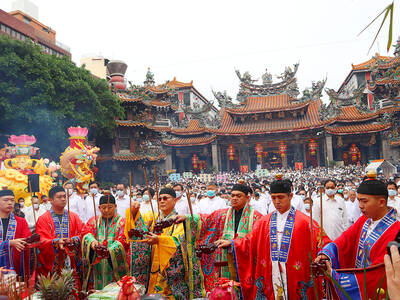
Recently the Chinese Nationalist Party (KMT) and its Mini-Me partner in the legislature, the Taiwan People’s Party (TPP), have been arguing that construction of chip fabs in the US by Taiwan Semiconductor Manufacturing Co (TSMC, 台積電) is little more than stripping Taiwan of its assets. For example, KMT Legislative Caucus First Deputy Secretary-General Lin Pei-hsiang (林沛祥) in January said that “This is not ‘reciprocal cooperation’ ... but a substantial hollowing out of our country.” Similarly, former TPP Chair Ko Wen-je (柯文哲) contended it constitutes “selling Taiwan out to the United States.” The two pro-China parties are proposing a bill that
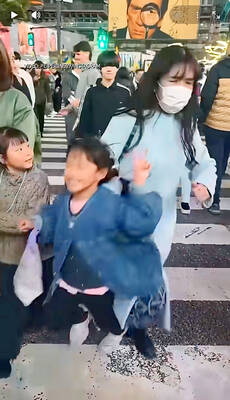
It starts out as a heartwarming clip. A young girl, clearly delighted to be in Tokyo, beams as she makes a peace sign to the camera. Seconds later, she is shoved to the ground from behind by a woman wearing a surgical mask. The assailant doesn’t skip a beat, striding out of shot of the clip filmed by the girl’s mother. This was no accidental clash of shoulders in a crowded place, but one of the most visible examples of a spate of butsukari otoko — “bumping man” — shoving incidents in Japan that experts attribute to a combination of gender

The race for New Taipei City mayor is being keenly watched, and now with the nomination of former deputy mayor of Taipei Hammer Lee (李四川) as the Chinese Nationalist Party’s (KMT) candidate, the battle lines are drawn. All polling data on the tight race mentioned in this column is from the March 12 Formosa poll. On Christmas Day 2010, Taipei County merged into one mega-metropolis of four million people, making it the nation’s largest city. The same day, the winner of the mayoral race, Eric Chu (朱立倫) of the Chinese Nationalist Party (KMT), took office and insisted on the current
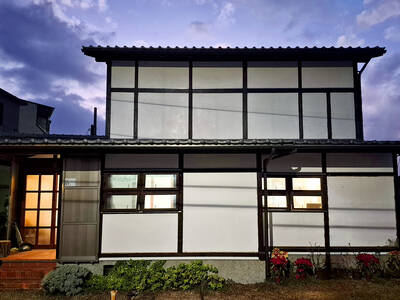
When my friend invited me to take a tour of a wooden house hand-built by a Pingtung County resident, my curiosity was instantly piqued and I readily agreed to join him. If it was built by a single person, it would surely be quite small. If it was made of wood, it would surely be cramped, dingy and mildewy. If it was designed by an amateur, it would surely be irregular in shape, perhaps cobbled together from whatever material was easily available. I was wrong on all counts. As we drove up to the house in Fangliao Township (枋寮鄉), I was surprised


 RSS
RSS