


The film Crouching Tiger, Hidden Dragon was a multi-national project, jointly produced by Columbia Tristar, Ang Lee's (
There have been reports that a Chinese producer invested in the film. But Hsu is quick to state that no Chinese investors were involved. "The US$15 million budget did not include a penny from Chinese investors," he said.
Originally, he said, a Taiwanese businessman who owns a listed electronics company expressed interest in throwing US$12 million into Crouching Tiger. "But soon after we signed the contract, Taiwan's stock market began to drop," he said.
"This businessman proposed to postpone the project for a year. But we did not have time to wait," said Hsu.
Hsu had initiated a lawsuit against the businessman but later dropped it because the businessman said to him: "I was moved by your devotion to film and therefore decided to invest. You are now making a film about chivalry. Please do not stab me in the back when I'm in trouble."
With the budget dropped, Lee had to seek investment from Columbia. Columbia picked up the project in the form of pre-sale.
"And the rest of the money we raised with a loan from insurance company," he said. A few deals in Cannes last year also helped round out the budget, Hsu said.
With Couching Tiger's box office receipts in North America alone having topped US$100 million, the loan from the insurance company has been cleared with a handsome profit to boot.
Hsu's own film Fleeting by Night, by contrast, although a best-selling film in Taiwan last year, still failed to cover its production costs. "The marketing and promotion system of Columbia was indeed a powerful boost for Crouching Tiger's commercial success," said Hsu.
Despite its major corporate backing, Hsu insists the film is still very much a Taiwanese production. "This is a big thing for Taiwanese film. I really regret to see that some in Taiwan not only show indifference to it, but also attack it," said Hsu, referring to criticism at home of the film.


Taiwan’s English education system is being pulled apart by three opposing forces. Bilingual Nation 2030 pulls students toward English and global communication. Artificial Intelligence (AI) readiness pulls them toward digital judgment, verification and AI-mediated work. But Taiwan’s old exam culture pulls them back toward memorization, grammar drills, timed reading and correct answers. If the education system keeps using old exams to define success, it risks producing graduates who are neither genuinely bilingual nor genuinely AI-ready, but trained for tasks machines can already perform. The first force is Bilingual Nation 2030. Launched in 2018, the policy aimed to “help Taiwan’s workforce connect

“Taiwan’s Opposition Leader Comes to US With a Message Straight Out of Beijing” read a May 31 headline in the Wall Street Journal. Top US administration officials and members of Congress almost certainly read the WSJ, and if there was a bullet point takeaway that people in Washington should absorb ahead of Chinese Nationalist Party (KMT) Chair Cheng Li-wun’s (鄭麗文) arrival in DC on June 9, that headline is it. The last few columns have discussed this very topic, and the timing is not coincidental. While those top officials likely do not read the Taipei Times, judging by the number

With weighty, anxiety-inducing geopolitical topics dominating the headlines, checking in on the wild and weird state of local politics can take some of the edge off. This November’s elections will determine who will be in charge of fixing potholes in your neighborhood, not the potholes in Taiwan’s complicated geopolitical space. Recently, after an online interview with a Taipei-based journalist, I commented that Taipei journalists never go further than the MRT can take them. He laughed and agreed. Naturally, the Taipei mayoral race is eating up much of the press attention. TAIPEI CITY Democratic Progressive Party (DPP) candidate Puma Shen (沈伯洋) has
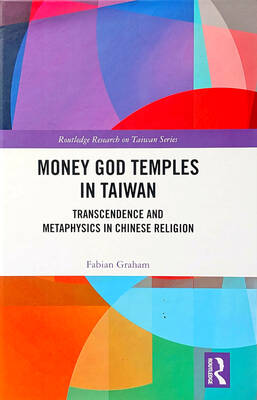
As someone who normally steers clear of books with “transcendence” or “metaphysics” in their subtitles, this reviewer — a casual observer of local belief systems since the 1990s — found Fabian Graham’s Money God Temples in Taiwan a challenging read. Those who’ve only dipped their toes into temple culture will likely need to parse several sections with special care if they’re to keep up with the author, a British ethnographic researcher whose previous books have investigated religious practices among ethnic Chinese in Southeast Asia. This scholarly volume examines a facet of Taiwan’s religious landscape that didn’t exist a century ago, and


 RSS
RSS