


As the Oscars draw near, the Crouching Tiger, Hidden Dragon (臥虎藏龍) team was busy completing its last-minute preparations in Los Angeles yesterday.
Wang Hui-ling (王蕙玲), nominated for best screenplay for Crouching Tiger, said she and others in the film's entourage would appear at the Oscars ceremony in Chinese-style dress.
"I am happy for Lee who visualized his dream world of martial arts. And did so in his own style," said Wang, originally a playwright, as she arrived at her hotel in Los Angeles.
Wang said all she did in the film was to help Lee integrate the original story and Lee's own ideas, and then rewrite some of the script so it sounded more natural both to Chinese-and non-Chinese-speaking audiences.
"I'm proud to have done the job," she said, but admitted she's not a martial arts fan.
In the film, a major element apart from the fighting is the dynamics of a love triangle and the consequential struggles with human desire along classic Taoist lines. "This is the part that Lee intended to stress in particular," said Wang.
Wang, who is best known for her award-winning TV dramas, cooperated once before with Ang Lee in Eat Drink Man Woman (飲食男女) and is currently working on a biographic film about modern Chinese writer Chang Ai-ling (張愛玲).
"When I received the script draft from Lee, it was an English one written by James Shamus mainly to solicit funds in the US at that stage. So I had to rewrite the script in Chinese to maintain the martial arts spirit of the original story," she said. Wang said Lee flew to Vancouver,where she currently lives, to spend three days discussing the story with her. Together they made the backbone of the story.
Lee credits Wang for bringing literary and philosophical weight to the story. She consulted the Tao Te Ching (道德經) as a reference in writing the dialogue between the characters and invented a sword fighting style called Hsuan-pin Style (玄牝劍法), which is also taken from the Tao Te Ching.
Indeed in the film, the dialogue between Chow Yun-fat (周潤發) and Zhang Ziyi's (章子怡) characters makes strong play of Taoist themes. "When you hold it you have nothing. But loosen your grip, you'll have the whole," says Chow.
"Lee is indeed into Taoism. You can see it from his style and patience and calmness," Wang said.
Wang said she appreciates Lee's talent in portraying the vivid lives of the two female protagonists in the film. "He has a concern about woman's fate, their adventures and their loves, which may be too fantastical to me as a woman writer. But he does make good drama about it."
The Oscar ceremony promises to have a distinct Chinese flair with the film's representatives in Chinese-style dress. "Ang Lee kept reminding me of this. He even called when I was in Shanghai doing research, making sure what kind of dress I'm gonna wear," Wang said.
Meanwhile, Taiwanese singer Coco Lee (
"There will be Chinese dancers flying around with martial arts, just like you see in the film," the singer said yesterday in Los Angeles. Lee said she will be wearing a Chinese-style dress designed by Chanel.


Taiwan’s English education system is being pulled apart by three opposing forces. Bilingual Nation 2030 pulls students toward English and global communication. Artificial Intelligence (AI) readiness pulls them toward digital judgment, verification and AI-mediated work. But Taiwan’s old exam culture pulls them back toward memorization, grammar drills, timed reading and correct answers. If the education system keeps using old exams to define success, it risks producing graduates who are neither genuinely bilingual nor genuinely AI-ready, but trained for tasks machines can already perform. The first force is Bilingual Nation 2030. Launched in 2018, the policy aimed to “help Taiwan’s workforce connect

“Taiwan’s Opposition Leader Comes to US With a Message Straight Out of Beijing” read a May 31 headline in the Wall Street Journal. Top US administration officials and members of Congress almost certainly read the WSJ, and if there was a bullet point takeaway that people in Washington should absorb ahead of Chinese Nationalist Party (KMT) Chair Cheng Li-wun’s (鄭麗文) arrival in DC on June 9, that headline is it. The last few columns have discussed this very topic, and the timing is not coincidental. While those top officials likely do not read the Taipei Times, judging by the number

With weighty, anxiety-inducing geopolitical topics dominating the headlines, checking in on the wild and weird state of local politics can take some of the edge off. This November’s elections will determine who will be in charge of fixing potholes in your neighborhood, not the potholes in Taiwan’s complicated geopolitical space. Recently, after an online interview with a Taipei-based journalist, I commented that Taipei journalists never go further than the MRT can take them. He laughed and agreed. Naturally, the Taipei mayoral race is eating up much of the press attention. TAIPEI CITY Democratic Progressive Party (DPP) candidate Puma Shen (沈伯洋) has
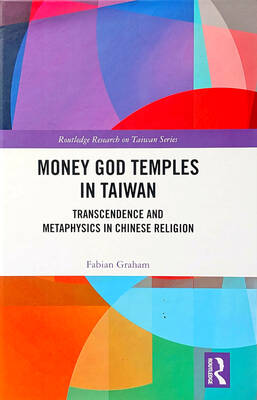
As someone who normally steers clear of books with “transcendence” or “metaphysics” in their subtitles, this reviewer — a casual observer of local belief systems since the 1990s — found Fabian Graham’s Money God Temples in Taiwan a challenging read. Those who’ve only dipped their toes into temple culture will likely need to parse several sections with special care if they’re to keep up with the author, a British ethnographic researcher whose previous books have investigated religious practices among ethnic Chinese in Southeast Asia. This scholarly volume examines a facet of Taiwan’s religious landscape that didn’t exist a century ago, and


 RSS
RSS