


As a world traveler, sculptor Li Chen (李真) dreamed of the day that he would be able to interact with the world through his art. His dream seems to be finally coming true.
A sculptor with considerable local repute from Taichung County, Li is among the small pool of Taiwan artists with the talent and, perhaps most importantly, the connections to take his work abroad.
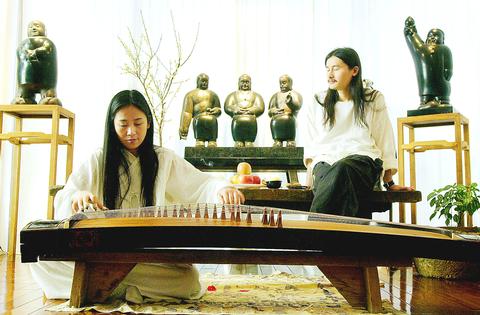
PHOTO: CHEN CHENG-CHANG, TAIPEI TIMES
The first step for Li onto a larger stage occurred at the 1999 Taipei Art Fair, where he put on his first solo exhibition. His local agent Hung Ray-yi (洪瑞鎰) had sent Li's portfolio to over 200 art dealers in the US and Europe in advance of the show, hoping to stir up talk about the sculptor's works. London-based art dealer Michael Goedhuis responded, seeing an artist with immense potential. At the five-day art fair, sales of Li's stylized Buddha-inspired sculptures from a series titled Energy of Emptiness: Delights of Ordinary People (虛空中的能量:凡夫諸趣系列) totaled nearly NT$10 million. As the whirlwind of the art fair settled toward the end of 1999, Hung was talking to Goedhuis about the possibility of joint representation.
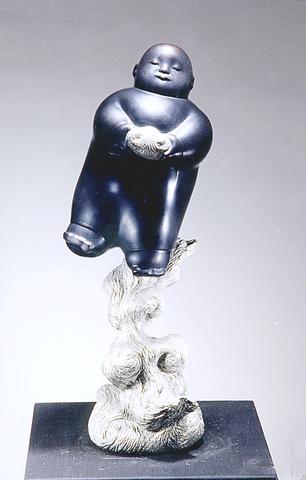
PHOTO: COURTESY OF RIVER ART
The term globalization may be a marketing catch phrase, but for Li, Goedhuis and Hung, the term carries special resonance as they work to bring Li's works into the wider art world. And Li's arrival on the local art scene has been nothing short of meteoric, as he appeared on the covers of two leading art journals last month and made a splash with a new series The Transformation of Emptiness: Boundary with Boundary (虛空化境:界中界) at the 2000 Taipei Art Fair.
Chubby buddhas
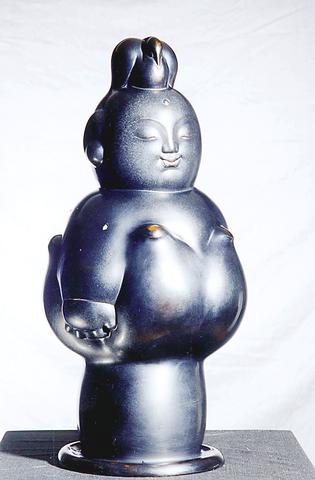
PHOTO: COURTESY OF RIVER ART
Those who visited Li's second solo show at last year's art fair saw that his Buddha-inspired chubby figures have undergone a further transformation. The Buddha variations are more human and have taken on a comical, cherubic look. Like a group of Garfields -- chubby, contented, sleepy, stunned or confused -- each one appears sweet like a baby. Infused in the sculptures are also Li's concerns and beliefs about life and the environment.
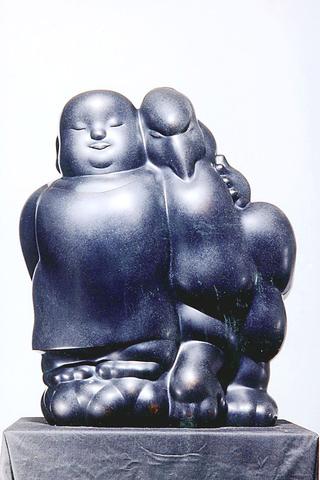
PHOTO: COURTESY OF RIVER ART
In The Egret's Spring (2000), for example, the figure embraces an egret, a species that is rapidly disappearing from Taiwan. The Buddha's Smile (2000) is inspired by the Statue of Liberty in New York, except that the fire of Lady Liberty's torch is replaced by a lotus flower. The flower is symbolic of one of Li's highest values: being true to oneself in the mist of the world's chaos and confusion. The freshness of the works and the distinctly Buddhist-inspired messages contained within them appeal to large audiences, both in Taiwan and abroad.
Finding an opening
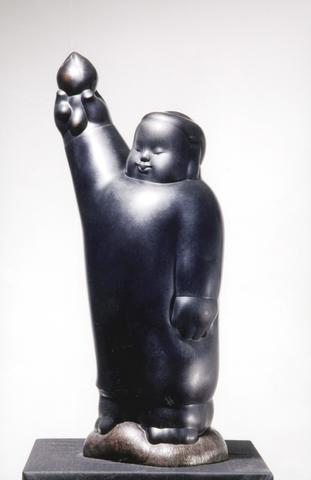
PHOTO: COURTESY OF RIVER ART
"I know it will work," says Hung. Having run several galleries for 20 years, Hung felt certain about his move to bring Li overseas and began to exclusively represent the sculptor in 1998. "The overseas market has always been fascinated by exotic, ancient Buddhist sculptural images. Li's Buddha variations go a step further to make them stand out, integrating Western sculpture techniques and Asian concepts of philosophy," he said.
Goedhuis, who specializes in commercial art fairs, currently represents 18 Taiwanese and Chinese artists scattered around the globe. Last year, he signed three Taiwanese artists, Li among them. Li is also one of only two sculptors on Goedhuis' roster.
"In our view, he is the leading sculptor from Taiwan," Goedhuis said. Goedhuis was in Taiwan last September to visit Li and Hung, and immediately afterward went straight to work making plans for shows abroad. The following month, Goedhuis was busy showcasing Li's sculptures in New York's International Fine Art Show.
Together, Goedhuis and Hung have arranged exhibits in Palm Beach, Florida next month, in New York in March and in Geneva in April. A solo exhibit is also planned at the Taichung River Art Gallery from March 3 to April 1.
Hung sees the shows as a major break for Li to move onto the international stage. "Taiwan is just a small island. It's not enough to provide large clientele. We need to reach out," Hung adds.
Hung says that an overseas agent is often necessary to break into the foreign art market. Some art fairs abroad, for example, have threshold requirements, such as a recommendation from a local art critic. The connection through Goedhuis overseas is the perfect opening for Li.
"His sculptures attracted enormous interest," Goedhuis says excitedly of the showcase in New York last October. Opera singer Jessye Norman bought a piece and the private museum, the Olenska Foundation, in Geneva, bought three others. Goedhuis says Li has become a key figure in contemporary sculpture in Asia because his works show "continuity with the cultural past and exposure to developments in the West.
"This is what makes Li Chen's art so interesting and valid," Goedhuis says.
Gaining recognition
Hung and Goehuis are doing their part to bring Li's sculptures to as many venues abroad as possible and Li spends as much time as possible cloistered at home working on more pieces. But his sculptures have yet to receive the nod of approval from the academic world, which would secure his position among the elite of contemporary artists.
Richard Chang (張學孔), a local art dealer for 10 years who specializes in overseas Asian artists in Europe, says Li has been offered a rare opportunity that most local artists will never receive. "So far I can only think of one or two artists from here that have been lucky enough to have an overseas agent and be systematically promoted abroad," Chang says.
"He has just walked beyond the gate, but is not yet successful in the classic sense. To gain worldwide recognition as a major artist, he needs to be endorsed by critics and significant museums. We will wait to see if he gets there."
For Willington Lee (李松峰), owner of Gallerie Elegance in Taipei, Li's growing prominence abroad is a phenomenon that comes with Taiwan's increased exposure to the world in general. "It's not enough for one single artist to start a significant dialogue with the world. It will take a group of artists to make a regional culture be noticed on the world map."
Indeed, Li's key to a global market is in many ways creditable to world-famous Taiwan artists who preceded him, including the sculptor Ju Ming (朱銘) and the painter Yu Peng (于彭).
A personal style
Li's family owned a small construction company in Taichung County while he was growing up, which brought him into contact with modeling and creating objects with his hands. He attended a vocational high school and chose art as his major course of study and later moved into sculpture exclusively.
His styles have changed radically over the years, from his more technical early works that relied on attention to minute detail, to his recent stylized Buddhas which are more humorous and conceptual.
After vocational school, Li worked for about 10 years under contracts from temples and private clients to make Buddha sculptures before he dedicated himself full time to his own works. As a commercial sculptor, he was often given photos to work from, and asked to do direct copies. He sculpted Buddhas of all sizes in a variety of styles from different dynasties in Chinese history. Tang dynasty Buddhas are plump and rounded, while Yuan dynasty Buddhas are more elaborately dressed in gowns with plenty of accessories. He quickly became a master at reproduction.
By the early 1990s, Li began to tire of technique-intensive sculpture contracts. He wanted to be creative and make an artistic impression with his works. Inspired by a video he saw in 1990 on Chinese sculptures held at The British Museum, he came up with his extremely popular design for Avalokitesvara, Goddess of Mercy with Water and Moon (水月觀音). In this piece, the goddess is sitting on top of rippling water, with the moon as her backdrop and a lotus in her hands. In a two-year span, Li made only 30 pieces in this series, earning a respectable NT$4 million.
But fortune and fame are not Li's primary goals. He could have made more of the Avalokitesvara series and enjoyed commercial success, but his motivation was instead to move forward with his creations and forge a uniquely Taiwanese tone in his art. He sought to create sculptures that are less spiritual, less authoritative, but catching, humanistic, fun, and conceptually rich.
The result has been his wildly successful?Energy of Emptiness series and last year's The Transformation of Emptiness.
Down on the farm
During a brief respite from the exhibit tour, at home in the countryside of Taichung County, Li works quietly in his studio. His traditional robes, soft voice and long flowing hair lend a quintessential sage appearance to the man. He is slightly reclusive, sitting in a corner of the art fair last month. But he appears to be taking the hubub surrounding him in stride. Asked about how it feels to be an artist on the verge of international recognition, he strikes a philosophical note: "I feel no pressure being in the limelight. Life goes on," he shrugs.
Nonetheless, he remarks that things have changed for him. It takes about two and a half months for a sculpture to take shape, and Li is already delaying some of his overseas engagements to give himself room to breathe. "My life was easier in that I just had to do sculpture, but now I have to work with an overseas manager and deal with the media. With my works sold abroad, I have to also work with an overseas manager that I can hardly communicate with, and who knows what will come next?"
Apparently he won't have much time to ponder that question with his hectic schedule of exhibitions, as his agents have already arranged a date for him with the world.
Li Chen's sculptures can be seen at his solo exhibition at the River Art Gallery, Taichung City, from March 3 to April 1.

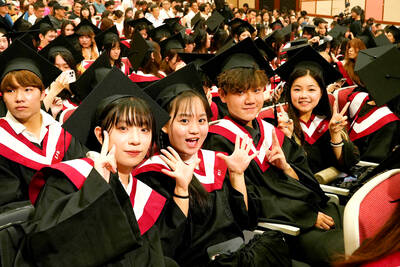
Taiwan’s English education system is being pulled apart by three opposing forces. Bilingual Nation 2030 pulls students toward English and global communication. Artificial Intelligence (AI) readiness pulls them toward digital judgment, verification and AI-mediated work. But Taiwan’s old exam culture pulls them back toward memorization, grammar drills, timed reading and correct answers. If the education system keeps using old exams to define success, it risks producing graduates who are neither genuinely bilingual nor genuinely AI-ready, but trained for tasks machines can already perform. The first force is Bilingual Nation 2030. Launched in 2018, the policy aimed to “help Taiwan’s workforce connect

“Taiwan’s Opposition Leader Comes to US With a Message Straight Out of Beijing” read a May 31 headline in the Wall Street Journal. Top US administration officials and members of Congress almost certainly read the WSJ, and if there was a bullet point takeaway that people in Washington should absorb ahead of Chinese Nationalist Party (KMT) Chair Cheng Li-wun’s (鄭麗文) arrival in DC on June 9, that headline is it. The last few columns have discussed this very topic, and the timing is not coincidental. While those top officials likely do not read the Taipei Times, judging by the number
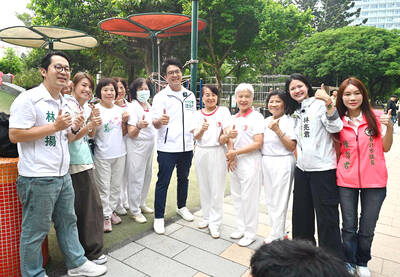
With weighty, anxiety-inducing geopolitical topics dominating the headlines, checking in on the wild and weird state of local politics can take some of the edge off. This November’s elections will determine who will be in charge of fixing potholes in your neighborhood, not the potholes in Taiwan’s complicated geopolitical space. Recently, after an online interview with a Taipei-based journalist, I commented that Taipei journalists never go further than the MRT can take them. He laughed and agreed. Naturally, the Taipei mayoral race is eating up much of the press attention. TAIPEI CITY Democratic Progressive Party (DPP) candidate Puma Shen (沈伯洋) has
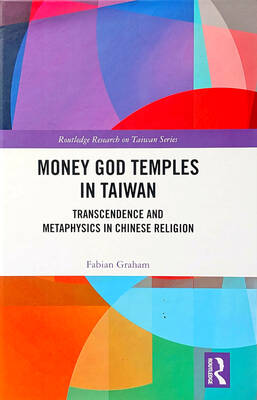
As someone who normally steers clear of books with “transcendence” or “metaphysics” in their subtitles, this reviewer — a casual observer of local belief systems since the 1990s — found Fabian Graham’s Money God Temples in Taiwan a challenging read. Those who’ve only dipped their toes into temple culture will likely need to parse several sections with special care if they’re to keep up with the author, a British ethnographic researcher whose previous books have investigated religious practices among ethnic Chinese in Southeast Asia. This scholarly volume examines a facet of Taiwan’s religious landscape that didn’t exist a century ago, and


 RSS
RSS