


At the closing ceremony of the Taipei Film Festival (TFF) last night, winners in the competition categories of the festival were announced and awarded their prizes. The main categories included local commercial releases, local independent releases, the Citizen Film and Video Competition and the Golden Lion International Student Film Festival.
The main event of the evening was the award of substantial cash prizes for the best achievements in independent film making -- films made without studio assistance and without commercial release. The Grand Prize of NT$1 million went to Birdland (
On receiving the prize, Huang told Taipei Times he would use the prize money to help repay debts accrued in the making of the NT$1.7 million feature about an illegal immigrant from China who first finds himself mistaken for another man and then finds an old lover while wandering about in Taipei.
Winners in other categories were awarded a cash prize of NT$200,000. Among the winners were Chen Hsin-yi (
And she wasn't (
In the commercial release category, the Best Film award went to Mirror Image (
The other winner of Most Promising Director this year was Chen Yi-hsiung (陳義雄) for his debut Sunny Doll (晴天娃), a film about high school life. Chen's most recent achievement was the script for Chang Chih-yung's (張志勇) Lament of Sand River (沙河悲歌), which was one of the dark horses to emerge from the Golden Horse this year.
The Citizen Film and Video Competition (
The Golden Lion Award for international student films went to Photographer by Alexander Kott, from Russia. The silver and bronze lion awards went to Night Course by Bui Thac Chuyen from Vietnam and The Magic Bell by Auriel Klimt from the Chech Republic, respectively.
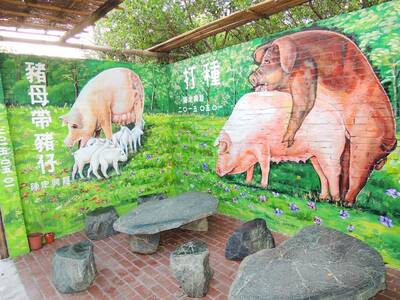
May 6 to May 12 Those who follow the Chinese-language news may have noticed the usage of the term zhuge (豬哥, literally ‘pig brother,’ a male pig raised for breeding purposes) in reports concerning the ongoing #Metoo scandal in the entertainment industry. The term’s modern connotations can range from womanizer or lecher to sexual predator, but it once referred to an important rural trade. Until the 1970s, it was a common sight to see a breeder herding a single “zhuge” down a rustic path with a bamboo whip, often traveling large distances over rugged terrain to service local families. Not only
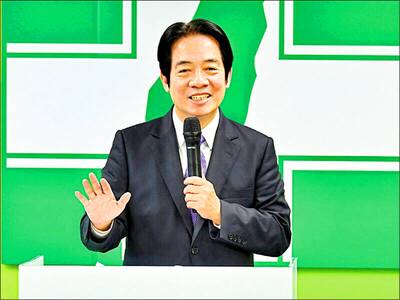
Ahead of incoming president William Lai’s (賴清德) inauguration on May 20 there appear to be signs that he is signaling to the Chinese Communist Party (CCP) and that the Chinese side is also signaling to the Taiwan side. This raises a lot of questions, including what is the CCP up to, who are they signaling to, what are they signaling, how with the various actors in Taiwan respond and where this could ultimately go. In the last column, published on May 2, we examined the curious case of Democratic Progressive Party (DPP) heavyweight Tseng Wen-tsan (鄭文燦) — currently vice premier
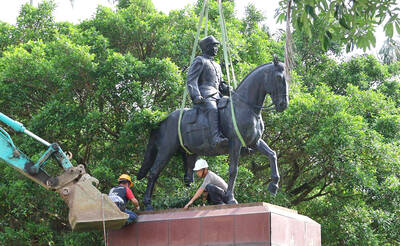
The last time Mrs Hsieh came to Cihu Park in Taoyuan was almost 50 years ago, on a school trip to the grave of Taiwan’s recently deceased dictator. Busloads of children were brought in to pay their respects to Chiang Kai-shek (蔣中正), known as Generalissimo, who had died at 87, after decades ruling Taiwan under brutal martial law. “There were a lot of buses, and there was a long queue,” Hsieh recalled. “It was a school rule. We had to bow, and then we went home.” Chiang’s body is still there, under guard in a mausoleum at the end of a path

Last week the Directorate-General of Budget, Accounting and Statistics (DGBAS) released a set of very strange numbers on Taiwan’s wealth distribution. Duly quoted in the Taipei Times, the report said that “The Gini coefficient for Taiwanese households… was 0.606 at the end of 2021, lower than Australia’s 0.611, the UK’s 0.620, Japan’s 0.678, France’s 0.676 and Germany’s 0.727, the agency said in a report.” The Gini coefficient is a measure of relative inequality, usually of wealth or income, though it can be used to evaluate other forms of inequality. However, for most nations it is a number from .25 to .50


 RSS
RSS