


IN the early evening, tucked away in an out-of-the-way recording studio at ICRT, Dennis Nieh (
He floats a few jokes on the airwaves to entertain listeners and then rolls into a satirical scene-setter, describing a movie star playing an ordinary family man.
"Michael Douglas and Catherine Zeta Jones are getting married, having babies, and picking up clothes. Douglas is gathering big bags, mall bags, everything, under his arms, around his neck and between his legs, trying to get all the clothes home."
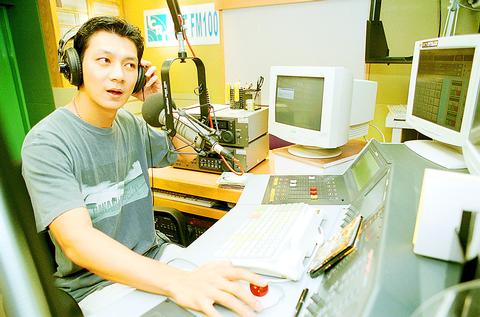
PHOTO: GEORGE TSORNG
Nieh reaches over to the computer in front of him and seconds later the movie sound track from "Mr. Mom" fills the studio. He smiles slightly, satisfied with his shtick. He is comfortable with this routine. It is something he has been polishing for more than 10 years, since his time as a heavy metal disc jockey in northern California.
Sitting in front of a large, state-of-the-art recording system, surrounded by computers and microphones, Nieh remembers his much smaller studio in San Jose. "I had two turn tables, a mike, and a small board with 8-track carts," says Nieh, who just played music for his first DJ job.
But in Taiwan, Nieh's role has grown well beyond just spinning discs. He promotes shows at McDonald's around the island; he goes to schools and prisons to give motivational talks; he does commercials; and he even started a mini-series on TV. Currently, he is on an island tour doing stand-up comedy with Theater Company 99, cracking jokes sans music.
"People expect more of you," says Nieh, while backstage prepping for his part in the stand-up comedy "Talk Maniac." "In the States, if you are a DJ, then you are a DJ. You don't do anything else. But here, DJs publish books and get involved in other things."
Nieh was born in Taiwan and moved to the States at the age of seven. He lived in California until three years ago, after a business trip to Taiwan sparked his interest anew in the island. After about six months, he ran into ICRT's general manager, Doc Casey, at a bar. Casey invited him to work at ICRT and that was the night he stepped up to a career in the spotlight, winding up as the sedate and sometimes sarcastic voice behind "Taiwan Tonight," a window into local scenes colored with music and spiced up with entertainment news.
The show has earned Nieh quite a following. He gets about 80 e-mails a day from fans, some of which he answers with the rest being read on his live program. He also weaves in bits of infotainment gleaned from the local press between a steady run of popular American songs and a few local acts.
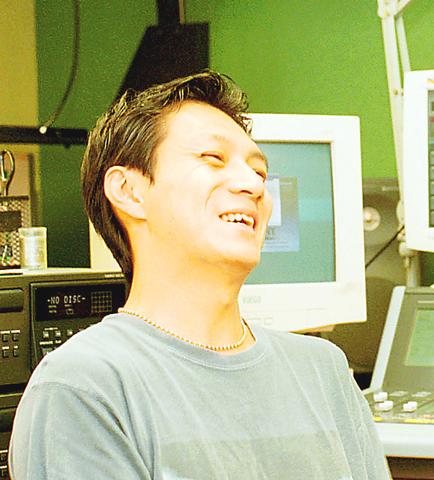
PHOTO: GEORGE TSORNG
"Through my program what I want to create is an environment," says Nieh. "What makes a program humorous and fun to listen to is personality. That's why you add a little personality spice to make it interesting. That's what binds all the elements together to make it work."
What Nieh is tackling today as a DJ is a lot more sophisticated than what he did on his first broadcasting job 10 years ago in San Jose. During those simpler days, Nieh would send up an endless stream of heavy metal music -- no chatter, very little personality needed. Since then, he's been riding the roller coaster of radio broadcasting, moving from heavy metal to American Top 40 to Chinese pop.
Though reserved when it comes to revealing his personal life, Nieh insists on being true to himself, even if it means trouble for him. "I will not change myself to become something else just to please other people," he says.
It may be this kind of genuineness that makes director Deng An-ning (
Or, perhaps, it's as Liu Chih-chi (
Despite his new success and his brushes with fame, Nieh still revels in memories rooted in ordinary family experiences. Like when the whole family would treat grocery shopping and cooking Chinese cabbage as a big deal. These are days he left behind on the other side of the Pacific. "The best thing that can ever happen in life is to be an ordinary person and lead an ordinary life," he says.
But ordinary seems a relatively abstract concept nowadays for Nieh. For the curtain is coming up and he's taking the stage again, this time as a comedian. Bounding off into the bright lights, he whispers: "Stay and watch."For your information: "Taiwan Tonight" airs on ICRT FM100.7 every weekday evening from 6PM to 9pm.


Taiwan’s English education system is being pulled apart by three opposing forces. Bilingual Nation 2030 pulls students toward English and global communication. Artificial Intelligence (AI) readiness pulls them toward digital judgment, verification and AI-mediated work. But Taiwan’s old exam culture pulls them back toward memorization, grammar drills, timed reading and correct answers. If the education system keeps using old exams to define success, it risks producing graduates who are neither genuinely bilingual nor genuinely AI-ready, but trained for tasks machines can already perform. The first force is Bilingual Nation 2030. Launched in 2018, the policy aimed to “help Taiwan’s workforce connect

“Taiwan’s Opposition Leader Comes to US With a Message Straight Out of Beijing” read a May 31 headline in the Wall Street Journal. Top US administration officials and members of Congress almost certainly read the WSJ, and if there was a bullet point takeaway that people in Washington should absorb ahead of Chinese Nationalist Party (KMT) Chair Cheng Li-wun’s (鄭麗文) arrival in DC on June 9, that headline is it. The last few columns have discussed this very topic, and the timing is not coincidental. While those top officials likely do not read the Taipei Times, judging by the number

With weighty, anxiety-inducing geopolitical topics dominating the headlines, checking in on the wild and weird state of local politics can take some of the edge off. This November’s elections will determine who will be in charge of fixing potholes in your neighborhood, not the potholes in Taiwan’s complicated geopolitical space. Recently, after an online interview with a Taipei-based journalist, I commented that Taipei journalists never go further than the MRT can take them. He laughed and agreed. Naturally, the Taipei mayoral race is eating up much of the press attention. TAIPEI CITY Democratic Progressive Party (DPP) candidate Puma Shen (沈伯洋) has
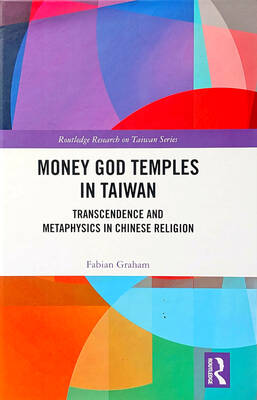
As someone who normally steers clear of books with “transcendence” or “metaphysics” in their subtitles, this reviewer — a casual observer of local belief systems since the 1990s — found Fabian Graham’s Money God Temples in Taiwan a challenging read. Those who’ve only dipped their toes into temple culture will likely need to parse several sections with special care if they’re to keep up with the author, a British ethnographic researcher whose previous books have investigated religious practices among ethnic Chinese in Southeast Asia. This scholarly volume examines a facet of Taiwan’s religious landscape that didn’t exist a century ago, and


 RSS
RSS