


"I like tall, pretty girls with long hair and nicely-shaped faces," says Wu Shih-cheng (
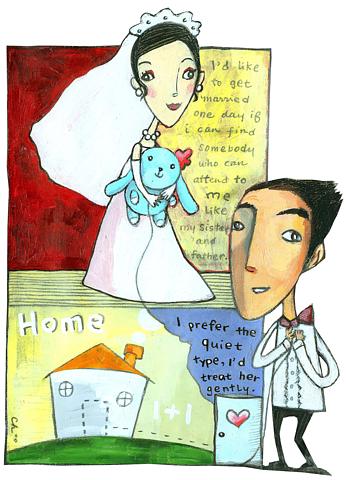
Then, getting more specific, he mentions a possibility but quickly dismisses her. "Shin-ying is too talkative. I prefer the quiet type," he says, stuttering as he eagerly presses on to describe how he would approach a woman if he did fancy her. "I'd greet her gently or write her a note."
Wu is a round-faced, young-looking man with uneven teeth. He is pale and a little chubby, and he tends to scratch his head while talking. Wearing a pair of jeans and a T-shirt, he hardly looks his age, 35-years old. He was born prematurely and his brain was partially damaged during the delivery, causing his mental disability.
He is single, and always has been.
"I haven't thought about marriage. And if I liked someone, I'd be too embarrassed to let her know, and my mom said I had to wait until my physical condition got better."
Wu is one of 30 students at Taipei's Children Are Us Foundation (CAUF,
Most organizations in Taiwan for the mentally disabled focus on programs that teach work skills and life skills while assigning lower priority to preparation for marriage or having children. This is mostly due to the challenge of instilling a firm understanding of the long-term responsibilities inherent in such commitments.
NO EASY ANSWER
Yet just like anyone else, people like Wu feel the need for relationships, the laughter of a girlfriend, the reassuring embrace of a boyfriend, the loving commitment of a mate. But parents, experts and care providers are at a loss on how to successfully tackle the issue, especially when considering the children of such relationships.
"I hope she can get married one day if she can find someone who is willing to take care of her," says Mr Chen, a salesman whose 20-year old daughter Chen Tzu-ying (陳姿穎) has epilepsy and as a result is slightly mentally disabled. "I don't mind if she marries someone with a similar physical disability, but then the marriage would demand a lot of assistance from us."
Though he seldom discusses the topic of marriage with his daughter, Chen senses that it will be a long time before she can tie the knot. "She is very forgetful. She needs a lot of reminders in her everyday activities. She has to be able to take good care of herself before anything else," he says.
Tsu-ying's appearance is neat, sweet and innocent and it is not until she speaks that there is any evidence of a mental disability. Obviously submissive to her family's opinions, she starts almost every sentence with "my sister said" or "my father said."
"I'd like to get married one day if I can find somebody who can attend to me like the way my sister or my father does. They said they would help me look around."
When talking about Chi-wen, a male admirer of hers who is also mentally disabled, she says, "Chi-wen once told me he wanted to do `that,' but I told him I couldn't because I was too young for `that.' I told him that if you insist, you'll have to tell my sister first."
Asked if it felt good to know that someone was interested in her, she replies, "Yeah. But I have not seen him for a long time, and my sister said she would find someone for me [to marry]. She worries I will meet someone bad."
While Tsu-ying seems patient -- or almost resigned -- in her attitude and pursuit of marriage, another of her fellow students, Tsao En-sheng (曹恩昇), almost wishes he'd been married yesterday. "I need to get married because my mom wants me to, so she can have grandchildren one day. And I also want to have a wife, because no-one can live alone. Then we can take care of each other."
Tsao is a 28-year old man, whose brain was damaged due to fevers when he was a child. Lately, he says, his desire to get married has grown stronger. He likes to look at women on the street and recently took a fancy to a woman introduced by his mom. "She was healthy, from the countryside," he says. "I chatted with her briefly. I kind of liked her. But I have not heard from her again."Tsao's mom says it is difficult for her son to develop a relationship because of his sense of inferiority and a lack of proper channels. "I wish more match-making associations could be found in society, or even that teachers at the foundation could take on the role [of matchmakers]," she says.
Tsao has noticed her son's increasing interest in the opposite sex but says she has had little luck in urging him to interact more. "He has experienced prejudices," she says, "both in the employment market and in interpersonal relationships."
For most people, puberty brings a heightened curiosity of the opposite sex. It is a time of intense exploration, fickle interest and rewarding successes and failures. However, it seems to mark the beginning of a nightmare for parents of the mentally disabled, who face a slew of problems as their children grapple with the nature of adolescence.
Relationships and marriage, not to mention sex, are thorny issues for parents of the mentally disabled because they believe their children need someone to look after them. It is difficult to find successful examples of marriage or commitment between the mentally disabled. Despite attempts, sources for this story could not suggest couples that would be regarded as happily married.
However, most parents of the mentally disabled are anxious for their children to get married, a situation that makes some special-education workers suspicious of motives. "To continue the family line (
Mentally disabled youngsters are rarely exposed to accurate information about sex, Lai says. They receive sex education mainly through the media, which frequently disseminates conflicting messages. This can easily lead to confusion and inappropriate sexual responses. Incidents, such as students touching each other's genitals, do happen at the foundation.
According to Lai, education is needed before there is any headlong rush into marriage. "To produce offspring is not the only purpose of a marriage, nor should we expect our partner to serve only as a caretaker. A successful marriage entails clear understanding of its meaning and responsibility, and how to maintain it."
Facing tremendous obstacles in finding a match for their children, many parents of the mentally disabled go overseas in search of "foreign brides" (
Marriages that exist only for the sake of having children frequently end tragically. Some brides run away after they realize their husbands are mentally retarded; some couples keep having children because they do not know how to use contraceptives.
"Preparation before marriage is absolutely necessary. Parents need to make sure their children are mature enough to assume such responsibilities. Evaluations must be done to find out if they are self-sufficient financially, or if both sets of parents are supportive of the decision. Even so, marriage should be an affair between the couple, rather than a duty for parents," Lai says.
Thorough preparation, education and assessments doesn't mean that the mentally disabled should be deprived of their right to marriage or having children. Mrs Tu, an insurance company clerk, whose 25-year old son is also a student at the foundation, suggested "community families" could be one solution to the problem.
In some countries the mentally disabled reside in "community homes" where social workers pay visits on a periodic basis to offer help with daily routines or to assist with emotional or physical problems.
"These children just need professional counseling and someone to assuage their stress regularly," Tu says.
However, before such a community is established in Taiwan, more can be done, Lai says. For instance, sex education should be taught to the mentally disabled in a more systematic way. "There is an extreme demand for such sex educators in Taiwan," she says. "Sexual desires are inborn. It is cruel to suppress the sexual needs of these children."

And so, in the wake of US President Donald Trump’s trip to the People’s Republic of China (PRC), all the experts on the Strait of Hormuz suddenly became experts on US-China-Taiwan relations. The Internet has certainly expanded human knowledge. Lots of these sudden experts made noise this week about Trump’s words after the meeting with PRC dictator Xi Jin-ping (習近平). Trump is going to sell out Taiwan! Longtime Taiwan commentator J. Michael Cole summed the situation up neatly in the Guardian: “We need to keep in mind that he has a tendency to say many things — sometimes contradicting himself within

There is considerable frustration and confusion among many, both in Taiwan and abroad — including in Washington — as to why the Chinese Nationalist Party (KMT) seems so dead set on using their legislative leverage to slash defense spending and disrupt the ability of the ruling Democratic Progressive Party (DPP) administration to function. Are they pawns of the Chinese Communist Party (CCP)? Are they traitors? In reality, there are multiple reasons. In the first column in this series on this subject, “Donovan’s Deep Dives: How and why the TPP and KMT help Beijing” (Sat May 16, page 12), we examined three

It took 12 years and months of standing in the same mountain location for director Liang Chieh-te (梁皆得) to capture a few seconds of footage: Taiwan’s largest resident raptor locking talons with its mate and spinning through the air in a courtship ritual. With only about 1,000 left in the wild and very short flight windows, the mountain hawk-eagle remains among Taiwan’s most elusive birds. The species generally produces only one offspring per year. Using forest cameras, the film crew and research teams document the arduous process the monogamous pairs go through for the chick to hatch and grow up, weathering

May 25 to May 31 Few believed that apples could be cultivated on a commercial scale in Taiwan’s high mountains. When horticulturalist Cheng Chao-hsiung (程兆熊) first proposed the idea in 1955, both American and Taiwanese colleagues dismissed it as implausible, arguing that temperate fruit could not be reliably grown on a subtropical island, especially on rugged terrain. However, it was this terrain in the Central Mountain Range where many Chinese Civil War veterans were resettled in the late 1950s. With limited job prospects and no family in Taiwan, they were placed on cooperative farms aimed toward self-sufficiency. Some say the conditions


 RSS
RSS