


When the China Dance Club studio burned down early yesterday morning, just a week after the Taipei city government confirmed that it was to be appointed a municipal heritage site, it was perhaps the final chapter in a history that has no shortage of tragic moments.
It's a history that begins with Tsai Jui-yueh (
Returning from Australia last Wednesday, Tsai was ill at ease about the government's decision to save her studio from the wrecking ball. "Will the government change its mind and demolish [this place]?" Tsai asked her daughter-in-law Ondine Hsiao (
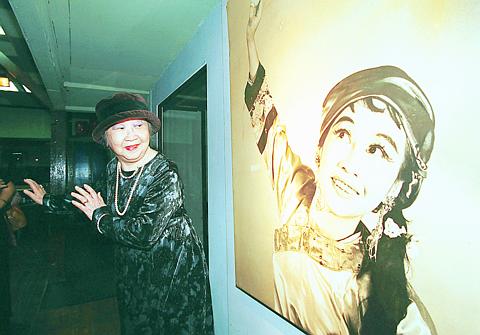
PHOTO: CHIANG YING-YING, TAIPEI TIMES
Tsai's distrust of the government is perhaps rooted in the conditions of her life, which was shattered by the political turmoil that swept Taiwan in the years after World War II.
In February 1947, two years after the KMT assumed control of Taiwan, the bloody crackdown on civilian protesters known as the 2-28 Incident took place. A thorough KMT crackdown on political dissent and a witch hunt for communists followed.
The White Terror, as the ensuing period of martial law came to be known, soon caught up with Tsai and her newly-wed husband Lei Shih-yu (
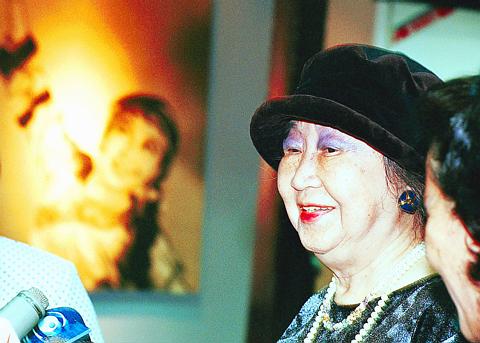
PHOTO: CHIANG YING-YING, TAIPEI TIMES
But the day before their departure, two intelligence officers came for Lei and took him away in full view of a roomful of visitors who had gathered for a farewell party.
Lei was expelled from Taiwan with dozens of other professors. Tsai and her baby boy were forbidden to leave Taiwan with him. That winter, Tsai was imprisoned.
It wouldn't be until 1990 -- 41 years after their forced seperation -- that the couple would meet again. By that time Lei had remarried in China, which Tsai herself had urged him to do via messages she sent him in the 1960s. It was a reunion mixed with sadness and joy, not least because the re-union allowed Tsai to discover that it was a postcard from one of her own students urging her and her husband to flee to Hong Kong and from there to China that had placed the couple under suspicion and led to Lei's deportation.
In prison, separated from her husband, Tsai, who had studied in Japan under the famous dancers Ishii Baku and Ishii Midori, continued to dance.
"I practiced the bar work the first day I was in prison. I also taught others in the prison how to dance," said Tsai, wearing a tranquil look on her face as she recalled the past.
Tsai's prison sentence lasted three years. But even after her release the shadow of "the White Horror," as she calls it, continued to follow her.
"For many years, I was awoken in the middle of the night [by intelligence officers] for a surprise checkup," Tsai says in the book, Prophet of Taiwan's Dance: An Oral History by Tsai Jui-yueh. "Over the course of twenty years after I was released from prison, I was required to report to the authorities on my whereabouts. Countless invitations for my participation in dance performances abroad were not realized as the authorities turned down my application for foreign trips.
"Similar episodes emerged in an endless stream, torturing you not to the verge of death, but forcing you to lead a life without dignity."
Decades later, sitting in a cozy chair in the dance club this past Thursday, Tsai couldn't help but frown.
"For many years, whenever I was to return to Taiwan from performances abroad, my heart ached -- as Taiwan was indeed like a prison for me," she said.
It was the stifling political atmosphere on the island along with her son's recruitment as a professional dancer by the Australian Dance Theatre that led her to leave for Australia in 1983.
But even her new life in Australia could not erase the scars of the past.
"The deepest regret is about my family," said Tsai. "About the fact that I was separated from my husband for the whole of my life."
But amid regrets, Tsai can still point to the applause she received for her dance performances as "the most happiest moments" in her life.
"I loved to swing my body as a child. But then I didn't know what I liked was called `dancing.' Dancing was more important to me than eating," she said. "Sometimes when sitting in the classroom, my feet would move around under the table reviewing the steps I had learned from the previous week's dancing class. I simply ignored all these lectures such as history and geography," Tsai said, laughing.
It was this passion for dance that took Tsai to Japan to study during the World War II, and also took her to Japan, China and Indochina, where she danced in more than a thousand performances with her teachers' companies.
In 1960, she was invited as an exchange professor to the Tokyo Dancing School, where she taught 14 of her major works to professional dancers. By the 1960s, the China Dance Club had become an important venue for international dance exchanges. Renowned dance groups such as the Martha Graham Dance Company, the Merce Cunningham Company, as well as the San Francisco Ballet -- all paid visits to the club. And for many contemporary dancers in Taiwan -- now an island that embraces a diversity of dance styles -- Tsai is not only a legend but an inspiration.
Lo Man-fei(羅曼菲), artistic director of the Cloud Gate 2, says that Tsai planted the seeds of modern dance in Taiwan.
"She served as a key catalyst for the development of modern dance on the island," Lo said. "Through her works as well as her efforts to introduce various key figures in modern dance to Taiwan, Tsai offered interested youngsters a window of opportunity to keep up with these trends."
Many of Tsai's young disciples later became key players in Taiwan's dance world. Examples include Lin Hwai-min(林懷民), founder of Taiwan's premier dance company, Cloud Gate Dance Theater, and another prominent dancer, Yu Hao-yen (游好彥).
Despite her contributions to modern dance in Taiwan, Tsai remains humble. She giggles at the fact that the Queensland University of Technology in Brisbane, Australia awarded her with an honorary doctorate last year.
She might giggle, but award is nothing less than fitting for this old lady in her green long dress and a pair of trendy black boots.
Becoming what people like Lin Hwai-min describe as a "dancing legend" has been a tumultuous journey.
"I've been tossed up and down by the waves of life," said Tsai.


Taiwan’s English education system is being pulled apart by three opposing forces. Bilingual Nation 2030 pulls students toward English and global communication. Artificial Intelligence (AI) readiness pulls them toward digital judgment, verification and AI-mediated work. But Taiwan’s old exam culture pulls them back toward memorization, grammar drills, timed reading and correct answers. If the education system keeps using old exams to define success, it risks producing graduates who are neither genuinely bilingual nor genuinely AI-ready, but trained for tasks machines can already perform. The first force is Bilingual Nation 2030. Launched in 2018, the policy aimed to “help Taiwan’s workforce connect

“Taiwan’s Opposition Leader Comes to US With a Message Straight Out of Beijing” read a May 31 headline in the Wall Street Journal. Top US administration officials and members of Congress almost certainly read the WSJ, and if there was a bullet point takeaway that people in Washington should absorb ahead of Chinese Nationalist Party (KMT) Chair Cheng Li-wun’s (鄭麗文) arrival in DC on June 9, that headline is it. The last few columns have discussed this very topic, and the timing is not coincidental. While those top officials likely do not read the Taipei Times, judging by the number
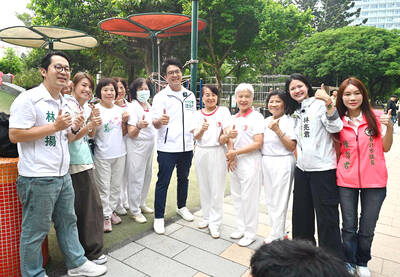
With weighty, anxiety-inducing geopolitical topics dominating the headlines, checking in on the wild and weird state of local politics can take some of the edge off. This November’s elections will determine who will be in charge of fixing potholes in your neighborhood, not the potholes in Taiwan’s complicated geopolitical space. Recently, after an online interview with a Taipei-based journalist, I commented that Taipei journalists never go further than the MRT can take them. He laughed and agreed. Naturally, the Taipei mayoral race is eating up much of the press attention. TAIPEI CITY Democratic Progressive Party (DPP) candidate Puma Shen (沈伯洋) has
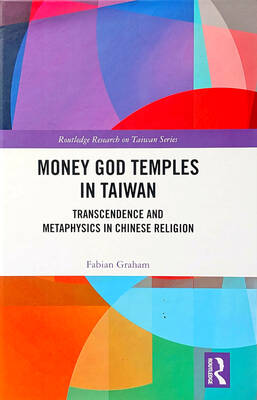
As someone who normally steers clear of books with “transcendence” or “metaphysics” in their subtitles, this reviewer — a casual observer of local belief systems since the 1990s — found Fabian Graham’s Money God Temples in Taiwan a challenging read. Those who’ve only dipped their toes into temple culture will likely need to parse several sections with special care if they’re to keep up with the author, a British ethnographic researcher whose previous books have investigated religious practices among ethnic Chinese in Southeast Asia. This scholarly volume examines a facet of Taiwan’s religious landscape that didn’t exist a century ago, and


 RSS
RSS