

Japanese Prime Minister Sanae Takaichi has inherited a lot of things from her mentor, the late prime minister Shinzo Abe: Her support base, conservative credentials, and even her favored slogan of “Japan is back.”
This is true of foreign policy, too. The sight of US President Donald Trump pulling the rug from under one of the US’ closest allies by ordering joint military drills with South Korea to be scaled back is but one reminder of the risks and rewards of Abe’s playbook in dealing with Washington. Russian President Vladimir Putin’s first-ever visit to islands controlled by Russia but claimed by Japan drags up the late premier’s biggest international failure. And talk of summits with North Korea recalls an event that made Abe’s early career, before turning to bitter regret.
Takaichi should put a little distance between herself and her mentor, and work through a new foreign policy to decide what should stay and what should go.
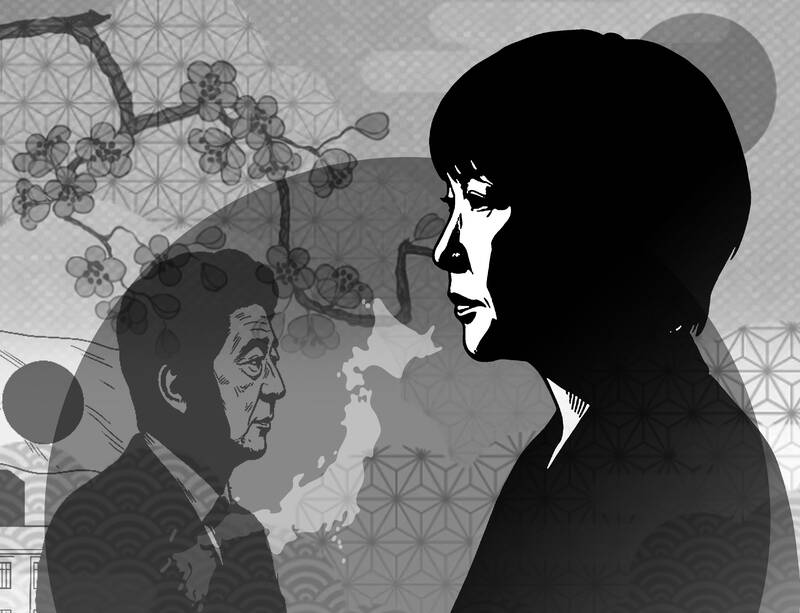
Illustration: Tania Chou
Start with Trump. Japan’s leader can learn many of the right lessons from his relationship with Abe. Whatever Trump’s true reason for abruptly hamstringing the South Korea drills — his affinity for North Korean leader Kim Jong-un, Seoul’s supposed failure to help with Iran or, as reports suggest, the slow pace of investment in the US — the move has startled Tokyo. Officials are no doubt concerned that as in 2018, Trump will increase demands on Japan ahead of the midterm elections.
One of Abe’s greatest diplomatic achievements was showing the world how to engage with the capricious president. He understood earlier than most that dealing with Trump meant flattery, copious reciprocity, big promises of spending, and a willingness to hold one’s nose. Despite periodic calls for higher spending on US troops and increased imports of US cars, Japan remains one of the few traditional allies that has largely dodged his opprobrium.
Takaichi has mostly followed that model, and for now Tokyo looks better placed than Seoul. She has turned US demands for investment into an opportunity to secure rare-earth and energy projects that will boost economic security. And she understands that Trump does not care if these do not add up to US$550 billion — the official amount Japan agreed to invest during last year’s tariff war — so long as he gets a good headline.
There are lessons to take away from Abe’s dealings with North Korea, too, amid reports that the US president is looking for another summit with Kim. As a young politician, Abe made his career with his hardline stance during then-Japanese prime minister Junichiro Koizumi’s historic summit with Kim’s father, Kim Jong-il, in 2002, which paved the way for the return of some of the Japanese citizens that North Korea had kidnapped.
Abe also sensibly avoided being used as a tool by Pyongyang, a concern that does not seem to bother Trump. Japanese media reported following his assassination four years ago that Abe had rejected a 2014 proposal to repatriate just two of the abductees, something he deemed a bad deal. Yet he was never able to secure his own visit to Pyongyang as leader, and was sidelined by Trump’s overtures to Kim.
Takaichi must similarly balance the risks of being bypassed against those of being used as a political pawn. Having taken up the abductee issue herself, a summit with North Korea would be a potential political win.
The question is leverage: This is a very different state from the impoverished one in 2002. Arms sales to Russia and crypto thefts leave Pyongyang with a diminished need for assistance. Without tangible results, Takaichi should not lend legitimacy to the Kim regime in return for a mere photo op.
For all his clear-eyed vision on China, Abe had a terminal blind spot for Putin. He burned years of political capital seeking a deal to reclaim the territory Moscow calls the southern Kurils and Japan dubs the Northern Territories, seized by the Soviet Union in the dying days of World War II. It was the unfinished legacy of his own father, Shintaro, who as foreign minister believed he could break the impasse.
Shinzo Abe held summits with Putin, seeking “hot-tub diplomacy” at an onsen resort, while officials from a northern prefecture gifted the Russian president an adorable dog. All to no avail, with Putin stringing Japan on so long that the dog died of old age last year.
Any attempt to restart such talks should stay dead, too, but there are concerning signs that some around the prime minister want to return to this failed strategy, and re-engage with Moscow. Takaichi is notably the only G7 leader yet to hold a bilateral meeting with Ukrainian President Volodymyr Zelenskiy. She must not make the same mistake Shinzo Abe did: allowing the ghosts of the past to dictate the present.
Shinzo Abe’s skill was in understanding that personal relations could create room for Japan where it might be militarily outmatched, but his mistake was sometimes to confuse relationships with actual results. Takaichi needs to know the difference.
Indeed, it is important to know when to change tactics when needed. That is what Shinzo Abe, at his best, would have done.
Gearoid Reidy is a Bloomberg Opinion columnist covering Japan and the Koreas. He previously led the breaking news team in North Asia, and was the Tokyo deputy bureau chief. This column reflects the personal views of the author and does not necessarily reflect the opinion of the editorial board or Bloomberg LP and its owners.
For the last 15 years, China has relied on gray zone operations to advance its territorial ambitions across Asia. And for 15 years, the US has struggled to respond. But the open door on which China has been pushing may finally be closing. Gray zone operations involve the assertive use of a variety of tools in ways that create conditions that can be described as neither peace nor war. Military forces might act provocatively — even dangerously — while carefully avoiding violence, whereas law enforcement employs nonlethal violence as a first resort. Such an approach creates difficult calculations for its targets.
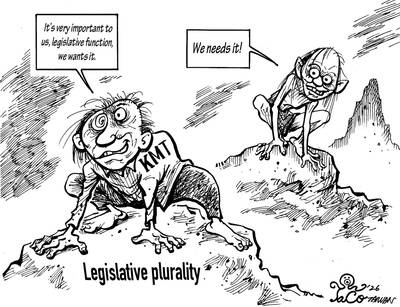
EDITORIAL CARTOON
Grab Holdings Ltd plans to acquire Taiwan’s No. 1 food delivery business, Foodpanda, for US$600 million. The Fair Trade Commission (FTC) is reviewing the proposal. Grab offers ride-hailing, dining, fresh food and grocery delivery, parcel delivery, payments, loans, insurance and digital banking services in 900 cities across eight Southeast Asian countries. Leveraging mapping data and artificial intelligence (AI) models developed in cooperation with China, it has built a comprehensive retail and consumer ecosystem. If Grab were to enter the Taiwanese market, it would have a major impact on the food service industry, convenience stores, supermarkets and e-commerce services. The ecosystem
On Wednesday last week an Indonesian frigate conducted exercises with the Chinese navy east of Taiwan, in waters Beijing has repeatedly used to demonstrate its capacity to encircle and blockade the nation. What was Indonesia doing there? The answer comes readily from Jakarta. Indonesia was practising bebas aktif, or “free and active” foreign policy, working with competing powers while reserving the right to belong to none of them. Indonesian personnel joined the US-led RIMPAC exercises in Hawaii this year, military contacts with Russia have continued, and the KRI I Gusti Ngurah Rai met the Chinese frigate Honghe while sailing home from


 RSS
RSS