

Grab Holdings Ltd plans to acquire Taiwan’s No. 1 food delivery business, Foodpanda, for US$600 million. The Fair Trade Commission (FTC) is reviewing the proposal.
Grab offers ride-hailing, dining, fresh food and grocery delivery, parcel delivery, payments, loans, insurance and digital banking services in 900 cities across eight Southeast Asian countries. Leveraging mapping data and artificial intelligence (AI) models developed in cooperation with China, it has built a comprehensive retail and consumer ecosystem.
If Grab were to enter the Taiwanese market, it would have a major impact on the food service industry, convenience stores, supermarkets and e-commerce services. The ecosystem behind Grab includes Didi Chuxing (滴滴出行), which holds about 5 percent of the company’s shares, and Grab’s core mapping service, GrabMaps, which signed a memorandum of cooperation with Huawei Technologies Co’s Petal Maps last year to obtain high-definition Southeast Asian mapping data. Grab also has resource and development centers in Beijing and Shenzhen.
Grab could pose a number of threats to the nation.
First, Taiwan’s geospatial data could come under Chinese control. Grab’s delivery platform collects vast amounts of GPS location data and real-time imagery each second, including shortcuts, alleys, building entrances and exits, and real-time road information — together forming highly detailed urban spatial data. Huawei, under China’s National Intelligence Law, is required to cooperate with the country’s national intelligence efforts, so the high-precision GPS traces and images collected by Grab could be transmitted to China.
Second, Taiwanese consumers’ behavioral data — such as purchasing activity, locations and movements — could be leaked to China. Grab’s ride-hailing unit, GrabCar, has been penalized multiple times by Singapore for data protection breaches, including incidents that exposed users’ mobile wallet balances, home addresses and route history.
Third, economic security would no longer be guaranteed. Data on orders, transactions and businesses, as well as information on the economic activity of at least 100,000 food service establishments, could come under China’s control.
Taiwan could grow overly dependent on Grab, as it could eventually expand beyond food delivery into ride-hailing, payments, financial and mapping services. If economic activity were to become increasingly concentrated on the platform, the viability and competitiveness of local businesses could be significantly undermined.
Fourth, the government could lose control of its digital sovereignty. If massive amounts of user data were to fall under the control of China via Grab, Taiwan’s digital forensics and jurisdictional authority would be constrained, and the government could lose control over who has access to precise geographic information within its territory. Digital sovereignty emphasizes strategic autonomy, and such damage would be irreversible.
As Taiwan has faced prolonged threats of political coercion and military intimidation by China, this case would bring enormous harm to Taiwan’s national and societal interests.
National University of Singapore associate law professor Burton Ong (王澤恩) said market concentration issues were discovered after Grab acquired Uber’s Southeast Asian operations in 2018, and that fines imposed were ineffective. Therefore, when Grab sought to acquire Foodpanda’s operations, Singapore blocked the deal.
The FTC should follow Singapore’s example and reject Grab’s acquisition proposal under Article 13 of the Fair Trade Act (公平交易法).
Chen Chun-li is an adjunct professor.
Translated by Kyra Gustavsen

For the last 15 years, China has relied on gray zone operations to advance its territorial ambitions across Asia. And for 15 years, the US has struggled to respond. But the open door on which China has been pushing may finally be closing. Gray zone operations involve the assertive use of a variety of tools in ways that create conditions that can be described as neither peace nor war. Military forces might act provocatively — even dangerously — while carefully avoiding violence, whereas law enforcement employs nonlethal violence as a first resort. Such an approach creates difficult calculations for its targets.
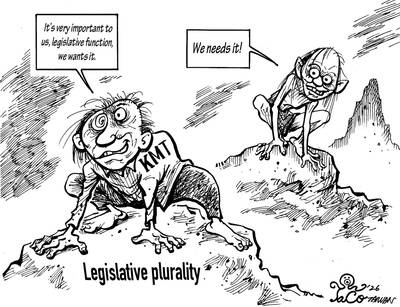
EDITORIAL CARTOON
President William Lai (賴清德) late last month received a delegation of Polish members of the European Parliament at the Presidential Office — the first single-party, single-nation delegation from the EU legislature to visit Taipei in nearly two terms. The group, led by former Polish prime minister Beata Szydlo, also met Legislative Yuan Speaker Han Kuo-yu (韓國瑜), a gesture spanning Taiwan’s political divide. For most Taiwanese observers, this was a pleasant, if minor, diplomatic event. It was much more than that — and the timing matters. Within the same fortnight, Hudson Institute senior fellow Ken Moriyasu said in the Washington Examiner
China’s State Council on July 31 announced the Regulations on Exit and Entry Administration. Set to take effect from Sept. 15, the regulation expands the People’s Republic of China’s powers to restrict people from leaving the country in the name of “safeguarding national sovereignty, security and development interests.” International observers widely regard it as another step back to a closed China. Given Beijing’s insistence that Taiwan is “a part of China,” experts warn Taiwanese traveling to China of increasing risk of indefinite detainment. Mainland Affairs Council (MAC) Minister Chiu Chui-cheng (邱垂正) has likewise warned that China has repeatedly revised


 RSS
RSS