

On Wednesday last week an Indonesian frigate conducted exercises with the Chinese navy east of Taiwan, in waters Beijing has repeatedly used to demonstrate its capacity to encircle and blockade the nation.
What was Indonesia doing there? The answer comes readily from Jakarta. Indonesia was practising bebas aktif, or “free and active” foreign policy, working with competing powers while reserving the right to belong to none of them.
Indonesian personnel joined the US-led RIMPAC exercises in Hawaii this year, military contacts with Russia have continued, and the KRI I Gusti Ngurah Rai met the Chinese frigate Honghe while sailing home from Russian exercises off Vladivostok. The engagements appear to offset one another and the freedom to engage is presented as a measure of Jakarta’s successful foreign policy.
Taipei would be mistaken to treat one exercise as a declaration of allegiance.
Taiwan’s objection concerns the waters rather than the partner, as Chinese military and coast guard activity east of Taiwan has increased in the past few years, and featured simulated missile strikes and blockades.
The Mainland Affairs Council called the most recent drill “political manipulation” intended to suggest that Beijing holds jurisdiction there, while the Ministry of Foreign Affairs asked Jakarta for clarification.
The Indonesian Navy said that it was a routine passing exercise, not warlike in nature, and that it reflected the country’s free and active foreign policy.
The explanation is credible and China’s Eastern Theater Command said the encounter was the first time its navy had exercised with a foreign navy in those waters. Beijing does not need Jakarta to endorse its sovereignty claims or say anything about unification. It gains something more modest and useful, a Chinese presence near Taiwan that no longer appears exclusively Chinese.
The two readings are not mutually exclusive. Indonesia can exercise its autonomy while China derives political value from the drills. Jakarta does not have to align with Beijing for its nonalignment to serve a Chinese purpose.
This is where the usual language of “sides” becomes misleading. It treats foreign policy as a line, with Washington at one end and Beijing at the other.
Indonesia instead occupies a field of commitments that bind different institutions, reward different groups and operate over different periods. A naval exercise with the US, a nickel complex financed by Chinese capital and a Taiwanese investment portfolio coexist because they do not perform the same function. They cannot be added together and declared balanced. Indonesia’s relationship with China is embedded in an industrial strategy built on nickel processing and battery production.
Two Chinese groups, Tsingshan and Jiangsu Delong, hold shares in refineries accounting for more than 70 percent of national refining capacity, and the Morowali Industrial Park in Central Sulawesi, a designated national strategic project, employs more than 80,000 people. Capital on that scale is entangled with ministries, state-owned companies, local authorities and private conglomerates. Sovereign choice is part of why the relationship with Beijing stays open. So is the constituency it has built inside the Indonesian state.
Taiwan’s presence enters the state through narrower channels: trade and investment, Indonesian students and workers, and semiconductor cooperation. The New Southbound Policy was designed precisely for that and on its own terms it has worked.
However, Taiwan matters to Indonesian businesses, universities and workers, while China matters to the industrial policy through which the Indonesian government imagines the country’s economic ascent. These interests do not carry equal institutional weight, which is why Jakarta can welcome Taiwanese investment while remaining detached from Taiwan’s security concerns and see no contradiction.
Is this Indonesian duplicity or evidence that the New Southbound Policy has failed? Neither. It is a limit built into the kind of relationship Taiwan has created. Economic density does not become strategic influence through accumulation alone. That limit is not permanent, but removing it requires a different argument from the one Taipei usually makes.
A blockade or military crisis would reach Indonesia quickly: semiconductor shortages in its factories and higher costs at its ports, as well as pressure on energy and financial markets that would not stop at the boundary drawn by the “one China” policy. Those consequences are Indonesian rather than borrowed from Washington, yet they surface in regional debate only after the arguments about democracy and coercion.
Taiwan cannot turn ASEAN states into security partners resembling US treaty allies. What remains available is narrower: making disruption in the Taiwan Strait legible as material risk inside the Indonesian institutions that already price risk, port authorities and industrial associations among them.
Indonesia has not moved into China’s camp, just as Jakarta insists. The exercises nevertheless assisted Beijing’s effort to make its military presence around Taiwan appear ordinary, as Taipei feared.
Both are true because strategic autonomy describes who retains the right to choose, not the wider order reproduced by that choice.
There was no Indonesian allegiance to lose, only an Indonesian calculation that Taiwan’s security has never entered. Years of economic and social engagement have built density without building consequence. Beijing asks nothing more of Jakarta than this: that an Indonesian ship enter the right waters under the name of neutrality.
Aniello Iannone is a lecturer in Indonesian and Southeast Asian politics in the Department of Political Science and Government at Diponegoro University in Indonesia. His research focuses on ASEAN regionalism, Indonesian politics and the international political economy of Southeast Asia.

For the last 15 years, China has relied on gray zone operations to advance its territorial ambitions across Asia. And for 15 years, the US has struggled to respond. But the open door on which China has been pushing may finally be closing. Gray zone operations involve the assertive use of a variety of tools in ways that create conditions that can be described as neither peace nor war. Military forces might act provocatively — even dangerously — while carefully avoiding violence, whereas law enforcement employs nonlethal violence as a first resort. Such an approach creates difficult calculations for its targets.
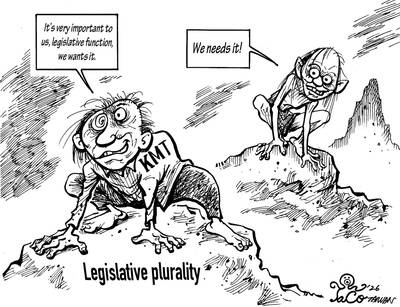
EDITORIAL CARTOON
China’s new exit and entry regulations might signal an increase in the risk that Taiwanese travelers will face, an analyst said on Tuesday last week. The new rules, which take effect on Sept. 15, expand the power of authorities to restrict travel on national, industrial and technological security grounds, question travelers about their reasons for leaving and inspect electronic data. Taiwanese who do not support the ruling party should not dismiss the warnings as fearmongering or propaganda. Beijing applies its “anti-secession” laws indiscriminately, an official said recently while presenting a report on proposed amendments to combat China’s efforts at transnational repression. Chinese
President William Lai (賴清德) late last month received a delegation of Polish members of the European Parliament at the Presidential Office — the first single-party, single-nation delegation from the EU legislature to visit Taipei in nearly two terms. The group, led by former Polish prime minister Beata Szydlo, also met Legislative Yuan Speaker Han Kuo-yu (韓國瑜), a gesture spanning Taiwan’s political divide. For most Taiwanese observers, this was a pleasant, if minor, diplomatic event. It was much more than that — and the timing matters. Within the same fortnight, Hudson Institute senior fellow Ken Moriyasu said in the Washington Examiner


 RSS
RSS