

The Chinese Nationalist Party’s (KMT) failure to win the previous three presidential elections has been tied to its tenacious approach to cross-strait relations, with polls showing that the electorate remain profoundly suspicious of the Chinese Communist Party (CCP).
At first glance, it might be confusing as to why a political party aspiring to return to power would continue to flog the pro-China horse. The answer is that continued engagement with the People’s Republic of China (PRC) makes sense, as long as one is willing to ignore some glaring omissions.
An editorial in a pro-China newspaper said that few could deny that China is overtaking other countries, including the US, in multiple metrics.
Many countries are engaging with China, while Taiwan continues to cling to the concept of “resisting China to protect Taiwan,” and the nation would lose by refusing to engage with the world’s second-largest economy in tourism, education, industry and technology, it said. It also warned against the assumption that the US military would handily defeat the Chinese People’s Liberation Army in the Western Pacific.
These are all fair points, which the article suggests are largely omitted from the pro-Taiwanese independence side. At the same time, it neglects to point out that, in Taiwan’s case, there is no possibility of a mutually beneficial economic exchange with China, nor does it concede that siding with Washington over the CCP is far more than an ideological preference. The devil is not only in the details: It is also in the omissions.
During an online interview on Friday last week, KMT Chairwoman Cheng Li-wun (鄭麗文) told host Dennis Peng (彭文正) that “Taiwan has never been independent, nor has it ever been a country.”
Cheng is incorrect in that assertion, although it is perfectly consistent with the KMT’s stance. The omissions in her statement are highly complex.
Cheng’s expression of the KMT position in this case is that the name of the country is not Taiwan, it is the Republic of China (ROC), bound to the ROC Constitution. This is not controversial from the KMT perspective, although pro-Taiwanese critics would certainly take issue with it. To Cheng, Taiwan only exists because of the ROC Constitution, which she called a “one China” constitution, omitting the logical conclusion that must be drawn: From the CCP’s perspective, the ROC no longer exists, and its constitution is little more than a historical document, albeit linked to the PRC’s own.
On how this inconvenient contradiction is to be cleared up, and how the KMT envisages “peaceful unification” with China, Cheng said her ideas would “be truly introduced and implemented as policy once the KMT retakes power.” She wants Taiwanese to hand her the presidency first before they find out what she has in store for them.
Cheng mocked the Democratic Progressive Party for “not daring to hold a referendum on Taiwanese independence.” Yet she knows what the political jeopardy to the CCP and the KMT, and the risk of war, would be if such a referendum were ever held. The list of omissions goes on.
After her meeting with Chinese President Xi Jinping (習近平) in Beijing in April, questions about whether Cheng would stand as the KMT’s presidential candidate in the 2028 election started to surface. Despite being the party chair, it is not necessarily the case that she would be the first option. A week, let alone two years, is a long time in politics, and if she ran, she would potentially be vying for the candidacy with three other strong candidates: Taipei Mayor Chiang Wan-an (蔣萬安), Legislative Speaker Han Kuo-yu (韓國瑜) — currently the party’s highest-ranked elected figure — and Taichung Mayor Lu Shiow-yen (盧秀燕).
According to an opinion poll released on Wednesday by the online media outlet Z.Media (震傳媒), when asked about who they thought would be the preferred KMT candidate for the 2028 presidential race, 20.4 percent of respondents said that they supported Chiang, 18.9 percent Han and 16 percent Lu. The differences are hardly insurmountable. Cheng only received 3 percent of the support.
In politics, omissions are to be expected, but the times also call for clarity and honesty.

For the last 15 years, China has relied on gray zone operations to advance its territorial ambitions across Asia. And for 15 years, the US has struggled to respond. But the open door on which China has been pushing may finally be closing. Gray zone operations involve the assertive use of a variety of tools in ways that create conditions that can be described as neither peace nor war. Military forces might act provocatively — even dangerously — while carefully avoiding violence, whereas law enforcement employs nonlethal violence as a first resort. Such an approach creates difficult calculations for its targets.
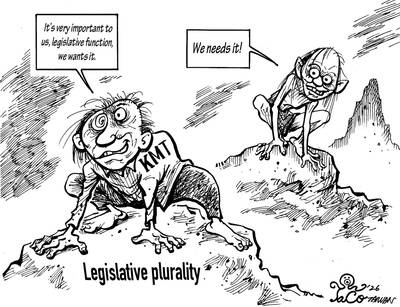
EDITORIAL CARTOON
Grab Holdings Ltd plans to acquire Taiwan’s No. 1 food delivery business, Foodpanda, for US$600 million. The Fair Trade Commission (FTC) is reviewing the proposal. Grab offers ride-hailing, dining, fresh food and grocery delivery, parcel delivery, payments, loans, insurance and digital banking services in 900 cities across eight Southeast Asian countries. Leveraging mapping data and artificial intelligence (AI) models developed in cooperation with China, it has built a comprehensive retail and consumer ecosystem. If Grab were to enter the Taiwanese market, it would have a major impact on the food service industry, convenience stores, supermarkets and e-commerce services. The ecosystem
On Wednesday last week an Indonesian frigate conducted exercises with the Chinese navy east of Taiwan, in waters Beijing has repeatedly used to demonstrate its capacity to encircle and blockade the nation. What was Indonesia doing there? The answer comes readily from Jakarta. Indonesia was practising bebas aktif, or “free and active” foreign policy, working with competing powers while reserving the right to belong to none of them. Indonesian personnel joined the US-led RIMPAC exercises in Hawaii this year, military contacts with Russia have continued, and the KRI I Gusti Ngurah Rai met the Chinese frigate Honghe while sailing home from


 RSS
RSS