

The death of a beloved leader has often presented challenges for China’s ruling Communist Party. With few avenues for overtly criticizing the regime, public mourning can become an expression of broader discontent.
The glowing tributes for former premier Zhu Rongji (朱鎔基), who died last week at 97, should be understood in that context. The outpouring of affection online for a charismatic, plain-spoken reformer, who presided over an economic transformation in the 1990s that paved the way for two decades of breakneck expansion, reflects not only admiration, but unease with the country’s direction. It is nostalgia and collective longing for the past.
It would be a mistake for the leadership to ignore the widespread anxiety on display. China’s factories are churning out ever larger volumes of cars, machinery and other goods for global markets, but this strategy might be unsustainable in the long term. A prolonged property slump has eroded household wealth, the job market is difficult, and weak domestic demand has kept prices under pressure. Politically, the space for dissent and public debate has narrowed as power has become increasingly centralized under Chinese President Xi Jinping (習近平).
Against that backdrop, it is easy to understand why the 1990s are being viewed so wistfully. The years between 1991 and 2003, when Zhu served as vice premier and then premier, were marked by rising prosperity and openness. Per-capita GDP has risen more than tenfold since then. Lionized as China’s economic tsar, he led the push to join the WTO, clean up the banking system and restructure the powerful state-owned sector to prepare for the foreign competition that membership would bring.
It is the sense of possibility that is making people hanker for that era. Nostalgia for the 1990s is having a global moment, with the decade remembered fondly as a simpler, more optimistic time. In China, few captured this yearning better than Zhao Jian (趙建), a prominent economist, who posted an essay on social media shortly after Zhu’s death.
Although written as a remembrance, the piece — which was quickly deleted by censors — amounted to a sharp critique of the modern day. Even though life was materially tougher three decades ago when a month’s salary could buy only a few pounds of meat, people were buoyed by the hope of better days ahead, Zhao wrote. He even said he wished he had been living in a dream since the 1990s from which he could wake up.
As part of that narrative, Zhu emerged as a symbol of confidence in the future. Zhao described watching on TV the tough-talking former premier’s first press conference in 1998; he came across as someone “holding up the weight of this country” and “giving his all for us.” Although the writer was careful not to point the finger at anyone, his target was hard to miss.
By romanticizing Zhu’s achievements, Zhao’s essay was widely read as an indictment of the economic direction that China has taken under the present leadership, which favors high-tech champions over consumers. I have written before that household spending must be given the same strategic priority as industrial upgrading, but idealizing Zhu’s economic record risks overlooking the extent to which his policies helped lay the foundation for ongoing problems.
Some of his decisions have not aged well. His reforms enhanced Beijing’s hand at the expense of market forces, said Victor Shih, a professor of political economy at the University of California at San Diego, and helped create more bad debts. Rural incomes lagged during his tenure, contributing to problems of widening inequality, which Zhu’s successors had to tackle. The economic model also became increasingly dependent on investment and exports as a proportion of GDP, setting the stage for current imbalances.
Yet nostalgia rarely turns on a precise account of the past. People are not yearning for mass layoffs or the meager living standards of 30 years ago. What they miss is the idea that painful change was leading somewhere. Three decades after Zhu helped set China on a path toward greater affluence and engagement with the world, his death has revealed that confidence about the future is itself an economic asset — something the leadership in Beijing should do much more to restore.
Juliana Liu is a columnist for Bloomberg Opinion’s Asia team, covering corporate strategy and management in the region. She was previously CNN’s senior business editor for Asia, and a correspondent at BBC News and Reuters. This column reflects the personal views of the author and does not necessarily reflect the opinion of the editorial board or Bloomberg LP and its owners.
For the last 15 years, China has relied on gray zone operations to advance its territorial ambitions across Asia. And for 15 years, the US has struggled to respond. But the open door on which China has been pushing may finally be closing. Gray zone operations involve the assertive use of a variety of tools in ways that create conditions that can be described as neither peace nor war. Military forces might act provocatively — even dangerously — while carefully avoiding violence, whereas law enforcement employs nonlethal violence as a first resort. Such an approach creates difficult calculations for its targets.
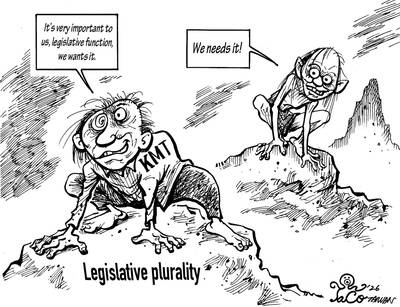
EDITORIAL CARTOON
Grab Holdings Ltd plans to acquire Taiwan’s No. 1 food delivery business, Foodpanda, for US$600 million. The Fair Trade Commission (FTC) is reviewing the proposal. Grab offers ride-hailing, dining, fresh food and grocery delivery, parcel delivery, payments, loans, insurance and digital banking services in 900 cities across eight Southeast Asian countries. Leveraging mapping data and artificial intelligence (AI) models developed in cooperation with China, it has built a comprehensive retail and consumer ecosystem. If Grab were to enter the Taiwanese market, it would have a major impact on the food service industry, convenience stores, supermarkets and e-commerce services. The ecosystem
On Wednesday last week an Indonesian frigate conducted exercises with the Chinese navy east of Taiwan, in waters Beijing has repeatedly used to demonstrate its capacity to encircle and blockade the nation. What was Indonesia doing there? The answer comes readily from Jakarta. Indonesia was practising bebas aktif, or “free and active” foreign policy, working with competing powers while reserving the right to belong to none of them. Indonesian personnel joined the US-led RIMPAC exercises in Hawaii this year, military contacts with Russia have continued, and the KRI I Gusti Ngurah Rai met the Chinese frigate Honghe while sailing home from


 RSS
RSS