


Switzerland is set for a nail-biter vote on a proposal to cap the population at 10 million, after a two-pronged push by campaigners that paired a polished appeal to sustainability-minded moderates with harsher anti-immigrant messaging.
Ahead of the ballot on Sunday, the Swiss People’s Party, or SVP, has cast the initiative as a solution to housing affordability and a defense of the environment, arguing that immigration is forcing the country to pave over its renowned Alpine scenery.
At the same time, groups further to the right have tapped into baser fears about foreigners. An online game released by the Egerkinger Komitee — which says it resists “claims to power of political Islam in Switzerland” — allows players to control a border guard and repel dark-skinned immigrants pictured begging or holding weapons.
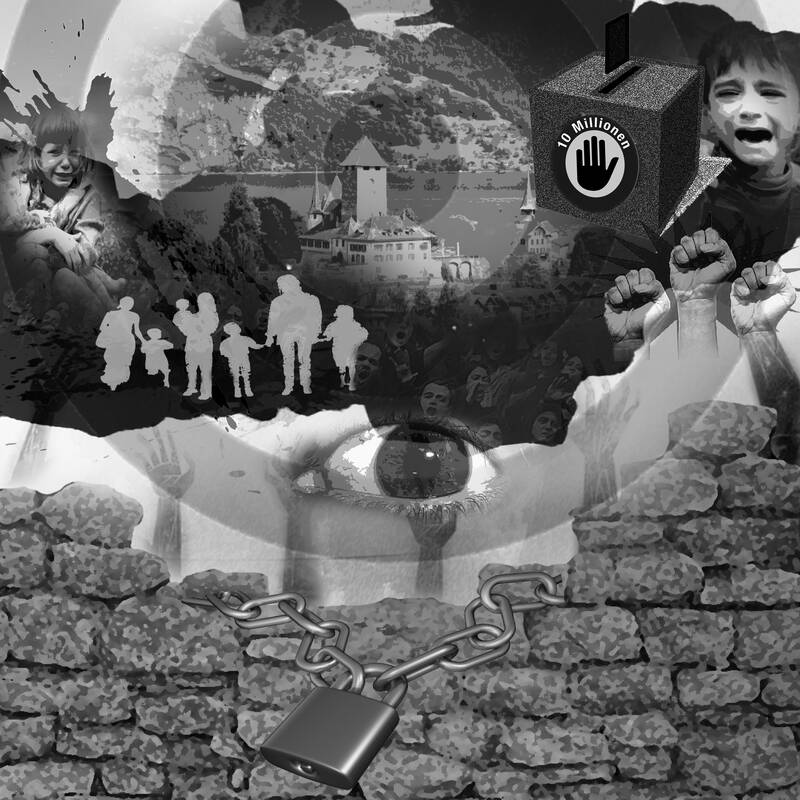
Illustration: Kevin Sheu
The population cap is an unprecedented proposal, one never before tried by a modern economy, and critics say it threatens investment, growth and the country’s reputation for openness.
The SVP needed a strong campaign to sell such an idea to a largely pragmatic nation. To do that, it has largely avoided dabbling in racist memes like in the past, instead targeting concerns that resonate with a wider demographic.
“It’s skillful populism,” said Jacob Funk Kirkegaard, a senior fellow at the Bruegel think tank. “They managed to capture the imagination of a wide range of groups by tapping into a variety of fallacies, welding together fears embracing environmental concerns and access to housing with traditional anti-immigration sentiment about changing the face of Switzerland.”
Switzerland’s population is about 9.1 million, having risen by some 2 million this century.
Against that backdrop, the broad concept of “too many people” has been getting through, with polls at one point showing a majority in favor of the cap. Support has since slipped, with opposition rising above 50 percent for the first time last week, but the result may still be close.
The latest polls were largely conducted before a knife attack in the city of Winterthur by a man with ties to Islamist groups. Police called it a “terrorist” incident, and it may sway some voters.
“This country already has way too many immigrants — particularly of the wrong ones,” said 55-year-old Thomas Friedli, a former relationship manager at various banks who emigrated to Ecuador and now runs a hotel. “Every time I come back to Switzerland it’s getting worse.”
DIRECT DEMOCRACY
Anti-immigration sentiment is not exclusive to Switzerland, but its direct democracy means there have been repeated votes on the issue.
The system allows people a greater say in parliament decisions, or to propose their own initiatives if they gather enough signatures. The June 14 ballot is the latest in a series going back decades that have tried to put stricter restrictions on immigration.
“Right-wing parties are getting more popular everywhere,” said Michael Hermann, a researcher who oversees public opinion polls for Swiss public television. “If you could cast a ballot against immigration in Germany, the UK or the US, you would get similar results — Switzerland just sticks out because we’re actually voting four times a year.”
In many of the immigration votes, the SVP has played a key role. Since the 1990s, it has grown into a formidable political force, now the largest in the parliament, largely by focusing on concerns about sovereignty and protecting Switzerland from outside influence.
In 2007, it ran controversial election posters in which white sheep kicked a black sheep off a field covered in the Swiss flag.
The party has become well-practiced at crafting emotional, patriotic narratives aimed at overriding economic arguments. And it has had victories, notably in 2014 when an initiative to impose immigration curbs was passed.
After failures in subsequent years, it proposed the population cap, trying to sway more moderate voters.
Opponents call it the “chaos initiative,” saying it will damage the economy and hurt businesses. They also warn that it will jeopardize trade relations with the EU, Switzerland’s biggest trading partner, at a time when fractured globalization means the country needs strong alliances.
“Such a policy would be a costly mistake for a small, open economy whose prosperity depends notably on attracting skilled workers and boosting productivity. Restricting access to foreign talent would undermine a key source of economic growth.”
Jan Kedzior, a retired dentist from Morschach, about 60km south of Zurich, says the SVP has tapped into public frustration, but concern about economic fallout may have the edge.
“People sometimes vote out of spite. Many want to teach our politicians a lesson,” he said. “It will be a very close race. But most Swiss vote with their wallet, so I don’t think it will pass in the end.”
Last year, Switzerland rejected a proposed 50 percent inheritance tax on super-rich residents, deciding the threat of wealthy people leaving the country was too much. Finance Minister Karin Keller-Sutter said at the time that voters were against a “risky fiscal policy experiment” that would have damaged Switzerland’s attractiveness.
If the population cap does secure voter approval, lawmakers may try to water it down later to limit any economic fallout.
The proposal includes a number of measures, starting with restrictions on asylum seekers. If the population breaches 10 million and remains above that level, the country would have to withdraw from an agreement with the EU on the free movement of people. That would affect other pacts in key areas like trade and market access.
Chinese Nationalist Party (KMT) Chairwoman Cheng Li-wun (鄭麗文) in San Francisco on Tuesday last week said if she had not met with Chinese President Xi Jinping (習近平), she would have been “just a plain” and “even negligible” KMT chairperson, bluntly signaling the role she is playing in her visit to the US — Beijing’s messenger from Taiwan. Cheng and her delegation arrived in the US on Monday last week for a two-week visit across five major cities. Her party said the group is scheduled to meet with US lawmakers, officials, policy experts and businesspeople. Before departing, Cheng said her trip
In 1935, the German Reich led by the National Socialist Party officially created the Nuremberg Race Laws, a “legal cage”, for German Jews, stripping them of citizenship, criminalizing their personal relationships, barring them from public life, and transforming them into stateless subjects and isolating them from the rest of society. Similarly, in March 2026, the People’s Republic of China (PRC) National People’s Congress adopted the “Promoting Ethnic Unity and Progress” law, which represents the most significant shift in Chinese domestic governance since the era of Mao Zedong (毛澤東). Ostensibly designed as domestic legislation to manage China’s 56 officially recognized ethnic groups,
The Comedy Club on Fuxing N Road in Taipei was vandalized with paint bombs mixed with feces on May 29, allegedly because one of its performers had satirized Chinese President Xi Jinping (習近平). The incident has triggered concerns about the growing threat from China’s cross-border repression within Taiwan. On the day of the attack, a comedian surnamed Huang (黃), who is known for mocking Xi, was the headline performer. The Comedy Club founder said the assault was obviously politically motivated. China, which Freedom House said “conducts the most sophisticated, extensive and far-reaching campaign of transnational repression in the world,” has
As semiconductor manufacturing crosses the 2-nanometer threshold into the era of the angstrom, the global chip race is now about much more than shrinking dimensions. It has become a broader system of competition encompassing transistor architecture, backside power delivery, advanced packaging, manufacturing data, artificial intelligence (AI) algorithms and national-level strategies. What makes Taiwan Semiconductor Manufacturing Co (TSMC 台積電) truly exceptional is not just its ability to manufacture chips, but its capacity to integrate unique client demands, process controls, equipment coordination, packaging technologies and high production yields into a system of manufacturing governance that is arguably the world’s most difficult to


 RSS
RSS