


Maps are never neutral. They are instruments of knowledge, yes, but also of power, ideology and often manipulation.
Nowhere is this more evident than in the depiction of Africa. For centuries, the Mercator projection — still ubiquitous in classrooms, media and digital platforms — has misrepresented Africa’s true scale, making one of the world’s largest landmasses appear deceptively small.
At more than 30 million square kilometers, Africa is larger than the US, China, India and much of Europe combined. Yet on most maps, it appears comparable in size to Greenland, a landmass that is 14 times smaller. Far from a harmless visual inconsistency, that distortion has long shaped narratives about Africa’s significance, resources and potential.
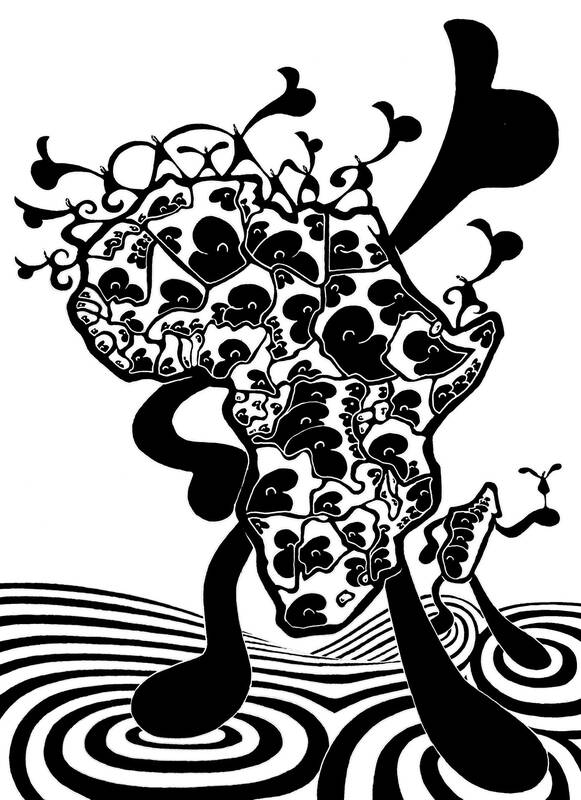
Illustration: Mountain People
A global initiative, Correct the Map, seeks to address this imbalance, not merely by adjusting cartographic conventions, but by challenging the deeper distortions that shape how the world sees Africa, and how Africa sees itself.
The Mercator projection, developed by the Flemish geographer Gerardus Mercator in 1569, was designed for maritime navigation, but distorts scale, especially farther from the equator. In an age of satellite imagery, advanced geospatial technologies and digital mapping, we are no longer constrained by the technical limitations that once justified such compromises. As academics have observed, we are approaching a “digital inflection point” at which accuracy is no longer optional.
However, this is not only a scientific issue; it is also a political one. Perception shapes policy, and a continent repeatedly represented as smaller than it truly is risks appearing less significant economically, strategically and culturally, with far-reaching implications for investment decisions, international negotiations and global governance.
Younger generations across Africa already recognize that the continent, home to more than 1.4 billion people and some of the world’s fastest-growing economies, cannot afford to be visually minimized. Less encumbered by inherited colonial frameworks and more comfortable navigating multiple cultural and intellectual registers, they are driving a shift toward an Africa that is neither insular nor reactive, but increasingly self-defined.
Against this backdrop, the African Union’s decision last year to endorse the Correct the Map was a watershed moment, reflecting a collective recognition that representation matters — not merely as a symbolic gesture, but as a question of fairness. By advocating the adoption of maps that reflect Africa’s true size within international institutions, including the UN, African leaders are asserting a simple yet powerful principle: representation should be grounded in reality.
A clearer understanding of Africa’s real scale would transform how the world— investors, policymakers and global partners — views its economic geography and infrastructure. When the continent is visually compressed, so too are perceptions of its reach, connectivity and strategic importance.
Trade is a case in point. From the Suez Canal to the strategic passages around the Cape of Good Hope, the continent is connected to some of the world’s most important maritime corridors. Its coastline stretches more than 30,000km, supporting fisheries, maritime transport, offshore energy and critical ecosystems that together form what is arguably the planet’s largest and least-developed blue economy. Beneath these waters lies another largely invisible, but essential form of infrastructure: a dense network of submarine cables underpinning much of the global digital economy.
There is also a cultural dimension to the Correct the Map initiative. For generations, educational systems around the world have reproduced inaccurate geographic representations of Africa. Correcting these distortions is an investment in ensuring that future generations — whether in Accra, Amsterdam or Seoul — grow up with a more accurate mental map of the world they inhabit.
To be sure, all maps involve some degree of distortion. No flat representation of a spherical Earth can ever be perfect, but that is no justification for inaction. Rather, it is a reason to make more responsible choices. When better alternatives exist, it becomes difficult to justify retaining models that systematically misrepresent entire regions.
The momentum behind Correct the Map reflects a broader global shift. In an interconnected world in which information moves rapidly and decisions are increasingly data-driven, there is little tolerance for inherited inaccuracies. The aim is not to rewrite history, but to update the tools through which we understand the present.
At its core, the campaign is also about dignity. Africa’s story has repeatedly been told from a perspective that diminished the continent’s scale and Africans’ agency. Correcting the map would be an important first step toward engaging with the continent on its own terms.
Governments, international organizations, educational institutions and technology companies must work together to adopt more accurate map projections. This is neither technically complex nor prohibitively expensive, yet the consequences of such a change could be profound.
Maps, after all, are never just representations of space. They also reflect how we see one another and should thus reflect the world as it truly is. Africa does not need to be enlarged. It needs, at long last, to be seen.
Carlos Lopes is a professor at the University of Cape Town’s Nelson Mandela School of Public Governance. Selma Malika Haddadi is deputy chairperson of the African Union Commission.
Copyright: Project Syndicate
KMT Chairwoman Cheng Li-wun’s (鄭麗文) recent visit to Beijing and her upcoming visit to Washington will serve as a high-level test of her diplomatic mettle. In Beijing, Cheng was received with symbolic gestures, a warm reception, and high-level access. In Washington, she will receive far less pomp and far sharper questions about the KMT’s vision for the future of Taiwan. Her challenge will be to persuade Washington that the KMT’s engagement with China can coexist with strong deterrence. Cheng’s April 7-12 visit to mainland China coincided with an intense period of conflict in Iran. Despite the strategic significance of Cheng’s trip,
The closure of the Strait of Hormuz has sent the vast Asian chemicals industry into a tailspin. Deprived of the likes of Qatari natural gas and Saudi Arabian oil, the region’s fertilizer and plastics plants are slowing production or even shutting down. Everywhere except China, that is. In petrochemicals, China is unique. As well as a traditional industry that uses oil and gas as feedstock, it has parallel output that relies on its abundant domestic coal. Unsurprisingly, India and other regional powers want to copy and paste the Chinese method. This would not be easy — or climate friendly. The
US President Donald Trump recently repeated his claim that “Taiwan stole America’s chip industry,” reigniting public debate on the issue. As a former Taiwanese minister of economic affairs and an entrepreneur deeply involved in semiconductor supply chain development, I feel a responsibility to clarify this misunderstanding. From the perspective of global industrial evolution and the economic principle of comparative advantage, such a statement appears overly simplistic and risks obscuring the essence of the issue. The rise of Taiwan’s semiconductor industry was not built on “replacing America,” but rather emerged as a result of countries pursuing different development paths within the
The Presidential Office on Saturday reiterated that Taiwan is a sovereign, independent nation after US President Donald Trump said that Taiwan should not “go independent.” “We’re not looking to have somebody say: ‘Let’s go independence because the United States is backing us,’” Trump said in an interview with Fox News aired on Friday. President William Lai (賴清德) on Monday said that the Republic of China (ROC) — Taiwan’s official name — and the People’s Republic of China (PRC) are not subordinate to each other. Speaking at an event marking the 40th anniversary of the establishment of the Democratic Progressive Party (DPP), Lai said


 RSS
RSS