


The recent legal defeat for Meta should provide a new impetus for governments to crack down on the scourge of online child abuse. A New Mexico jury determined not only that the company’s platforms have exposed children to predators and sexually explicit material, but that it also misled the public about such risks.
Yet despite this landmark case, the debate about children’s safety online could continue to move from scandal to scandal without arriving at truly effective solutions. Public outrage tends to peak after major court cases or in response to disturbing news stories, like when Grok allowed users to flood social media with sexualized images of children this January. Politicians duly speak out, even promising meaningful regulation, only for public attention to fade without any action. All the while, the technology continues to evolve and brings fresh challenges.
However, it does not have to be this way, because we already understand how to prevent abuse online. The problem is not a lack of knowledge. It is that our response has not kept pace with the evidence. A recent systematic review of the academic literature and real-world interventions to tackle abuse, published by the International Panel on the Information Environment (IPIE), came to a stark conclusion: While we already have the tools we need, the global response remains fragmented and incomplete.
For example, digital platforms and investigators rely heavily on systems that scan the web for known illegal images and identify grooming behavior. Without these tools, much of the abuse online would remain hidde.
Moreover, AI is increasingly being used to improve these tools and analyze huge volumes of platform data, enabling investigators to find previously unseen abuse material.
Yet these tools’ effectiveness depends on the data used to train the model, and researchers often lack secure access to the data sets they need. The IPIE review thus urges governments to facilitate safe, controlled environments where authorized researchers can study sensitive data while still protecting victims. Without such cooperation, progress would remain uneven and inconsistent.
Moreover, these methods all deal with abuse after the fact. As important as it is to improve the detection of perpetrators, preventing harms before they happen must be the goal. Here, the IPIE identifies serious blind spots. Digital payment systems, advertising tools, and other widely used platform features can help offenders organize and profit from abuse. Yet policy interventions rarely target these mechanisms. If the financial infrastructure that supports exploitation remains untouched, efforts to combat abuse would always be reactive.
Then there is public awareness. Education campaigns that warn minors about grooming risks and explain the harms of illegal content show promise in encouraging safer behavior and increasing reporting, but they remain underdeveloped. However, education cannot replace responsible platform design or effective enforcement. Children should not be asked to navigate systems that enable their exploitation. The responsibility must remain with the companies that build and operate these platforms.
The major technology companies operate globally, whereas enforcement remains largely national. Without stronger legal frameworks that operate across borders, offenders would exploit regulatory gaps. Some policymakers already have the power to apply laws beyond their territory by requiring companies to report abuse, preserve evidence, and cooperate with investigations. For example, the EU — a major market for all the big digital platforms — is particularly well positioned to hold major platforms and offenders accountable.
Still, as the IPIE review shows, much more could be done to improve international coordination so that companies and criminals face clearer and more consistent enforcement. The Grok scandal was a textbook illustration of how regulators are struggling to keep up with fast-moving technologies. Although regulators did respond quickly when it became clear that the chatbot was developing child sexual abuse material, it took a significant public outcry to call attention to the problem.
Otherwise, lobbying, economic pressure, and other forms of industry influence dissuade policymakers from pursuing meaningful regulation.
Taken together, the IPIE’s findings describe a global response to online child abuse that is both essential and insufficient. Detection tools routinely identify abuse that is already known; law-enforcement agencies pursue offenders where they can, and education programs try to call attention to outstanding risks. However, the system still struggles to keep pace with ever-evolving digital technologies.
Financial systems that support exploitation remain poorly understood; researchers lack access to the data needed to improve detection; and legal frameworks do not account for the global nature of the problem.
For years, policymakers argued that stronger action required more evidence. However, that is no longer a credible excuse. The IPIE has established that the evidence is already there. We know which interventions help reduce harm, and we know where the major gaps lie. What remains unknown is whether political leaders would do what is necessary to keep children safe.
Andy Phippen is Professor of Digital Rights at Bournemouth University and a visiting professor at the University of Suffolk.
Copyright: Project Syndicate

KMT Chairwoman Cheng Li-wun’s (鄭麗文) recent visit to Beijing and her upcoming visit to Washington will serve as a high-level test of her diplomatic mettle. In Beijing, Cheng was received with symbolic gestures, a warm reception, and high-level access. In Washington, she will receive far less pomp and far sharper questions about the KMT’s vision for the future of Taiwan. Her challenge will be to persuade Washington that the KMT’s engagement with China can coexist with strong deterrence. Cheng’s April 7-12 visit to mainland China coincided with an intense period of conflict in Iran. Despite the strategic significance of Cheng’s trip,

The closure of the Strait of Hormuz has sent the vast Asian chemicals industry into a tailspin. Deprived of the likes of Qatari natural gas and Saudi Arabian oil, the region’s fertilizer and plastics plants are slowing production or even shutting down. Everywhere except China, that is. In petrochemicals, China is unique. As well as a traditional industry that uses oil and gas as feedstock, it has parallel output that relies on its abundant domestic coal. Unsurprisingly, India and other regional powers want to copy and paste the Chinese method. This would not be easy — or climate friendly. The
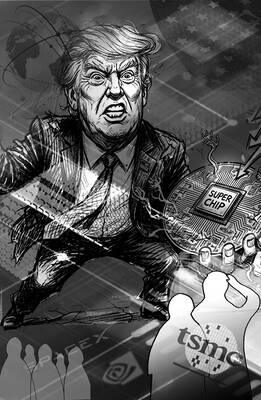
The White House’s decision to take a 9.9 percent stake in Intel Corp is looking like very shrewd business indeed. Since the government bought in at US$20.47 a share last August, the US chipmaker’s surging stock price has delivered the US a US$43 billion return. One of the reasons the investment has so far proved so sound is that the White House has made sure of it. According to The Wall Street Journal, Howard personally pushed deals on Intel’s behalf with some of the most lucrative clients imaginable. They include Nvidia Corp, the company at the heart of the AI
Indonesian President Prabowo Subianto says he knows how to fix the problems facing Indonesia. Yet his economic mismanagement and authoritarian tendencies are steering the nation toward a familiar mix of currency instability and political chaos. The world’s fourth-most populous nation risks reversing the hard-won democratic and business reforms that came after the Asian Financial Crisis in 1997. At that time, the rupiah collapsed and the political upheaval that followed forced former president Haji Mohamed Suharto from power. Prabowo’s administration is ignoring similar warning signs. That disconnect was apparent in a national address on Wednesday, when Prabowo projected the swagger that has


 RSS
RSS