


An amendment proposed by Chinese Nationalist Party (KMT) Legislator Ko Ju-chun (葛如鈞) seeks to introduce exemptions to Taiwan’s restrictions on foreign ownership of public telecommunications networks.
Under the Telecommunications Management Act (電信管理法), foreign ownership of public telecom networks in Taiwan is capped at 49 percent direct ownership and 60 percent combined direct and indirect ownership unless otherwise approved.
Ko’s proposal would allow exceptions if the government determines that doing so would not harm telecom security, market development, national security or the public interest.
The amendment is widely viewed as an effort to facilitate Starlink’s entry into the Taiwanese market, amid reports the company prefers operating only through a wholly owned subsidiary.
That position is difficult to justify, given that Starlink operates through local partnerships in other markets.
In Japan, it works with KDDI and Internet Initiative Japan (IIJ), while in the Philippines it partners with PLDT Enterprise, Converge ICT and Globe Telecom.
Taiwan’s caution reflects credible security threats from China, including repeated damage to undersea cables. In a full-scale conflict, communications infrastructure would likely be an early target through physical and cyberattacks.
Satellite connectivity could provide important redundancy, especially in rural regions, outlying islands such as Kinmen, Lienchiang and Penghu, and remote territories including Itu Aba Island (Taiping Island, 太平島) and the Pratas Islands (Dongsha Islands, 東沙島). Ukraine’s use of Starlink demonstrates the value of low Earth orbit networks in maintaining wartime communications.
However, reliance on foreign systems raises concerns given Elon Musk’s past comments on Taiwan and Tesla’s exposure to China, including its Shanghai Gigafactory. China remains one of Tesla’s largest markets alongside the US and accounts for a substantial share of global deliveries, creating a strategic risk different from Ukraine’s experience.
Even if Starlink were operational in a crisis, concerns remain that Beijing could exert pressure to access data or communications. These risks underpin Taiwan’s strict foreign ownership rules for critical infrastructure.
Other low Earth orbit providers, including Eutelsat OneWeb and Amazon’s Project Kuiper, have indicated willingness to comply with local arrangements, though Amazon retains significant commercial ties to China through logistics and cross-border operations.
Given these constraints, Taiwan’s most secure long-term option might be developing its own low Earth orbit satellite system under domestic control, including the ability to restrict military access in wartime.
Democratic Progressive Party Legislator Chen Su-yueh (陳素月) raised this idea at a meeting of the legislature’s Transportation Committee on April 22, stating that “Taiwan has many talented people, and we should develop our own low Earth orbit satellites to ensure our own safety.”
The Taiwan Space Agency (TASA) has expanded capabilities through Formosat and CubeSat missions. While still reliant on foreign launch providers, Taiwan is steadily building expertise in imaging, climate monitoring and satellite technology.
In cooperation with the Chungshan Institute of Science and Technology, TASA could accelerate development of commercial and military low-Earth-orbit satellite systems, providing a secure sovereign communications backup network.
Taiwan could still consider allowing Starlink entry, but any arrangement must comply with foreign ownership rules and be subject to strict oversight. In a conflict scenario, access would need to be tightly controlled or restricted.
Ultimately, Taiwan’s communications resilience would be best ensured through sovereign low Eart orbit satellite infrastructure.
KMT Chairwoman Cheng Li-wun’s (鄭麗文) recent visit to Beijing and her upcoming visit to Washington will serve as a high-level test of her diplomatic mettle. In Beijing, Cheng was received with symbolic gestures, a warm reception, and high-level access. In Washington, she will receive far less pomp and far sharper questions about the KMT’s vision for the future of Taiwan. Her challenge will be to persuade Washington that the KMT’s engagement with China can coexist with strong deterrence. Cheng’s April 7-12 visit to mainland China coincided with an intense period of conflict in Iran. Despite the strategic significance of Cheng’s trip,

The closure of the Strait of Hormuz has sent the vast Asian chemicals industry into a tailspin. Deprived of the likes of Qatari natural gas and Saudi Arabian oil, the region’s fertilizer and plastics plants are slowing production or even shutting down. Everywhere except China, that is. In petrochemicals, China is unique. As well as a traditional industry that uses oil and gas as feedstock, it has parallel output that relies on its abundant domestic coal. Unsurprisingly, India and other regional powers want to copy and paste the Chinese method. This would not be easy — or climate friendly. The
Indonesian President Prabowo Subianto says he knows how to fix the problems facing Indonesia. Yet his economic mismanagement and authoritarian tendencies are steering the nation toward a familiar mix of currency instability and political chaos. The world’s fourth-most populous nation risks reversing the hard-won democratic and business reforms that came after the Asian Financial Crisis in 1997. At that time, the rupiah collapsed and the political upheaval that followed forced former president Haji Mohamed Suharto from power. Prabowo’s administration is ignoring similar warning signs. That disconnect was apparent in a national address on Wednesday, when Prabowo projected the swagger that has
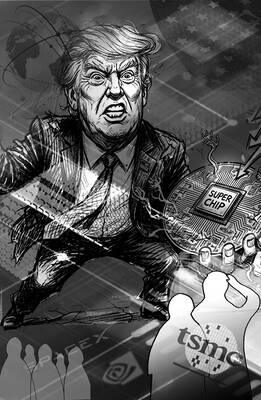
The White House’s decision to take a 9.9 percent stake in Intel Corp is looking like very shrewd business indeed. Since the government bought in at US$20.47 a share last August, the US chipmaker’s surging stock price has delivered the US a US$43 billion return. One of the reasons the investment has so far proved so sound is that the White House has made sure of it. According to The Wall Street Journal, Howard personally pushed deals on Intel’s behalf with some of the most lucrative clients imaginable. They include Nvidia Corp, the company at the heart of the AI


 RSS
RSS