


If the Iran war has taught us nothing else, it is that weaponizing shipping routes is now the military move du jour. It has rightly turned attention to the Taiwan Strait, but in this era of intense US-China rivalry, the Strait of Malacca is just as important.
The shipping route — which carries roughly 40 percent of global trade and about 80 percent of China’s imported oil — has long been regarded as vulnerable to disruption. Southeast Asia’s divisions would make any crisis much harder to contain.
The confrontation between the US and Iran over the Strait of Hormuz has shown how easily chokepoints can be militarized and how quickly economic fallout can spread.
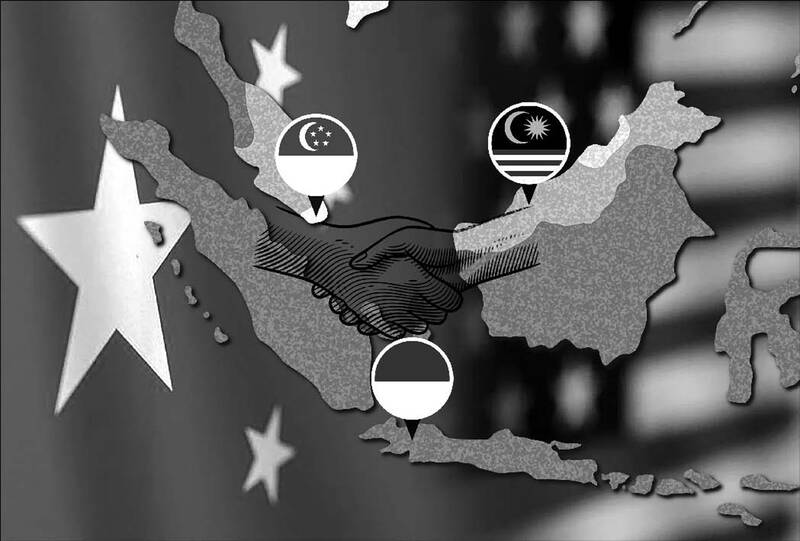
Illustration: Louise Ting
The same logic applies to Malacca, except here, the consequences would cut to the heart of Asia’s economies.
Indonesia, Malaysia and Singapore border the strait and jointly manage it, but have no common framework to deal with pressure in their own waters. Existing cooperation has largely been limited to operational issues such as piracy and safety, but that approach is poorly suited to geopolitical pressure.
Discussions between Jakarta and Washington on expanding defense cooperation indicate the Trump administration could be seeking a greater role in the region.
Earlier this month, the two announced a major defense partnership and discussed the possibility of expanded US military overflights through Indonesian airspace. Jakarta has stressed that nothing has been finalized, but even limited access would enhance US ability to monitor — and project forces across — this corridor linking the Pacific and Indian oceans.
Southeast Asia’s response to Hormuz remains fragmented, although Singapore’s approach is worth considering. It has emphasized the principle of freedom of navigation and adherence to international law, arguing that paying tolls for safe passage through the Strait of Hormuz, as Iran is demanding, would set a dangerous precedent for the Malacca Strait.
Malaysia has taken a different route, negotiating a deal that allows several of its ships to cross the waterway. Indonesia, meanwhile, continues to hedge between Beijing and Washington, even as it explores closer defense ties with the US. However, this could be interpreted as alignment by China, potentially drawing Jakarta more directly into a US-China confrontation it has long sought to avoid.
There is no immediate threat to Malacca, but the strait is uniquely exposed to tensions between China and the US both because of its geography and its role in the global economy.
Chinese strategists worry that, in a conflict, US forces could threaten the sea lanes that carry much of its imported oil, a vulnerability former Chinese president Hu Jintao (胡錦濤) famously termed the “Malacca dilemma.”
Washington has far greater capacity to project power in this area than China does, thanks to its naval reach and network of allies and partners.
The war in Iran has underscored Beijing’s Achilles’ heel. In a crisis — whether over Taiwan, the South China Sea or other points of tension between the two powers — the strait could be drawn into US-China competition. The impact would not be confined to China: Disruption would reverberate across global supply chains, raising energy costs, delaying trade flows and intensifying economic shocks worldwide.
Beijing has spent billions trying to mitigate that risk, building pipelines through Myanmar, investing in the China-Pakistan Economic Corridor, and even Arctic routes, but so far none offers a viable substitute for Malacca.
It is time for Indonesia, Malaysia and Singapore to take a unified approach to maritime security governance of the waterway. Countries are beginning to diversify their options, and this should continue. Thailand, for example, is already pushing ahead with plans for a land bridge linking the Indian and Pacific oceans that would in theory allow it to bypass Malacca altogether.
Yet none of that is a substitute for Asian unity, particularly among the nations that manage the waterway. They should consider upgrading existing arrangements with more robust joint patrols and develop clearer mechanisms for what to do if conflict breaks out. Above all, they need to present a unified front to both Washington and Beijing and resist the temptation to strike separate deals, which weakens their collective leverage.
Failing to do so means the Strait of Malacca would become another contested artery of international trade. In an era of intensifying geopolitical rivalry, the costs of such fragmentation would be felt far beyond Southeast Asia. The global economy cannot afford another shock.
Karishma Vaswani is a Bloomberg Opinion columnist covering Asia politics with a special focus on China. Previously, she was the BBC’s lead Asia presenter and worked for the BBC across Asia and South Asia for two decades. This column reflects the personal views of the author and does not necessarily reflect the opinion of the editorial board or Bloomberg LP and its owners.
When 17,000 troops from the US, the Philippines, Australia, Japan, Canada, France and New Zealand spread across the Philippine archipelago for the Balikatan military exercise, running from tomorrow through May 8, the official language would be about interoperability, readiness and regional peace. However, the strategic subtext is becoming harder to ignore: The exercises are increasingly about the military geography around Taiwan. Balikatan has always carried political weight. This year, however, the exercise looks different in ways that matter not only to Manila and Washington, but also to Taipei. What began in 2023 as a shift toward a more serious deterrence posture
Reports about Elon Musk planning his own semiconductor fab have sparked anxiety, with some warning that Taiwan Semiconductor Manufacturing Co (TSMC) could lose key customers to vertical integration. A closer reading suggests a more measured conclusion: Musk is advancing a strategic vision of in-house chip manufacturing, but remains far from replacing the existing foundry ecosystem. For TSMC, the short-term impact is limited; the medium-term challenge lies in supply diversification and pricing pressure, only in the long term could it evolve into a structural threat. The clearest signal is Musk’s announcement that Tesla and SpaceX plan to develop a fab project dubbed “Terafab”
China’s AI ecosystem has one defining difference from Silicon Valley: It is embrace of open source. While the US’ biggest companies race to build ever more powerful systems and insist only they can control them, Chinese labs have been giving the technology away for free. Open source — making a model available for anyone to use, download and build on — once seemed a niche, nerdy topic that no one besides developers cared about. However, when a new technology is driving trillions of dollars of investments and leading to immense concentrations of power, it offered an antidote. That is part of
In late January, Taiwan’s first indigenous submarine, the Hai Kun (海鯤, or Narwhal), completed its first submerged dive, reaching a depth of roughly 50m during trials in the waters off Kaohsiung. By March, it had managed a fifth dive, still well short of the deep-water and endurance tests required before the navy could accept the vessel. The original delivery deadline of November last year passed months ago. CSBC Corp, Taiwan, the lead contractor, now targets June and the Ministry of National Defense is levying daily penalties for every day the submarine remains unfinished. The Hai Kun was supposed to be


 RSS
RSS