


When 17,000 troops from the US, the Philippines, Australia, Japan, Canada, France and New Zealand spread across the Philippine archipelago for the Balikatan military exercise, running from tomorrow through May 8, the official language would be about interoperability, readiness and regional peace.
However, the strategic subtext is becoming harder to ignore: The exercises are increasingly about the military geography around Taiwan.
Balikatan has always carried political weight. This year, however, the exercise looks different in ways that matter not only to Manila and Washington, but also to Taipei.
What began in 2023 as a shift toward a more serious deterrence posture is now taking firmer shape. The network the Philippines started building with the US and other like-minded partners appears to be on a stronger footing and Balikatan 2026 suggests it would continue to deepen. Philippine and US officials have described the drills as the largest and most expansive in Balikatan’s history, with more than 17,000 personnel and 17 observer nations. The significance lies less in the scale than in what the scale represents.
Balikatan is no longer just a bilateral alliance exercise. It is becoming a visible rehearsal for coalition operations along the first island chain.
Taiwan sits at the center of that chain. Any serious conflict over Taiwan would not remain confined to the Taiwan Strait. It would spill south into the waters and airspace linking Taiwan to the northern Philippines, especially the Bashi Channel. That is why Balikatan’s geography matters so much.
Training in northern and western Luzon, along with maritime and air defense scenarios near key sea lanes, places the exercise in terrain that would be operationally critical in a Taiwan contingency.
The clearest sign of change this year is Japan. For the first time, Japanese combat-capable forces are taking part in Balikatan on Philippine soil, a notable milestone made possible by the Reciprocal Access Agreement between Tokyo and Manila. Reports say Japan could send about 1,000 personnel, including ground units and possibly anti-ship missile systems such as the Type 88 surface-to-ship missile.
This signals that Japan increasingly sees the security of the Philippines, the East China Sea and Taiwan as part of one connected strategic theater.
Balikatan 2026 appears likely to be the first time the Philippines tests or integrates its BrahMos missile in the exercise, although reporting suggests interoperability planning began earlier.
For Taiwan, that is one of the most important signals in this year’s drills. Tokyo is moving beyond rhetorical support for peace and stability in the Strait and developing operational habits of cooperation with forces that would matter in a crisis.
If Japanese ground forces are training with US and Philippine units in the northern Philippines, the old fiction that a Taiwan contingency can be neatly separated from the wider regional order becomes much harder to sustain.
The second major shift is Balikatan’s sharper multi-domain focus. Philippine Armed Forces chief General Romeo Brawner Jr has said this year’s drills would place greater emphasis on cyberdefense, drawing lessons from Ukraine and the Middle East, where attacks on networks and command systems have often preceded kinetic operations. Organizers have also highlighted training across land, sea, air, cyber and space.
A Taiwan crisis would likely begin not with ships colliding at sea or fighter jets clashing overhead, but with jamming, hacking, command-and-control disruption, radar degradation and efforts to fracture coalition decisionmaking before the first major shot is fired.
Balikatan is not only getting bigger, but also more realistic. Coastal defense drills, maritime strike events, integrated air and missile defense, combined live fire exercizes and distributed logistics all point to a harder-edged understanding of what war in the western Pacific could actually look like. Taiwan sits at the center of that logic, because it is where geography, alliance commitments, Chinese military pressure and US force posture converge most sharply.
The logistics component could be the most underappreciated part of the exercise. Balikatan 2026 emphasizes moving forces and supplies across dispersed Philippine locations, including ship-to-shore operations and the use of prepositioned stocks. That is strategically decisive.
In a Taiwan contingency, the side that can disperse, resupply and sustain forces under fire would hold a major advantage. The northern Philippines could become essential terrain for exactly that purpose.
This is also where the Philippines’ role has changed most dramatically since 2023. Under Philippine President Ferdinand Marcos Jr, Manila has expanded US access under the Enhanced Defense Cooperation Agreement, including at sites in northern Luzon facing Taiwan and the Bashi Channel.
Those sites are emerging as nodes in a wider coalition architecture linking American presence, Philippine geography and growing Japanese participation. The broader point is increasingly difficult to miss: The deterrence network the Philippines began constructing in 2023 is maturing into something more credible and more operational.
That does not mean Balikatan is a war plan for Taiwan. The Philippines still faces domestic political constraints. Japan continues to operate within legal and political limits. The 17 observer nations do not amount to a ready-made combat coalition. Still, it would be a mistake to dismiss the exercise as theater. Military exercises reveal what governments are willing to normalize, what armed forces are preparing to do together and which contingencies they consider plausible enough to rehearse.
That is why Taiwan’s significance to Balikatan should be understood in strategic rather than declaratory terms. Taiwan need not be explicitly named in the exercise order for it be shaped by Taiwan-related scenarios.
The location of the drills, the inclusion of Japanese combat-capable forces, the emphasis on cyber and space and the focus on distributed logistics all make the most sense if planners are thinking seriously about a high-end contingency in the waters between Luzon and Taiwan.
For Taipei, the lesson is not simply that regional partners are paying closer attention. It is that the region is quietly building muscle memory for coalition operations in Taiwan’s neighborhood. That should push Taiwan to think less narrowly about its own defense and more seriously about how it fits into an emerging deterrence network that extends well beyond Taiwan.
Balikatan means “shoulder to shoulder” in Tagalog. In 2026, the phrase carries a harder meaning than before. The drills are no longer just about defending the Philippines or demonstrating alliance solidarity. They are shaping the military map of the western Pacific around Asia’s most volatile flashpoint.
Taiwan might not be listed as a participant, but it is increasingly a key strategic reason the exercises matter.
Aadil Brar is a Taipei-based journalist and geopolitical analyst.
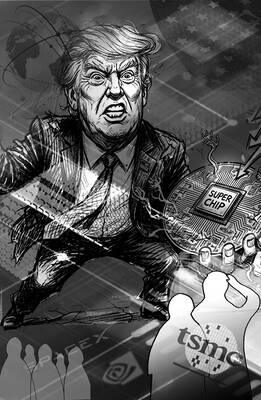
The White House’s decision to take a 9.9 percent stake in Intel Corp is looking like very shrewd business indeed. Since the government bought in at US$20.47 a share last August, the US chipmaker’s surging stock price has delivered the US a US$43 billion return. One of the reasons the investment has so far proved so sound is that the White House has made sure of it. According to The Wall Street Journal, Howard personally pushed deals on Intel’s behalf with some of the most lucrative clients imaginable. They include Nvidia Corp, the company at the heart of the AI
A single photograph can cut through a lot of noise, but it can also be used to misrepresent the truth. At the very least, it can concentrate the mind on something that requires further investigation. On Monday last week, Ma Ying-jeou Foundation CEO Tai Hsia-ling (戴遐齡) and former National Security Council secretary-general King Pu-tsung (金溥聰) held a news conference in which they showed a photograph of former foundation CEO Hsiao Hsu-tsen (蕭旭岑), now Chinese Nationalist Party (KMT) deputy chairman. In the image Hsiao is seated next to Xiamen Taiwan Businessmen Association chairman Han Ying-huan (韓螢煥). The two men were holding
I first met Professor Ray Jiing (井迎瑞) as a film and documentary student at Shih Hsin University’s (SHU) Department of Radio Television and Film in 1988. The following year, he went on to become the director of the Chinese Taipei Film Archive — forerunner of the Taiwan Film and Audiovisual Institute (TFAI). Over his eight-year tenure, Jiing rescued and restored over 200 classic Taiwanese films. In 1997, he established the Graduate Institute of Studies in Documentary and Film Archiving at Tainan National University of the Arts (TNNUA), and I joined the program in his third cohort of students. Beyond a
A recent report concerning a student who is suing his teacher posed the question in its headline: Does failing a student in two subjects constitute bullying? The college student in Chiayi County apparently sought NT$2 million (US$63,603) in state compensation, but a court dismissed the case. The first reaction of many might have been to ask: What has happened to students nowadays? Some say that teachers have lost their authority, while others say students are overindulged. Some even start reminiscing over the days when “whatever the teacher says goes.” However, the real issue might be overlooked if emotional reactions like that are the


 RSS
RSS